

Spain’s external sector is undergoing a structural and largely unnoticed transformation. Growth is increasingly being driven by high value-added exports of non-tourism services –transport, construction, insurance, consultancy, intellectual property and telecoms, among others–. These are knowledge-intensive activities that create skilled and better-paid jobs.
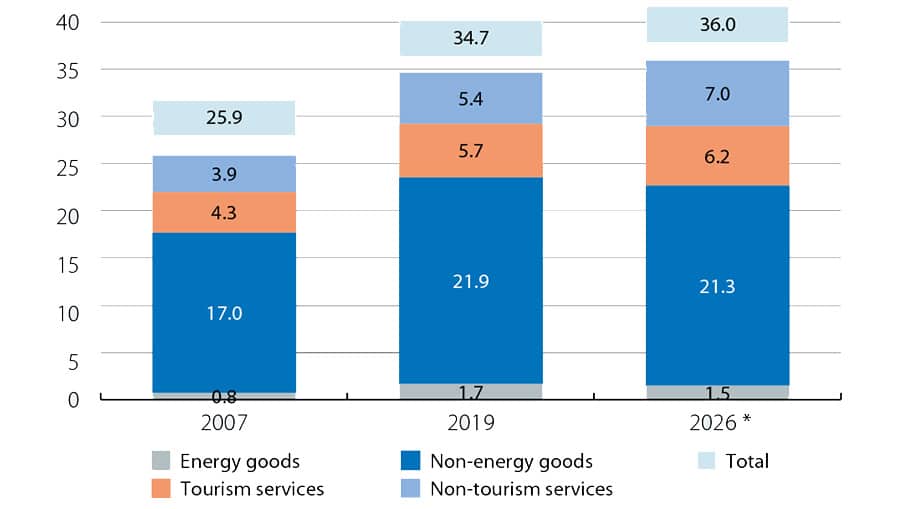
The surge in these exports –from €61.7 billion in 2020 to €105 billion in 2025– began after the pandemic and has been one of the factors driving the post-pandemic expansion. In the year to May they contributed 7% of GDP, up from 5.4% in 2019 (see Figure 1).
Figure 1. Spain: exports of goods and services (% of GDP)
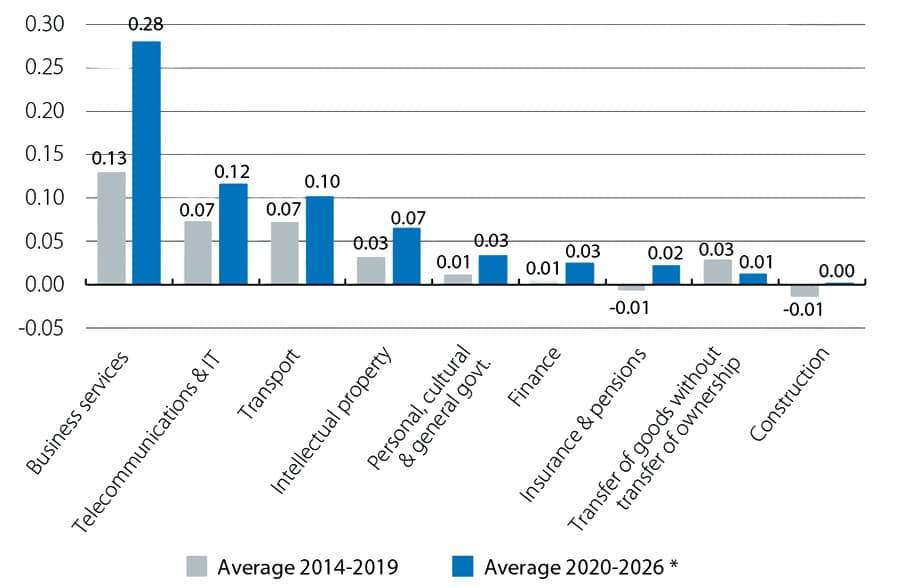
GDP, hard hit by the COVID pandemic, plummeted 10.8% in 2020, the sharpest fall in the EU, and did not recover its pre-pandemic level until the first quarter of 2023. Since then, however, average real economic growth (2023-25) has been 2.9%, well above the euro zone average. Non-tourism service exports contributed an annual average of 0.55 points to GDP growth between 2020 and 2025, compared with 0.33 points between 2014 and 2019 (see Figure 2).
Imports of non-tourism services (payments as opposed to the revenue from exports) have risen at a much slower pace than exports: from €46.2 billion in 2020 to €77.3 billion in 2025. The positive balance (€43.2 billion in 2025 compared with €15.5 billion in 2021) is increasingly important in keeping Spain’s current account in the black by offsetting the structural trade deficit in goods. The current account has generated a surplus since 2013 (2.9% of GDP in 2025), only beaten, among the four large EU economies, by Germany.
The current account ran up a whopping deficit of 9% of GDP in 2008, fuelled by the real estate boom, a loss of trade competitiveness and heavy reliance on foreign borrowing, underlining the extent to which Spain was living beyond its means.
Figure 2. Spain: non-tourism service exports; contribution to nominal GDP growth (pps)
Exports of goods between 2020 and 2025 increased by a smaller extent than services –from €266.8 billion to €392.8 billion–, although from a much higher starting point. Spain’s world share of service exports is higher than that for goods exports (see Figure 3).
Figure 3. Exports of goods and services, 2025 (% of world share)
| Goods | Services | |
|---|---|---|
| France | 2.60 | 4.42 |
| Germany | 6.72 | 5.26 |
| Italy | 2.77 | 1.76 |
| Spain | 1.70 | 2.64 |
New service business increased in September for the fifth straight month. The S&P Global Spain Services PMI Business Activity Index rose to 58.3 in September from 57.8 in August. September’s reading matched the 3-1/2-year high hit in July. The 50-mark separates growth from contraction. Export business, however, fell for the first time since May as firms cited uncertainty linked to the war in the Middle East and AI-related spending. Employment continued to grow for the 48th consecutive month. The increase in staffing levels was linked to higher levels of new business. Backlogs of work increased for a fourth consecutive month.
Beyond the EU, the main market for exports of non-tourism services and goods, the US is emerging as an important client. This is partly explained by the presence in the US of Spanish companies. For instance, Santander entered the US retail banking market in 2006 with the purchase of 25% of Sovereign, in 2009 it fully acquired Sovereign, in 2024 it launched its digital bank Openbank and in August 2026 acquired Webster Bank, significantly expanding its footprint in the north-east. The insurer Mapfre began to expand in the US in 1995 with the purchase of Western Pioneer in California, in 2001 it acquired SWICO in New York, in 2008 it bought the Commerce Group in Massachusetts and in August 2006 the Safety Insurance Group, strengthening its position in Massachusetts.
Another competitive benefit is Spain’s geographic advantage as a key point in data interchange between the Americas, Africa and Europe. Spain’s fibre-optic network covers 95% of the population (the EU average is 70%) and is connected to numerous countries by 40 submarine cables.
Engineering services also benefit from the international presence of Spanish companies. In 2025, 70% of these companies’ revenue from services came from their projects abroad, making it the leader in this category, followed by Turkey (60%) and Austria (33%).
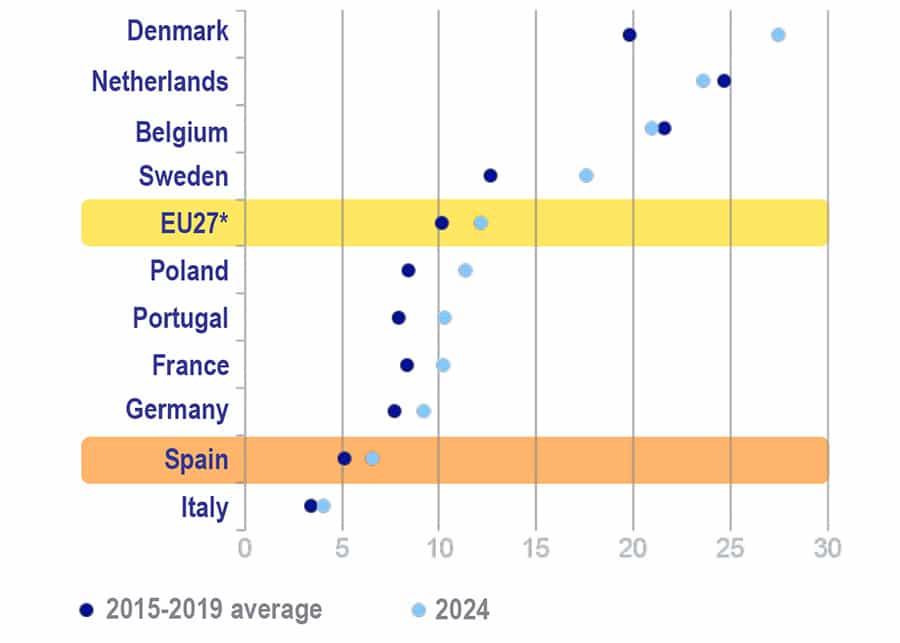
Spain has made substantial progress in exports of non-tourism services, but there is still a significant gap with other EU countries in GDP terms (see Figure 4).
Figure 4. Non-tourism exports by country, 2015-2019 and 2024 (% of GDP)
Further progress requires greater productivity, which is estimated to be 20% below the EU’s. This requires more investment in R&D (1.4% of GDP as against the EU’s 2.2%), greater cooperation and links between universities and companies, more gazelles (high-growth companies) –they are limited by the lack of adequate employees and financing obstacles– and increased risk capital financing.