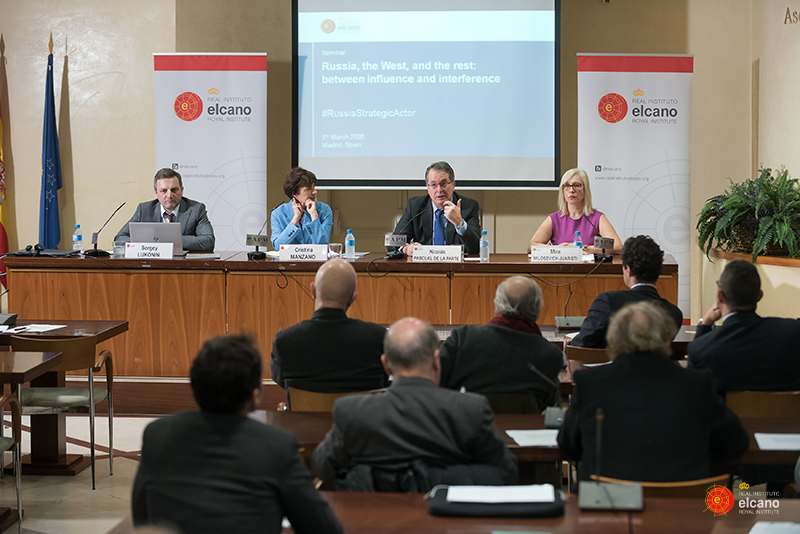
Thursday, 5 March 2020, from 9:45 to 11:45 h. Venue: Asociación de la Prensa de Madrid (c/ Claudio Coello nº 98, Madrid).
In recent years, the international community has witnessed Russia’s return as a major global player. Since Vladimir Putin took over the presidency of the Russian Federation in 2000, but especially since 2012, Russia has carried out a sophisticated, well-resourced and, until now, successful campaign to expand its global influence.
The global reach of Russian foreign policy is now broader than is often appreciated. Moscow’s attempts to compete globally with the US and Ch
ina, and to create a network of presence and influence in Europe, Africa, Latin America, Central Asia, the Middle East and the Arctic are not a new element of Russian foreign policy, and have roots in the Soviet times.
This two-panel seminar addressed the questions of what are the main characteristics of “Russia’s return” as a strategic actor, as well as what is the prospect of improving relations between Russia and the West and what are the main obstacles to achieving this.
Hashtag: #RussiaStrategicActor
Participants:
- Emilio Lamo de Espinosa, Chairnam, Elcano Royal Institute | @PresidenteRIE.
- Adam Thomson, director, European Leadership Network | @SirAdamELN
- Jeffrey Mankoff, Deputy director of the Europe, Russia, and Eurasia Programme,, CSIS | @DrJMankoff
- Alexey Gromyko, Director of the Institute of Europe of the Russian Academy of Sciences (IE RAS); member of the Russian International Affairs Council | @Russian_Council
- Nicolás Pascual de la Parte, Diplomat and former former Spanish ambassador to NATO
- Sergey Lukonin, Head of Sector of Economy and Politics of China, IMEMO Institute | @IMEMO_RAN
- Mira Milosevich-Juaristi, Senior Analyst, Elcano Royal Institute | @MiraMilosevich1.
Moderators:
- Charles Powell, Director, Elcano Royal Institute | @CharlesTPowell
- Cristina Manzano, Editor-in-chief of Esglobal | @ManzanoCr