
Green competitiveness is a portfolio problem
Europe’s clean energy transition is often described as a security imperative. That framing is correct but incomplete. Renewed disruption around the Strait of Hormuz in September 2026 again showed why, as Brent moved above US$100/barrel. But the lesson is not simply that Europe needs to diversify its fossil-fuel suppliers. Lasting energy security depends on reducing exposure to imported fuels while building the technologies, infrastructures and industrial capabilities needed for a clean energy system. These capabilities are distributed across the Union, but uneven fiscal capacity, national energy choices, slow permits, insufficient grids and divergent industrial preferences impede coordination. Spain illustrates both sides of the equation, combining abundant renewable resources and a growing clean-energy industrial base with weak electricity interconnection to the rest of Europe, significant grid and storage needs and persistent implementation bottlenecks. The policy problem is therefore not whether Europe can deploy more clean energy but if the EU can organise a fragmented capability base into a coherent innovation and industrial strategy.
The distinction matters for public policy. A national-champions approach treats green competitiveness as a race between member states. A portfolio approach treats it as a coordination problem across a multilevel polity. The relevant unit is not the firm or even the national industrial strategy, but the European system connecting demand, infrastructure, innovation, standards, finance and supply chains. Clean energy resilience, from this perspective, is not only an energy security goal. It is a capability-building agenda.
The EU is not starting from zero. The Energy Union and its Governance Regulation created common objectives and national energy and climate plans; REPowerEU added an explicit energy-security logic after Russia’s invasion of Ukraine; the Net-Zero Industry Act and Critical Raw Materials Act target clean manufacturing and material security; and the Draghi report, Competitiveness Compass and Clean Industrial Deal put scale and investment at the centre of the debate. The problem is less the absence of European initiatives than the gap between European objectives and national delivery. Implementation remains fragmented, infrastructure is still planned and permitted mainly at the national or subnational levels, and member states remain wary of surrendering control over energy mixes, taxation, industrial support and strategic assets.
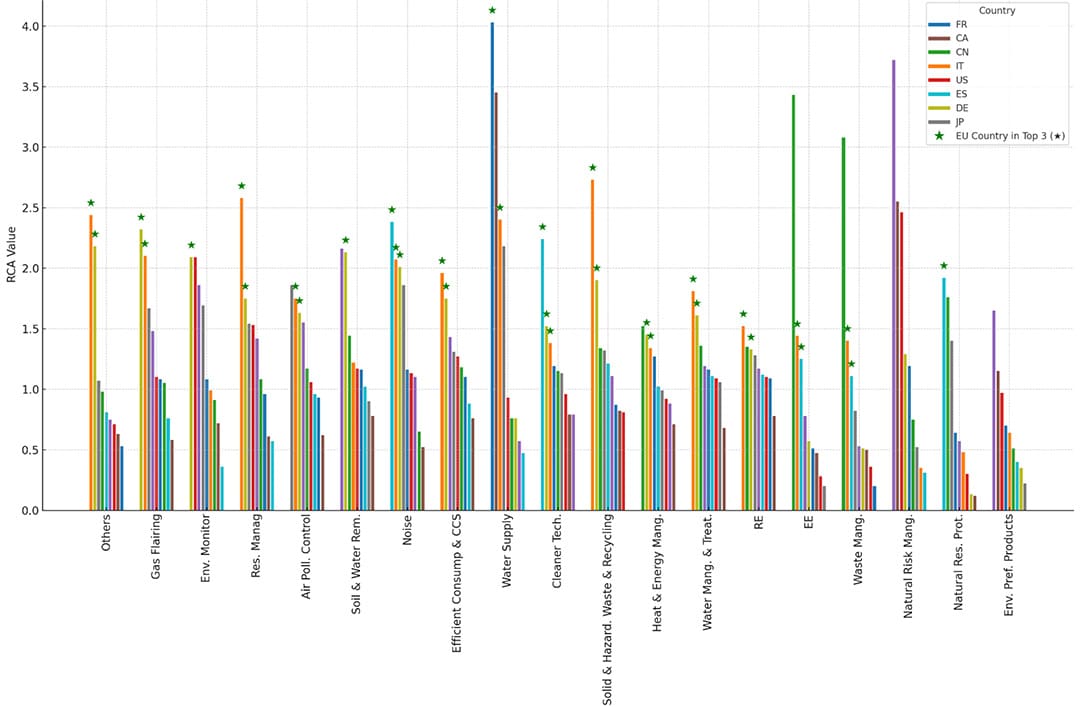
Evidence on green technology capabilities reinforces this logic. Comparative advantages across green technology categories are spread across countries rather than concentrated in a single European leader (see Figure 1). The implication is not that Europe lacks green capability, but that its capability is scattered. Competitiveness therefore depends on whether the EU can connect national specialisations and convert them into scale, reliability and market share Union-wide.
Figure 1. Chart of green technology categories showing the leading countries in each
From national strategies to European capabilities
Fragmented national programmes are unlikely to deliver that outcome. Member states have strong incentives to secure their own adequacy margins, subsidise their own firms and protect their own consumers. While understandable individually, the aggregate result can be inefficient, with duplicated support where scale is needed, gaps where interconnection is required and subsidy competition that rewards fiscal capacity more than technological potential. Germany’s ability to mobilise very large national support packages illustrates the fiscal asymmetry. Spain’s long-standing under-interconnection with France illustrates a different barrier, as projects can be slowed down by national permitting, cost allocation and political priorities even when their benefits are cross-border.
The public-good character of clean energy resilience is central, following the familiar logic of European public goods. Cross-border grids, electricity flexibility, strategic manufacturing capacity, critical material resilience and demand reduction all generate benefits that spill across national borders. Yet no single member state has a sufficient incentive to fund them at the European optimum. But coordination alone does not create legitimacy. A credible transition must also be just, ie, citizens and affected territories need a meaningful voice, costs and benefits must be distributed fairly and policy must recognise that households, workers and regions begin the transition from very different positions. The Iberian blackout of April 2025 showed how quickly technical failures can become narratives of policy failure. Poorly designed renovation policy can likewise be experienced as an imposed cost rather than greater security, and subsidy races can make smaller member states see European industrial policy as structurally unequal. Therefore, resilience, competitiveness and legitimacy depend on the same governance challenge of coordinating a European portfolio.
The clean resilience portfolio
A portfolio strategy would bring together four assets European policy often governs separately: grids, buildings, clean industry and materials. Their complementarities are the basis of Europe’s potential competitive edge. Grids come first because renewable generation reduces fossil exposure only when electricity systems can connect, move, balance and store power. The highest value transmission, storage and flexibility investments are often cross-border, yet planning and permitting remain largely national. Treating grids as security infrastructure shifts the question from how many projects individual countries approve to which projects maximise European system value. Buildings are the second asset. The cheapest energy security resource is the energy Europe no longer needs to import. Buildings account for roughly 40% of EU final energy consumption and about one-third of energy related emissions, so demand reduction is a security instrument in its own right. Deep renovation, heat pumps, district heating, insulation and demand response reduce exposure to volatile fuel markets while improving household welfare. Upfront costs and landlord-tenant split incentives can also slow down the uptake in rental markets; a portfolio approach should combine targeted finance, information and simpler delivery. Exposure is also uneven across the Union. The share of natural gas in residential space heating varies widely (see Figure 2), so a price shock that is manageable in one member state is a crisis in another. Buildings policy is therefore not a secondary social policy attached to the transition. It is a demand-side resilience policy that creates markets for clean technologies while reducing vulnerability to external shocks.
Clean industrial capability is the third asset. Europe should not subsidise every green activity. It should concentrate support where system needs, technological complexity, market growth and existing or plausible European capability overlap, as the green industrial policy literature has long argued. This requires a European view of comparative advantage, not a sequence of disconnected national plans. It also points beyond near-shoring. ‘Cleanshoring’ should favour production and supply relationships that strengthen both resilience and decarbonisation without replacing one strategic dependence by another. Critical materials are the fourth asset. The transition reduces a continuous, flow-type dependence on fossil fuels but increases a more stock-like dependence on minerals, processing capacity and manufacturing bottlenecks, especially where mining or processing is highly concentrated. Research on renewable energy material vulnerability points to substitution, recycling, pooled stockpiles, joint purchasing and partnerships with producer countries, which can reduce risk more effectively at Union scale than through 27 separate strategies. The EU has already experimented with this logic through AggregateEU, which sought to coordinate gas demand after the 2022 crisis.
The governance gap
Europe already has many elements of this portfolio, but they are not yet governed as such. The binding constraint is institutional. EU climate and energy targets are ambitious, yet delivery depends on planning, financing and permitting systems that remain fragmented across levels of government, producing a mismatch between the European scale of the policy challenge and the national or local scale of many delivery instruments.
The mismatch has several dimensions. The Treaty leaves the energy mix largely to member states while energy taxation is constrained by unanimity. Fiscal firepower is deeply asymmetric, so when state-aid rules are loosened, larger economies move faster and spend more, tilting the single market rather than strengthening European capability. Permitting, grid planning and building renovation are still administered largely through national or subnational systems, even when the benefits of action are cross-border. The EU Governance Regulation and national energy and climate plans provide coordination mechanisms, but implementation and enforcement gaps remain. Europe therefore has common objectives, but not yet the institutional capacity to organise the complementary assets on which clean energy resilience depends.
Recent geopolitical disruptions make this institutional question urgent. The prolonged US-Iran conflict and renewed escalation around Hormuz are reminders that diversification of fossil suppliers and emergency preparedness remain necessary, but they cannot be Europe’s structural answer. The appropriate response is to reduce exposure by coordinating the capabilities that lower fossil demand, improve system reliability and create markets for clean technologies. That requires a more disciplined European industrial and innovation policy, ie, making choices, protecting the single market from subsidy races and aligning public instruments behind areas where distributed European strengths can combine into scale. The EU should map green capabilities at portfolio level, identify where infrastructure, demand creation, standards and finance can reinforce one another, and make national implementation gaps more visible and consequential. A portfolio strategy would not add another policy layer; it would provide a governance logic for connecting existing ones.
Competitiveness through resilience
Europe’s next competitive edge will not come from installing more renewable capacity or subsidising more clean technologies alone. It will come from building a system in which clean energy reduces geopolitical exposure, strengthens industrial capability and improves the everyday security of households and firms. That system cannot be assembled through national programmes alone, because the decisive assets are complementary and cross-border.
A European portfolio strategy would make policy more selective and more integrated. Infrastructure planning should be organised around European system value, with stronger mechanisms for cross-border cost allocation. Clean industrial support should be tied to capability mapping and strategic complementarities, rather than determined mainly by national fiscal capacity. Demand-side policies, especially building decarbonisation, should be treated as market-creating innovation policies, not only as social and climate policies. Critical material strategies should combine recycling, substitution, pooled stockpiling and joint purchasing. National energy and climate plans should be assessed not only against targets, but also against their contribution to the wider European resilience portfolio.