
Key messages
- The AccelerateEU Communication sets out short-term measures for coordination and consumer protection in the face of the new energy crisis.
- In the long term, it commits to decarbonisation and electrification to reduce dependence on and vulnerability to imported fossil fuels.
- The Communication has been well received by stakeholders in decarbonisation and electrification, although criticised for a lack of ambition and specificity.
Analysis
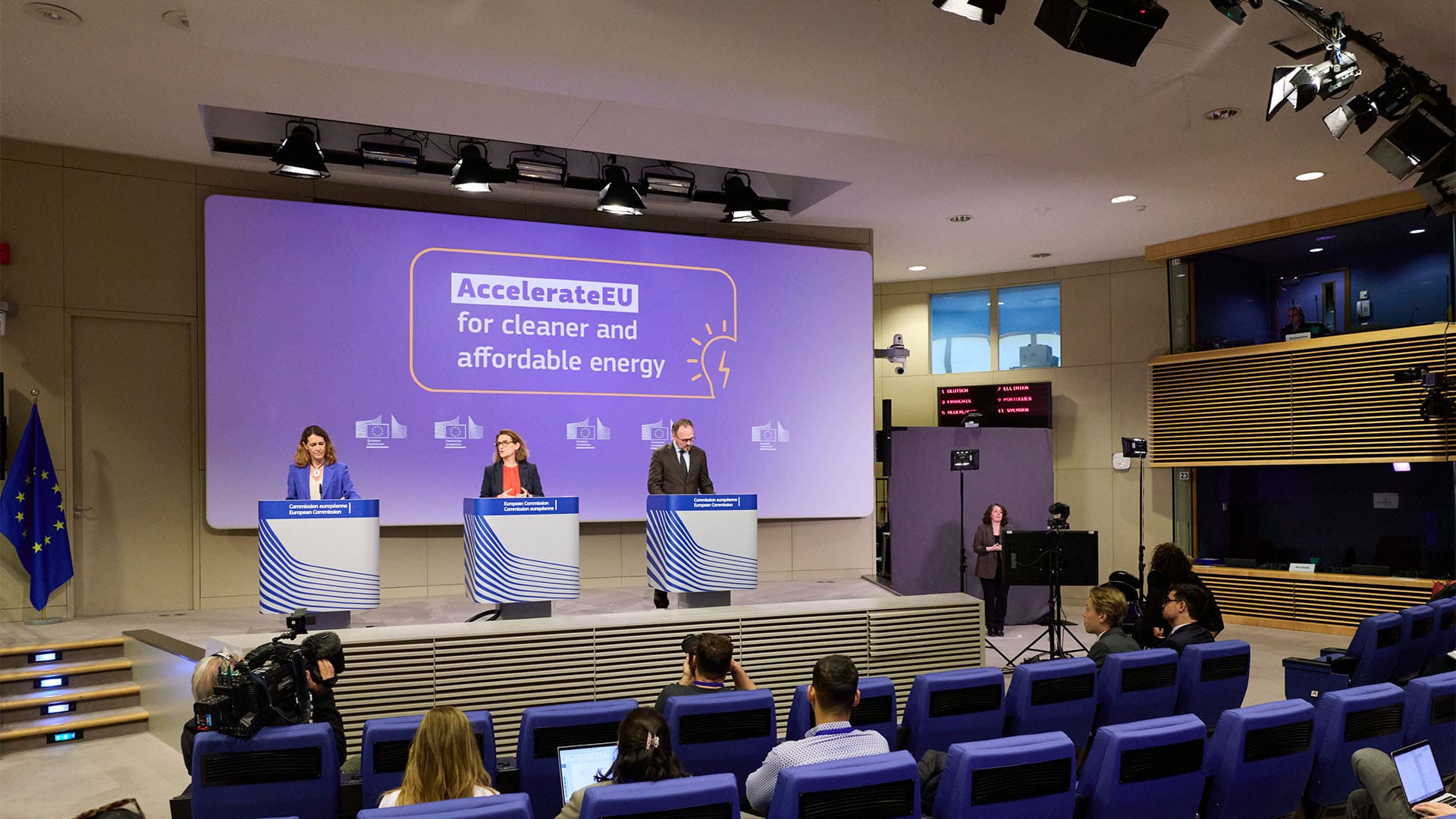
The European Commission’s Communication ‘AccelerateEU-Energy Union: affordable and secure energy through accelerated action’ aims to provide a short- and long-term response to the energy crisis stemming from the current conflict in the Middle East through a set of guidelines and measures. The analysis first addresses the Commission’s fundamental shift in approach, which makes clear that for the EU, decarbonisation is no longer merely a climate and environmental imperative, but an economic, social, competitiveness and security necessity. It thus replaces the traditional energy trilemma relationship between economic, environmental and security objectives with that of a virtuous circle between the three goals. It then examines the five groups of measures set out in the Communication: in the short term, the coordination of measures among Member States and protecting consumers and industry; in the long term, but with immediate effects, accelerating decarbonisation and electrification, improving the European energy system and boosting investment.
The end of the European energy trilemma in the long term
The proposals are based on a two-fold assessment: first, that although the duration of the conflict is uncertain, the impact of the energy crisis on the EU may persist over time even in the least extreme scenarios; secondly, that the succession of two energy crises in less than five years, caused by geopolitical shocks, highlights the ‘dangers of Europe’s dependence on fossil fuel imports’. This assessment was already implicit in the RepowerEU plan adopted following the energy crisis caused by the Russian invasion of Ukraine. AccelerateEU makes this explicit, marking a significant conceptual shift in European energy policy by clearly establishing that, in the long term, the EU does not face a trilemma between security, competitiveness and sustainability; on the contrary, for Europe, the energy transition is not only ‘a climate and environmental necessity, but also a socio-economic, competitiveness and security imperative’, in line with what was already noted in the Draghi Report.
These are energy policy objectives which, far from contradictory, ‘reinforce and complement each other’, meaning that the trilemma disappears and is transformed into a virtuous circle. The Communication also aims to anticipate future geopolitical shocks, acknowledging that the EU’s problem is not to replace some gas and oil suppliers with others, but to reduce its dependence on fossil fuel imports. This approach recognises that the EU must pursue its own decarbonised energy path to compete with China and the US, and that to overcome this rivalry it must advance an open decarbonisation strategy based on the diversification of alliances to prevent energy dominance from its rivals.
This approach has several implications, which are set out in five groups of proposals that also align with the overall strategy of the RepowerEU plan. First, the urgent need for short-term action (1) to coordinate Member States’ responses and (2) to protect vulnerable European consumers and industries from rising energy prices and prevent supply shortages. Secondly, the need for long-term action to transform the European energy system and reduce its vulnerability to external shocks by (3) accelerating decarbonisation and electrification, (4) improving its operation and integration, and (5) undertaking the necessary investments to achieve this. Taken together, AccelerateEU comprises a mosaic of 44 measures, several of which were already included in RepowerEU and other previous Commission Communications, as detailed in the following sections of this analysis.
In the short term, the Commission’s capacity to adopt measures is very limited, as it is the Member States that control the levers of economic, energy and fiscal policies. Hence the emphasis on coordinating measures and the proposal for general guidelines for national energy policies to prevent further fragmentation of the European energy market. This indicative approach has been criticised for failing to include more drastic measures addressing the risk of fuel shortages and the deterioration of citizens’ living standards and European competitiveness, but it must be emphasised that the measures available to the Commission are limited. In the long term, the strategy consists of accelerating the decarbonisation and electrification measures already proposed, as well as preparing the European energy system for this through complementary reforms and new investments. In this regard, the Communication has also been criticised for proposing a patchwork of existing measures with few new elements.
Coordination
Coordination would apply to gas storage and the relaxation of storage obligations, joint purchases of gas and oil, the release of oil reserves, national emergency measures, and ensuring the availability of aviation fuel and diesel, including the ‘optimisation of oil refinery production capacity’. Given that these activities are in the hands of Member States’ governments or private companies, their Europeanisation does not appear straightforward, as demonstrated by the criticism of the limited results of joint gas purchases. To facilitate coordination, the Communication also proposes to establish a Fuel Observatory to monitor supply and available stocks, initially prioritising aviation fuels.
As an example of the limitations facing these proposals, Spain is in a more comfortable position regarding refining than other European countries, thanks to significant recent investment and the presence of three different refining companies within the country. Some of the products refined in Spain are exported to the EU, but also to other EU partners, such as Morocco and the US. It is not clear from the Communication what the coordination would entail, nor whether it would involve some form of ‘European preference’ mechanism as an alternative to market forces, which on their own should tend to prioritise meeting European demand. The creation of an observatory is welcome, but it remains to be specified what the Commission would do with the data obtained, how it intends to optimise refinery production, and what measures it plans to adopt to prevent shortages in the most affected countries.
Protection of consumers and industry
The second package of proposals aims to protect vulnerable consumers and industries, based on three general principles: (a) a timely response to address the urgent needs of the crisis; (b) that this response be temporary, so that the measures adopted do not distort the incentives for long-term decarbonisation; and (c) that it be targeted, so that it is directed exclusively at the most vulnerable citizens and sectors. This new trinity of the three ‘Ts’ of European energy policy presents its own difficulties. Regarding urgency, at the recent informal summit in Cyprus on 23 and 24 April, it was agreed to postpone short-term measures and to instruct the Finance and Energy Ministers to continue the debate at forthcoming meetings scheduled for May, presenting concrete proposals in June to address rising prices.
With regard to the use of targeted measures, the AccelerateEU proposals incorporate those already set out in last March’s Communication on the Citizens’ Energy Package: income-based support schemes; vouchers, social tariffs and reductions in excise duties on electricity for vulnerable households and energy-intensive industries; VAT reductions for the installation of heat pumps, solar panels and batteries; tax incentives for electric vehicles; incentives and facilitation for energy communities and self-consumption, etc. Several Member States, however, have adopted socially regressive tax measures that fail to differentiate by income level; these include Germany and Spain, although in the Spanish case these have been accompanied by some of the measures proposed to provide a social safety net for the most vulnerable households and incentives for energy communities and self-consumption.
A much-criticised element of the Commission’s proposal is the green light given to state aid, raising the risk of fracturing the single market as the wealthier states with stronger fiscal positions could grant greater support –a point highlighted by countries such as Italy–. State aid would be particularly harmful if not conditional on effective short-term measures in favour of electrification that enable a structural transformation of the European energy system. However, the Communication does not include the proposal from Germany, Austria, Spain, Italy and Portugal for a tax on energy companies’ windfall profits, a highly controversial measure which in the past led these companies to point out the inconsistency of increasing their tax burden whilst encouraging them to make major investments in decarbonisation. Instead, it does recognise Member States’ ability to do so at national level, a move criticised by associations such as Wind Europe. Eurelectric has also warned that the measures must not distort markets or affect the predictability of regulation.
Nor have measures been adopted to decouple electricity prices from gas prices, such as the one that allowed the Iberian exception to be applied during the 2022 crisis and which was also opposed by the electricity sector, as it was considered a distortion of the marginalist market that negatively affected price and investment signals. In this regard, it should be noted that the price level reached by natural gas in Europe has not reached the extreme levels of 2022, when it stood at around €300/MWh on the benchmark TTF, compared with €45/MWh recorded at the time of writing. It should also be remembered that the roll-out of renewables since then has reduced the influence of gas on electricity pricing, particularly in countries such as Spain and France, which have a higher share of renewables and nuclear power in their electricity mix, respectively. According to the data cited in the Communication itself, since 2021 the EU has installed some 260 GW of renewable capacity, equivalent to a saving of around 15 bcm of gas in generation by 2025 and 5% of European gas imports.
Accelerating decarbonisation and electrification
The third set of measures relating to the long-term transformation of the energy system concerns accelerating the transition to clean energy and electrification. The Communication notes that in the first six weeks of the energy crisis caused by the conflict in the Middle East, the EU’s bill for fossil fuel imports rose by €24 billion; it also notes that in 2025 the EU imported fossil fuels worth €340 billion, equivalent to almost half of the NextGenerationEU funds (€750 billion). The Communication highlights that those Member States with higher penetration of renewables and nuclear generation have more moderate wholesale electricity prices. The Communication proposes to mitigate the vulnerability posed by dependence on fossil fuel imports by accelerating the deployment of all indigenous energy sources it classifies as clean: solar photovoltaic and thermal, wind, geothermal, biomethane, sustainable biofuels, hydrogen (although it being a Carrier rather than a source) and nuclear.
The commitment to decarbonisation is clear and consolidates the direction of European energy policies, including the defence of the European Emissions Trading System (ETS). However, the Communication has been criticised for reshuffling elements of existing plans, which could result in a lack of ambition, integration and consistency in the measures. For example, it states that the annual installed renewable electricity generation capacity should increase to 100 GW per year, as already set out in the Clean Industrial Pact Communication. On the subject of nuclear energy, it revisits previous Communications by proposing the construction of new small modular reactors (SMRs) or ‘avoiding the premature decommissioning of existing nuclear capacity’. In the Commission’s defence, one might ask whether, in the current European political context, there is an appetite for greater ambition on renewables and whether opposition to nuclear energy from some Member States allows for further progress in this area.
The second key idea is the commitment to accelerating electrification ‘to end exposure to fossil fuel price fluctuations and dependence on imports’. For some analysts, one of the most important achievements of the European response to the current energy crisis would be for the EU to adopt ‘a genuine electrification strategy’. The Clean Industry Pact and the Action Plan for Affordable Energy already set a 32% electrification rate target for 2030 as a benchmark, but AccelerateEU proposes setting a new target immediately. It should be noted that Spain is lagging behind the 35% target the country had set for 2030. The Communication makes explicit reference to heat pumps and the electrification of transport. For example, it proposes adopting measures to ‘promote the sales of electric vehicles’ and accelerate the development of ‘sufficient charging infrastructure’.
In addition to electrification, the Communication also proposes supporting the development of biogas, biomethane and renewable hydrogen, for which it proposes revising the production criteria to drive industrial decarbonisation. It also proposes accelerating the development of sustainable aviation fuels (eSAF) and sustainable marine fuels (eSMF).
Improvement and integration of the European energy system
The fourth set of measures relates to improving the energy system, although it focuses on accelerating the already approved European Networks Package to develop these networks, make them more flexible and advance greater integration at European level capable of incorporating more renewables. The Commission is committed to concluding negotiations on the European Networks Package by this summer (July), including accelerating the Energy Highways Initiative to remove the main European bottlenecks; these include electricity interconnections with the Iberian Peninsula and the south-western hydrogen corridor that will link it to Germany. It also reiterates the target of a 15% interconnection rate, but as with other proposals, only for indicative purposes without introducing new obligations or financial commitments beyond those already approved.
To develop network capacities, the Communication aims to adopt a legislative proposal on network tariffs and taxes to facilitate electrification and reduce bills. The aim is to provide incentives for the optimal use of network infrastructure, clarify the framework so that national regulatory authorities can apply specific reductions to network tariffs, and ensure that electricity bears a lower tax burden than gas. To increase flexibility, the Communication highlights the need to adopt measures to support storage, whose current capacity in the EU stands at 55 GW, and proposes increasing this to 200 GW by 2030, particularly in batteries. However, the Commission has been criticised by solar associations for failing to propose concrete measures to achieve these levels of battery storage and other forms of non-fossil energy flexibility.
Investments
The fifth set of measures aims to increase investment in the energy transition and the circular economy to ‘break the cycle of dependence on fossil fuels once and for all’. The aim is to mobilise public and private investment to anticipate and accelerate the energy transition. AccelerateEU highlights that public funds alone cannot cover the necessary investments in the energy transition, estimated at €660 billion annually until 2030 and €695 billion annually between 2031 and 2040. To mobilise private investment, the Communication draws on the Clean Energy Investment Strategy launched by the Commission last March, which seeks to ‘catalyse’ private investment by improving access to capital markets for electricity network operators, reducing the risk associated with innovative clean technologies, and establishing an Energy Transition Investment Council with the investment community.
One of the most interesting points, yet to be finalised, concerns a legislative proposal to update and modernise the ETS, including an Investment Accelerator funded by €400 million from the ETS to support the decarbonisation of energy-intensive industries. It is proposed that the Commission assist Member States wishing to explore the use of ETS revenues to invest in industrial electrification and decarbonisation.
However, the Communication does not propose the creation of new funds, referring instead to the final tranche of the Recovery and Resilience Facility, the Connecting Europe Facility funds, the Cohesion Fund, and those funds earmarked for research, development and innovation in clean technologies. It does propose assessing the adoption of additional measures to simplify rules and accelerate the deployment of EU funds for the energy transition. Nor does it explore the possibility of excluding public investment in transition infrastructure from debt procedures, as proposed by Italy. Nor does it consider whether investments in the energy transition could be financed through Eurobonds, as recently proposed by the President of the European Central Bank.
Conclusions
Overall, the Commission’s proposals have been well received, especially by those advocating decarbonisation and electrification. The explicit commitment to both as key pathways for achieving the EU’s economic, security and environmental goals consolidates the direction of European energy policy in a challenging political context and is in line with most independent analyses. Perhaps the most interesting element is the introduction of an ambitious electrification target, although it remains to be seen whether it will be binding. Also significant is the prominence given to reforming the ETS by directing it towards investment in the decarbonisation of energy-intensive sectors, rather than eroding it as some countries and sectors had demanded. The short-term proposals in response to the energy crisis, regarding the coordination of measures and the Communication’s conceptual and guiding terms for consumer protection, have also been generally welcomed. Although they have been criticised as insufficient by some stakeholders, it must be borne in mind that the Commission’s influence on Member States’ policies is limited given its limited powers and the differing preferences between countries.
The Communication has also been criticised for bringing together initiatives already underway without introducing any major new developments in terms of targets, new instruments or additional funding. These criticisms can be qualified by the fact that there is little point in introducing highly ambitious new targets, for example on electrification, without mobilising the necessary resources to achieve them. Some analysts and associations have also expressed concern that the measures could distort and fragment markets by allowing Member States to apply state aid and windfall taxes. Conversely, these same stakeholders have welcomed the fact that the Communication does not respond to calls from some countries to apply such taxes at European level or to reform the electricity market to decouple it from gas prices.
From now on, the EU’s Economy and Energy Ministers will have to take decisions to finalise the measures selected. At the Cyprus summit on 23 and 24 April, it was agreed to continue discussions in May on short-term measures to alleviate the energy crisis. The Commission has proposed presenting a catalogue of energy-saving and efficiency measures in May, based on an assessment of the most successful measures adopted since the 2022 energy crisis to rapidly reduce oil and gas consumption in the short term. Long-term measures should also be taken immediately, or at least this is envisaged in the AccelerateEU timetable, whose 44 measures are planned for the coming months.
From a national perspective, AccelerateEU largely aligns with Spanish preferences. Although an opportunity has been missed to make the interconnection target binding, despite the importance attached to it in the Communication itself and the conclusions of the Letta and Draghi Reports, it once again highlights the need for greater energy interconnection. Whilst it advises against the adoption of measures not focused on consumers and the most vulnerable sectors –such as some of those adopted by Spain– it does include other measures adopted by the Spanish government aimed at their protection, as well as incentivising self-consumption and energy communities. Setting an electrification target could help Spain catch up in this regard and, in any case, aligns with Spanish preferences. Finally, AccelerateEU barely mentions cooperation with third countries, but the considerations regarding the EU’s external action are of interest to Spain, even if they appear as footnotes: the importance of consolidating a Mediterranean hub, the implementation of the Trans-Mediterranean Initiative for Renewable Energy and Clean Technologies, and the Latin American dimension of the Global Gateway.