

Key Messages[1]
- The Spanish-Moroccan energy relationship is characterised by a complex asymmetric interdependence in which Morocco is especially dependent on Spanish supplies.
- The asymmetry is offset by the strategic value of energy interconnections and Spanish exports, as well as by the opportunities offered by Morocco’s renewable deployment.
- Using existing energy flows as a political tool would undermine Spain’s reliability as a supplier and drive Morocco’s diversification.
- ‘Firmness’ measures seem limited to future projects or flows affecting national and European interests, based on technical considerations and within EU frameworks.
Analysis
Introduction
Morocco and Spain maintain a long-standing and close trade relationship, facilitated by their location in the Strait of Gibraltar, one of the main trade and energy gateways between Europe and Africa. Spain is Morocco’s main trading partner, accounting for the largest share of both Moroccan exports and imports. Spain accounted for between 14% and 17% of Morocco’s imports over the last decade, whilst receiving more than 20% of Moroccan exports (with the exception of 2022, when the figure stood at 19.63%), according to UN Comtrade. This trade interdependence is, however, asymmetrical: although Morocco’s share of Spanish trade has more than doubled since 2005, in 2025 Morocco accounted for 3.2% of Spain’s exports and 2.3% of its total imports.
Energy trade plays a prominent role in Spanish-Moroccan economic relations thanks to a network of shared infrastructure. In addition to the ports that facilitate fuel trade logistics, they share two undersea electricity interconnectors in operation since 1997 and 2006 respectively, and the Maghreb-Europe Gas Pipeline (GME), which has been operating in reverse flow since 2022 to supply Morocco with natural gas from the Iberian Peninsula. Consequently, energy relations are particularly close: over the last decade, Morocco has received between 6.4% and 10.3% of the total value of Spanish energy exports, including electricity. According to Comtrade data, Spain is one of Morocco’s major energy suppliers, accounting for around one-fifth of the total value of the country’s energy imports over the last decade, including electricity.
Since 2022 Spain has been the country’s second-largest energy supplier by export value, only after Saudi Arabia in 2022 and the US between 2023 and 2025, after being its leading supplier for several years during the previous decade. Petroleum refinery products account for a particularly large share of Spanish exports, with Morocco having become its main destination. Moroccan imports of Russian energy, which had been significant since late 2022, disappear from Comtrade records from 2024 onwards, but different sources indicate that Morocco has continued to purchase Russian energy products through non-transparent channels.
Moroccan energy exports tend to be quantitatively marginal to Spain, but in recent years the country has been exporting diesel to the Spanish market. In 2026 Morocco had exported 220,000 tonnes of diesel to Spain up to August, according to Cores, raising concerns about the fuel’s possible Russian origin. Furthermore, Moroccan energy exports hold greater strategic value than trade figures suggest, as demonstrated by the role of its electricity exports in restoring the peninsular grid during the Iberian blackout. They also carry geopolitical implications: at the bilateral level, as occurred during the Ceuta crisis, when calls were made for the Spanish side to use energy supplies to Morocco as a political tool; and at the European level, as illustrated by the controversy surrounding Moroccan diesel exports suspected of being of Russian origin. They also have geo-economic implications, as they combine cooperation and rivalry in the renewable energy sector.[2]
This diversity in the bilateral energy relationship makes it particularly complex and difficult to manage, as interests vary across sectors. Overall, as with bilateral economic relations, energy relations between Morocco and Spain follow a pattern of complex asymmetric interdependence. Strategically, Morocco may be more dependent on Spanish supplies than Spain is on Moroccan ones; nevertheless, Morocco represents an important market for Spanish exports of electricity, gas and fuels, and the electricity interconnections provide greater security and flexibility to the Spanish electricity system. Together with the cooperation path offered by the energy sector, these factors partially compensate the asymmetry reflected by trade figures alone.
This paper first analyses electricity, natural gas and refined petroleum products, their geo-economic significance and the role of Spanish investment. It then reflects, from a Spanish perspective, on how to manage energy interdependence with Morocco during crises such as the recent one affecting Ceuta. In particular, it sets out the limitations of using energy flows as a political tool and the need to balance energy rivalry and cooperation, exploring how to adopt a ‘firm’ stance in Spanish energy cooperation with Morocco. The final section summarises the main conclusions.
Electricity
Spain and Morocco are interconnected through two undersea cables that have been operational since 1997 and 2006, with a third electricity interconnection being under consideration. This third interconnection was agreed in a memorandum of understanding in 2019 and would have a similar capacity to the previous two. However, the costs initially estimated at €234.7 million have risen in recent reviews to over €434.6 million. The National Commission for Markets and Competition (CNMC) has already warned that this increase in costs requires a review of the project, requesting more detailed information on the benefits it may offer both Spain and the EU. Morocco has also requested the construction of a fourth interconnector with the Iberian Peninsula, whilst at the same time reviving the interconnector project with Portugal.
Morocco is a net importer of electricity and its exports to Spain are minimal. It was a net supplier to the Spanish market only in 2019 and 2021, due to the commissioning of a large coal-fired power station in Safi. Moroccan power stations were not subjected to CO₂ emission allowances or taxes, and 2019 coincided with a sharp rise in the EU’s ETS price. In 2021 this was explained by the high price of gas in the Iberian market, coupled with the EU’s ETS at historic highs. The highest peaks in Spanish electricity exports to Morocco occurred in the past decade, but since 2021 they have been rising steadily once again. In 2026, based on data available up to September, Spain has exported 24.53% more electricity than in the previous year over the same period, suggesting that the trend towards a greater surplus in Spain’s favour is set to continue. Spain’s structural position as an exporter should not obscure the fact that Moroccan electricity exports proved crucial during the Iberian blackout of April 2025, with Morocco allocating up to 38% of its generation capacity to restore the peninsular electricity system.
Figure 1. Spain-Morocco electricity flows (MWh)
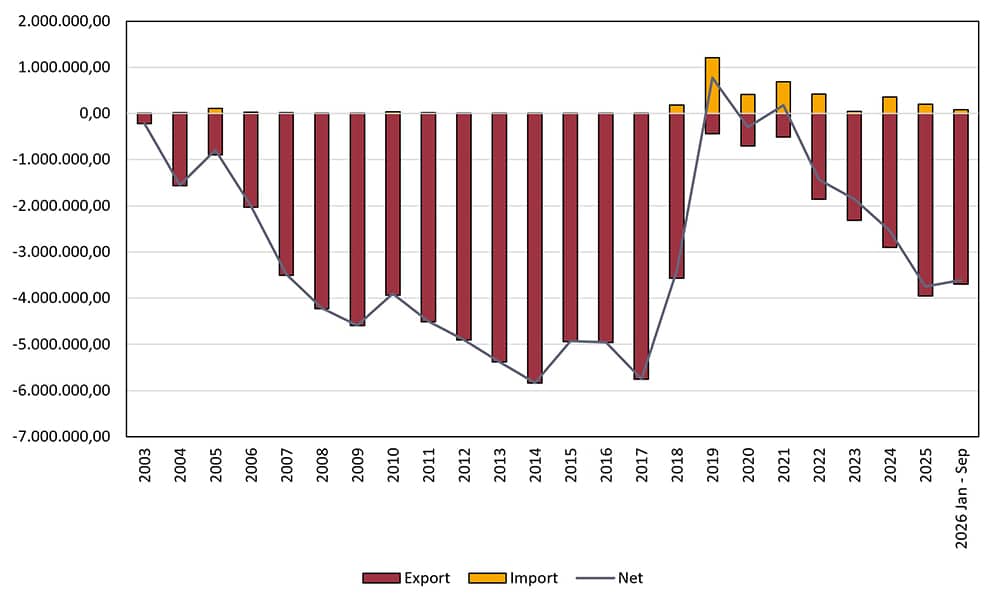
For Morocco, the role of these interconnections goes beyond the quantitative aspect, because they enable the country to be connected and synchronised with the European grid, thereby providing stability to its electricity system. The electricity interconnection with Spain is currently the country’s only operational one. Although it is connected to Algeria, their interconnection has been inactive since relations broke down in 2021. Morocco recognises that the interconnection with Spain offers economic, technical and geostrategic benefits: it enables the country to be supplied with electricity, to export surplus electricity at specific times, to stabilise its grid and to integrate a growing share of renewable generation. On a political level, it fosters good bilateral relations with Spain and positions Morocco as an electricity bridge between Africa and Europe.
In the long term, Morocco aspires to become an exporter of renewable electricity to Europe, which would attract foreign investment and further develop its renewable energy sector. At present, this prospect seems unfeasible, both due to Morocco’s capacity constraints and the electricity bottleneck on the Iberian Peninsula in the Pyrenees. Spain could feed larger quantities of surplus electricity into the European grid, but it lacks the necessary interconnections. Even with new interconnections, Morocco’s potential for electricity exports remains limited in the short to medium term: according to data from IRENASTAT, in 2024 only 24.5% of Morocco’s electricity mix came from renewable sources, meaning that the bulk of Morocco’s ambitious renewable energy deployment should be directed towards decarbonising its own generation rather than exports.
Figure 2. Spanish net electricity exports as a proportion of Morocco’s domestic production (% of GWh)
Spanish electricity exports have historically met a significant proportion of Morocco’s electricity demand. Although Morocco has significantly increased its installed capacity and generation, the supply from Spain via cable remained stable at around 15% of Morocco’s electricity generation between 2007 and 2017, with a decline in subsequent years that has recovered slightly since 2022. If Spanish electricity exports in 2026 continue at the current rate, it is possible that Spanish electricity could account for between 8% and 9% of Morocco’ electricity generation by 2026. If we take into account the role of natural gas exported by Spain in Moroccan electricity generation (as will be seen below, 9.6% of Moroccan electricity was generated with gas in 2024), we can estimate that around 15% of the electricity generated in the country comes from Spanish sources.
Natural gas
Spain and Morocco are linked by a gas interconnector, the Maghreb-Europe Gas Pipeline (Gasoducto Magreb-Europa, GME), which was initially intended to export Algerian gas to Spain and Portugal. When gas flows through the GME were interrupted in 2021 due to political conflicts between Morocco and Algeria leading the Algerian government not to renew the transit contract, the pipeline began to be used in reverse flow to export liquefied natural gas (LNG) regasified in Spain to Morocco from 2022 onwards. Morocco does not have any regasification terminal, and its LNG purchases on the international market, primarily from the US, pass through Spain to be regasified and re-exported via the GME.
Since it began operating in reverse flow in 2022, Morocco has been importing around 10,000 GWh of gas annually, with a slight upward trend. In 2026 the pace of exports has slowed: in the January-July period exports were down 13.74% compared with 2025 and 6.46% compared with 2024. High LNG prices on the international markets appear to be behind the slowdown in Moroccan imports in the first half of the year, but they have risen again since April. These recent fluctuations could complicate the possibility of a structural and substantial increase in Spanish re-exports, as Morocco had requested.
Figure 3. Spanish gas exports to Morocco (GWh)
Gas imports from Spain account for most of the natural gas available to Morocco. The country produces gas on a limited scale from small fields in Tendrara, El Gharb and Meskala, being dependent on supplies from Spain. According to the International Energy Agency (IEA), in 2024 gas accounted for 9.6% of Morocco’s electricity generation, thanks to two thermal power stations: the Tahaddart combined-cycle plant near Tangier, and the Aïn Béni Mathar hybrid gas and solar-thermal plant in the east of the country. Consequently, excluding small-scale local production, it can be estimated that in 2024 around 9% of Morocco’s electricity generation would be fuelled by Spanish natural gas exports.
To reduce its dependence on its sole operational gas connection, Morocco plans to install a floating LNG (FLNG) regasification terminal at the port of Nador West Med, with an annual capacity of 5 bcm –more than five times its gas consumption in 2024 (0.9 bcm)–. However, the tender, launched in December 2025, was suspended in February 2026 with no date set for its resumption. The Moroccan natural gas roadmap also includes a regasification plant at the Atlantic port of Dakhla and a third plant on the Atlantic coast, with no particular location specified. The other major Moroccan project is a gas interconnector with Nigeria, approved in July 2026 by ECOWAS, which is due to start construction in 2028 and be completed in 2031. Of these projects, only the gas pipeline to Nigeria is still moving forwards, although a final investment decision has yet to be made.
Should Morocco eventually build a regasification plant, Spain’s role as a major gas partner would be diminished, but the economic viability of such projects remains doubtful. For Morocco, it is far more economical to import gas from Spanish regasification terminals than to acquire its own FLNG, a process which would take several years. If the forecasts for renewable energy deployment are met, or if the African Atlantic gas pipeline were eventually to come into operation, any regasification plant would run the risk of becoming a stranded or low utilisation asset, undermining its economic viability and the return on investment.
Petroleum products
Morocco has become one of the main destinations for Spanish petroleum product exports, accounting for the largest share of its energy exports by value to its neighbour. Since the closure of the SAMIR refinery in Mohammedia in 2015 due to a colossal level of debt, Spanish exports of petroleum products to Morocco have grown from 2.09 million tonnes to stabilise in the range of 2.49-3.18 million tonnes, accounting for around 12%-14% of Spain’s total exports of refined products. As shown in Figure 4, since 2013 Morocco has consistently ranked among the top three destinations for Spain’s fuel exports, being its first customer in 2016, 2017, 2021, 2025 and between January and July 2026.
Figure 4. Spanish exports of petroleum products, 2015-July 2026 (thousands of tonnes)
| Year | Belgium | United States | France | Gibraltar | Greece | Italy | Morocco | Netherlands | Portugal | United Kingdom | Total |
|---|---|---|---|---|---|---|---|---|---|---|---|
| 2015 | 1.217 | 2.449 | 2.365 | 628 | 1.698 | 2.089 | 1.101 | 1.613 | 1.194 | 21.645 | |
| 2016 | 1.064 | 2.241 | 2.652 | 280 | 2.386 | 3.065 | 1.098 | 1.719 | 698 | 23.006 | |
| 2017 | 864 | 2.294 | 2.632 | 773 | 2.486 | 3.012 | 1.797 | 1.748 | 465 | 25.285 | |
| 2018 | 825 | 2.871 | 2.617 | 1.017 | 2.262 | 2.605 | 2.420 | 1.478 | 557 | 25.286 | |
| 2019 | 1.040 | 2.062 | 2.672 | 817 | 2.136 | 2.486 | 2.213 | 1.639 | 422 | 23.391 | |
| 2020 | 941 | 2.184 | 2.741 | 495 | 1.729 | 2.696 | 2.064 | 1.611 | 309 | 22.009 | |
| 2021 | 1.050 | 2.252 | 2.564 | 914 | 607 | 2.173 | 3.155 | 2.023 | 1.774 | 447 | 22.186 |
| 2022 | 772 | 2.465 | 2.651 | 541 | 302 | 1.235 | 2.583 | 1.902 | 1.922 | 556 | 20.271 |
| 2023 | 577 | 3.016 | 3.247 | 694 | 247 | 1.191 | 2.936 | 1.080 | 2.013 | 429 | 21.013 |
| 2024 | 678 | 1.714 | 3.830 | 804 | 145 | 1.753 | 3.176 | 1.182 | 1.984 | 985 | 22.127 |
| 2025 | 605 | 1.739 | 2.502 | 1.270 | 167 | 849 | 3.081 | 949 | 2.059 | 410 | 21.952 |
| 2026 (Jan-Jul) | 304 | 794 | 1.173 | 736 | 69 | 798 | 1.395 | 431 | 1.394 | 246 | 10.457 |
Diesel is the most exported product: it rose from 0.8 million tonnes in 2015 to between 1.2 and 1.9 million tonnes from 2016 onwards, and since 2019 has accounted for around half of all Spanish petroleum products exported to Morocco. Morocco received between 12% and 22% of the diesel exported by Spain, with an upward trend. LPG accounts for a smaller volume (230-420 thousand tonnes per year), but Morocco is its main destination: it receives between 58% and 79% of the LPG exported by Spain.
Figure 5. Spanish exports of petroleum products to Morocco (thousands of tonnes)
From January to July 2026 Spanish fuel exports to Morocco fell by 21% compared with the same period of the previous year, mainly due to declines in diesel (-23%), kerosene (-67%) and fuel oils (-45%), whilst LPG and petrol rose by 17%. The decline in diesel coincides with Morocco’s diversification of suppliers towards the US, Saudi Arabia and, according to monitoring by various energy intelligence agencies, Russia.
Reports regarding the possible Russian origin of fuels exported by Morocco began to emerge in 2023, when European sanctions on Russian diesel coincided with Moroccan diesel exports to the EU. Morocco maintained that the fuel originated in Saudi Arabia, but the fall in diesel imports from that country, coupled with the high volume of Russian diesel imports that Rabat began to make in late 2022, cast doubt on this claim. In the first few months of 2026, Moroccan imports of Russian diesel would have accounted for 45% of Morocco’s total diesel imports, and the 220,000 tonnes of diesel imported by Spain have drawn criticism due to the suspicion that Morocco is being used to circumvent European sanctions on Russian fuel.
These re-exports would make no economic sense if Morocco were importing Russian diesel at market prices, but they could be economically justified if Russia were offering it at a discount, a practice that has become commonplace to find Russian fuel outlets due to Western sanctions. Currently, there is no laboratory method enabling customs authorities to verify the origin of a refined product, and verification relies primarily on documentation. Verification challenges are significant, creating an opportunity to circumvent reporting requirements by blending Russian diesel with products from other origins. This practice does not alter the product’s origin for the purposes of sanctions, but makes traceability extremely difficult. The Commission has warned importers of the risk of falsified documentation and the use of third countries as re-export hubs with fraudulent origin labelling.
According to Cores, Moroccan diesel exports to Spain fell in July to only 13.6% of the previous month’s figure, and August recorded no Spanish imports of Moroccan diesel. The reduction in Moroccan exports coincides with the fall in Russian diesel exports due to Ukrainian attacks on its refineries. In fact, Morocco has demonstrated its close cooperation with Russia by exporting a petrol shipment last July to alleviate the Russian fuel shortage.
A complex asymmetric interdependence
The energy relationship between Morocco and Spain generates substantial export revenues for Spain. These revenues stem mainly from petroleum products, whilst electricity revenues have remained relatively stable over the last two decades, with declines in the period 2018-20. Natural gas export revenues have fluctuated depending on available infrastructure and price trends, gaining prominence from 2022 to 2024 but declining in 2025.
According Datacomex (see Figure 6), in the period 2021-24 petroleum products were Spain’s main export chapter to Morocco, accounting for between 14% and 16.1% of Spanish exports’ revenue to the country. In 2025 they fell slightly, becoming the fifth-largest export chapter, accounting for 10.7% of total export revenues. Gas accounted for between 2%-3% of the value of total Spanish exports to Morocco during 2021-24, declining in 2025 to account for 1.3% of that value. Electricity accounted for between 1.3% to 3% of Spanish export revenues from 2022 to 2025. Coal accounted for less than 1% of the value of Spain’s annual exports to Morocco over the last decade, except for 2023, when it accounted for 1.6%.
Figure 6. Spain-Morocco energy trade balance (€ mn)
This constitutes an asymmetrical pattern of interdependence, in which Morocco depends more on Spain than vice versa. It is also a complex interdependence pattern, spanning different sectors and characterised by a coexistence, to varying degrees, of cooperation in some sectors with competition in others. This pattern extends beyond mere flow figures: the electricity interconnections with Spain stabilise the Moroccan grid, Spanish electricity exports account for almost 9% of Morocco’s available electricity, whilst Spanish gas exports account for around another 9% of its electricity generation. Regarding fuels, due to their proximity and complementarity (Spain has several modern refineries while Morocco has none), Spain has become Morocco’s natural supplier, although it faces competition from the US and Russia. Spain’s continued exports to Morocco of petroleum products that are in short supply due to the Strait of Hormuz crisis demonstrate their current significance for Morocco’s security of supply.
This asymmetry is partially offset by the strategic value of Spain’s energy interdependence with Morocco, which encompasses the relative security and flexibility provided by the interconnections to the Spanish electricity system and the geopolitical significance of having the only electricity interconnection between the two shores of the western Mediterranean. From a geo-economic perspective, Spanish energy exports to Morocco generate significant revenues, allow for the use of electricity interconnections and the GME and offer investment opportunities in the Moroccan energy sector, particularly in the roll-out of renewables.
Figure 7. Flows and stocks of Spanish foreign direct investment (FDI) in Morocco, total and in energy sectors, 2005–2025 (€ mn)
| Stock | Flow | |||||||||
| Year | IED Esp Total | IED Esp Energy | Energy / Total (%) | IED Total Morocco | IED Esp / Total Morocco (%) | IED Esp Total | IED Esp Energy | Energy / Total (%) | IED Total Morocco | IED Esp / Total Morocco (%) |
| 2005 | – | – | – | 17590,91 | 0,00% | 82,24 | 0,00 | 0,0% | 1329,48 | 6,19% |
| 2006 | – | – | – | 22732,73 | 0,00% | 647,02 | 0,00 | 0,0% | 1950,46 | 33,17% |
| 2007 | 1367,47 | 30,89 | 2,3% | 26229,88 | 5,21% | 162,65 | 0,00 | 0,0% | 2046,70 | 7,95% |
| 2008 | 1433,99 | 30,30 | 2,1% | 28302,08 | 5,07% | 565,42 | 0,00 | 0,0% | 1690,92 | 33,44% |
| 2009 | 1187,35 | 30,89 | 2,6% | 29557,82 | 4,02% | 99,25 | 0,00 | 0,0% | 1399,48 | 7,09% |
| 2010 | 1304,45 | 55,61 | 4,3% | 33738,96 | 3,87% | 57,62 | 0,00 | 0,0% | 1187,30 | 4,85% |
| 2011 | 1414,66 | 55,22 | 3,9% | 34404,51 | 4,11% | 145,94 | 38,56 | 26,4% | 1844,83 | 7,91% |
| 2012 | 1570,40 | 53,76 | 3,4% | 34292,86 | 4,58% | 18,41 | 4,22 | 22,9% | 2123,29 | 0,87% |
| 2013 | 1349,98 | 62,00 | 4,6% | 37572,33 | 3,59% | 17,04 | 1,09 | 6,4% | 2483,25 | 0,69% |
| 2014 | 1545,66 | 56,62 | 3,7% | 42164,57 | 3,67% | 23,38 | 0,00 | 0,0% | 2680,47 | 0,87% |
| 2015 | 1638,17 | 31,32 | 1,9% | 45624,14 | 3,59% | 42,23 | 3,27 | 7,7% | 2933,75 | 1,44% |
| 2016 | 1572,10 | 26,32 | 1,7% | 51972,30 | 3,02% | 35,69 | 0,00 | 0,0% | 1948,69 | 1,83% |
| 2017 | 1619,34 | 55,63 | 3,4% | 52701,58 | 3,07% | 38,42 | 0,00 | 0,0% | 2377,62 | 1,62% |
| 2018 | 1523,87 | 37,98 | 2,5% | 56013,10 | 2,72% | 132,83 | 0,00 | 0,0% | 3013,55 | 4,41% |
| 2019 | 2001,60 | 25,24 | 1,3% | 59240,70 | 3,38% | 148,00 | 0,00 | 0,0% | 1536,40 | 9,63% |
| 2020 | 1949,99 | 20,57 | 1,1% | 58654,55 | 3,32% | 101,63 | 0,00 | 0,0% | 1242,34 | 8,18% |
| 2021 | 2225,63 | 23,46 | 1,1% | 64448,17 | 3,45% | 45,00 | 0,00 | 0,0% | 1915,96 | 2,35% |
| 2022 | 2110,66 | 14,59 | 0,7% | 49717,79 | 4,25% | 39,78 | 0,00 | 0,0% | 2146,25 | 1,85% |
| 2023 | 2302,14 | 7,08 | 0,3% | 53883,26 | 4,27% | 24,71 | 0,43 | 1,7% | 975,68 | 2,53% |
| 2024 | 2528,33 | 9,07 | 0,4% | 62110,89 | 4,07% | 61,56 | 0,00 | 0,0% | 1614,93 | 3,81% |
| 2025 | – | – | – | 68767,66 | – | 95,26 | 0,00 | 0,0% | 2953,98 | 3,22% |
This asymmetrical relationship is also reflected in Spanish investment in Morocco, although Spain’s share of foreign direct investment (FDI) is significantly lower when compared to trade. According to DataInvex and UNCTAD data (see Figure 7), the stock of Spanish investment in the country has grown in recent years, from €1,524 million in 2018 to €2,528 million in 2024, which is equivalent to around 4.29% of the total FDI stock received by Morocco. In the energy sector, however, the Spanish stock has fallen almost continuously since its peak in 2013 to account for barely 0.36% of Spanish investment in the country, and the last significant energy investment dates back to 2011. Spain is therefore not a major energy investor in Morocco, but its total investment remains significant for the country. Moroccan statistics assign an even greater weight to Spanish FDI: according to the latest data from the Office des Changes, Spain was the third-largest investor in 2023 in terms of FDI stock, accounting for 9%. Ahead of it are France, which accounts for 28%, and the United Arab Emirates, with 19%. They are followed by the UK (6%), Italy (5%), Switzerland (4%), Germany, Kuwait and Saudi Arabia (3% each), and the Netherlands (2%). The five EU Member States in the list account for 47% of the FDI stock.
Although Spain’s share of FDI stock in the Moroccan energy sector is not particularly significant, Spain is an active player in the country through the implementation of projects. Among the projects financed by the World Bank[3] involving foreign contractors, Spanish companies have undertaken 14 out of 116 projects since 2000 (12.1%). The share of Spanish contractors is similar for energy projects, which have carried out three of the 24 projects since 2000, or 12.5% of the total. Europe once again plays a prominent role, with France as the main contractor: 51 of the total 116 contracts (44%) and nine of the 24 energy contracts (37.5%). Portugal, Germany and Belgium each account for a further two energy contracts each, meaning that 18 of the 24 energy contracts awarded to foreign bidders (75%) have gone to EU companies. Consequently, Spain’s presence in Morocco cannot be measured solely by its FDI, because part of the activity carried out by Spanish companies is not recorded as investment but as project implementation contracts.
Morocco is also a recipient of investment under the Global Gateway framework, with seven projects focused on digital transformation, transport, and energy and climate, three of which have energy and climate links: the regional PEEB Med programme, which supports energy efficiency in buildings such as social housing, schools and health centres through technical assistance and concessional loans; a project for data centres powered by renewables; and support for the Fonds d’Équipement Communal financing urban projects to combat climate change. The European Investment Bank also regularly finances energy and climate adaptation projects in the country. In 2025 it mobilised €70 million in loans to the ONEE, as part of the EU-Morocco partnership to contribute to the National Drinking Water and Irrigation Programme. Another example is the €170 million mobilised alongside the €130 million from the German development bank KfW to integrate new renewable energy capacity, improve security of supply and reduce emissions by 2030.
Finally, the 2025 Pact for the Mediterranean aims to strengthen relations between the EU and its Mediterranean partners, placing particular emphasis on energy cooperation. The Pact’s main energy instrument is the T-MED initiative, which includes an investment platform designed to reduce the risk associated with renewable projects, grid infrastructure and the manufacture of clean technologies; a mechanism to support regulatory reforms, such as third-party access to the grid or market liberalisation; and a certification programme for the cross-border trade of renewable electricity and hydrogen. Furthermore, it proposes exploring agreements to facilitate sustainable investment to attract FDI, which could strengthen the European investment presence in Morocco.
Energy during bilateral crises
The Ceuta crisis has prompted a reflection on Spain’s external policy towards Morocco, in particular whether the strategy of building a ‘cushion’ of shared interests remains effective in preventing and limiting the scope of bilateral political crises. The issue lies not so much in the thickness of the energy ‘cushion’ as in whether it provides opportunities for cooperation and delivers functional and tangible results. The electricity interconnections and the gas pipeline linking the two countries are examples of long-term, structuring shared projects whose functionality persists in the face of political differences (albeit in reverse flow, as occurs with gas through the GME).
Despite this, there has been some public debate in Spain regarding the opportunities offered by the energy sector to respond to bilateral crises. Proposals to use Spanish gas and electricity exports to Morocco as a tool were quickly ruled out, not only because they would breach existing contracts and agreements, but also to prevent an escalation that could be difficult to reverse. Three factors may help to clarify the debate during potential new bilateral crises: (a) the limitations of using energy flows as a political tool; (b) the need to balance rivalry and cooperation in the bilateral energy relationship; and (c) how to articulate a Spanish position of what has been called ‘firmness’ regarding energy cooperation with Morocco.
First, although Spain has means of exerting energy-related pressure on Morocco, the use of existing energy relations as a tool should be considered only as a last resort measure. In the case of gas and electricity flows, breaking existing agreements and contracts would irreparably damage Spain’s reliability as a supplier and incentivise Morocco’s diversification implying economic and strategic losses for Spain. In the case of petroleum products, Spanish exports are carried out on market terms by private operators competing with non-EU suppliers such as the US or Russia. Existing infrastructure, flows and projects must be preserved, limiting political interference and allowing regulators and system operators to act based on technical and economic arguments.
Secondly, the Spanish-Moroccan energy interdependence pattern reflects a complex balance between rivalry and cooperation. On the one hand, Spain and Morocco are legitimately competing to lead the energy transition in the western Mediterranean and capitalise on their comparative advantages, attracting investment and positioning themselves as renewable energy powers and decarbonised industrial hubs. In this competition, Spain is well ahead, with an electricity mix that is almost 80% decarbonised, compared with around 25% in Morocco. Nevertheless, the optimal Spanish strategy seems to be positioning itself as a partner in the energy transition and decarbonisation paths in the EU and the western Mediterranean, and Morocco is its natural partner on the southern shore. Maintaining a balanced approach to the energy incentives that Spain offers Morocco remains key to managing bilateral energy interdependence and preserving its opportunities.
Finally, it is worth asking what energy deterrence measures might be adopted in the face of potential future bilateral crises. The term most frequently used in the wake of the Ceuta crisis has been ‘firmness’; it may therefore be useful to outline what kind of energy measures might articulate a ‘firm’ stance. Barring, except for cases of force majeure, the instrumentalisation of existing energy relations and the prioritisation of rivalry over cooperation, there remains scope for what has been termed ‘firmness’ in the defence of national (and EU) energy interests.
For example, it could be argued that there is no urgency to press ahead with a third electricity interconnector whose necessity is not that clear to the regulator, nor to begin planning a fourth before the third has been proved necessary and approved. A similar approach could be taken regarding Morocco’s preference to increase gas flows well above current levels, particularly given the current state of the LNG markets. This is not a matter of ruling them out outright, but rather of bringing them into line with gas markets reality and European regulatory requirements, proposing economically viable exchange schemes with realistic timeframes.
The commitment to Ceuta’s energy supply can be emphasised by the inauguration of the only electricity interconnection with the mainland. Scheduled for November, the interconnection will end the autonomous city’s isolation from the electricity grid and marks a milestone in reaffirming its energy security. Continuing to strengthen the energy security of Ceuta and Melilla would be another way of asserting national energy interests. Preventing the maritime, human and environmental risks associated with exports of petroleum products channelled by the Russian ‘dark fleet’ to Morocco is also an integral part of Spain’s energy interests. This was demonstrated in early 2026 when an oil tanker from the Russian ‘dark fleet’ broke down off the coast of Almería and had to be escorted to its destination, the Moroccan port of Tangier Med.
The European dimension also offers opportunities to streamline bilateral energy relations. The EU’s new 2025 Pact for the Mediterranean includes the development of projects for energy interconnection, exchange and cooperation, providing a European framework for Morocco’s demands and for Spanish-Moroccan energy cooperation, including future hydrogen projects. It has been argued that the EU must avoid reactively scaling back its relations with Morocco due to migration tensions, prioritising a constructive approach based on investing in areas where interests coincide for both parties, such as energy cooperation. However, not all elements of the bilateral energy relationship necessarily meet this requirement of addressing shared interests. For example, as Morocco does not yet have a carbon pricing mechanism, Moroccan energy exports are subjected to the European Carbon Border Adjustment Mechanism (CBAM).
In the case of future electricity interconnections, or in the longer-term hydrogen interconnections, their regulatory implications must be considered, as well as their economic implications, in particular, Spain’s preferences to becoming a decarbonised industrial hub. Regarding fuels, it might be worth exploring in greater depth the origin of Morocco’s re-exports of diesel to Spain, whose purported Russian origin also has European geopolitical implications. In addition to circumventing European sanctions, the use of sanctioned vessels poses a risk not only to Spain’s maritime safety and environmental security, but to that of the EU as well.
Conclusions
Energy relations between Morocco and Spain follow a pattern of complex asymmetric interdependence in which Spain’s role as a net supplier is balanced by the benefits Spain derives from cooperation with its neighbour across the various energy sectors. Spain is key to Morocco’s energy security, but Morocco also contributed to Spain’s during the 2025 blackout; Spanish exports of electricity, gas and petroleum products generate considerable revenue; and Morocco’s expansion of renewable energy offers new opportunities for bilateral and Euro-Mediterranean cooperation in the medium and long terms. The diversity of the energy relationship has shaped a dense and complex network of companies, regulators and public authorities that has become increasingly consolidated over the years and has tended to manage this interdependence by combining cooperation and competition in a fairly balanced manner.
The complex energy interdependence between Morocco and Spain is difficult to manage; it is not as asymmetrical in Spain’s favour as a mere numerical analysis of trade figures would suggest. Politically interfering with this pattern of interdependence in response to bilateral crises jeopardises energy relations that are both structural and functional. Furthermore, the instrumentalisation of energy flows has clear limits, as it would encourage Morocco to pursue an aggressive diversification strategy that benefits neither country. A balanced cooperative rivalry appears to remain the most appropriate pathway for optimising the opportunities offered by such close and diversified bilateral energy relations. Barring exceptional circumstances, ‘firm’ measures should be carefully calibrated, justified by Spanish and European interests, applied primarily to future projects and actions, drawing on European frameworks where appropriate, and using technical and economic arguments to avoid disrupting existing energy flows and the opportunities for energy cooperation offered by Morocco.
[1] Gonzalo Escribano acknowledges his participation in the GEOESTRECHO project, funded by Spain’s Ministry of Science, Innovation and Universities, reference PID2023-149810NB-I00.
[2] See G. Escribano (2019), ‘The geopolitics of renewable energy and electricity cooperation between Morocco and Spain’, Mediterranean Politics, vol. 24, p. 5; and section 2.5 on Morocco in the monograph by G. Escribano, E. San Martín & J. Paredes (2025), España y la geopolítica de las renovables, Colegio de Eméritos.
[3] The World Bank provides the data in three series divided by time periods, with slight methodological changes: 2001-16, 2017-19 and 2020 onwards.
Did you find this publication helpful?
Autores