
Key messages[1]
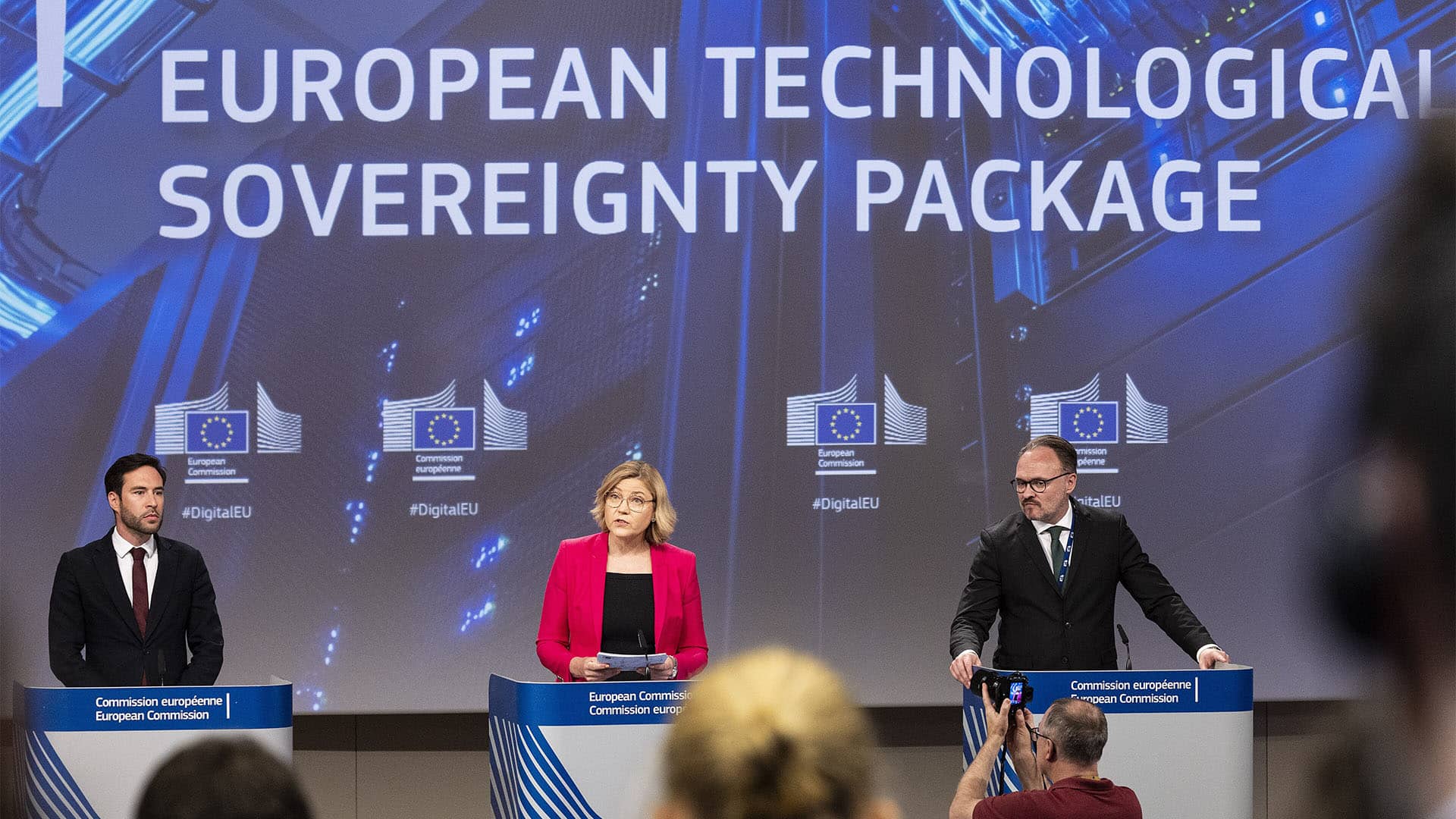
- The European Commission has presented the EU’s technological sovereignty package, addressing the relationship between energy and digital technologies, semiconductor production and supply chains, data centres and cloud services, as well as the strengthening of open-source software ecosystems.
- Despite the necessary new elements introduced by its approach, the absence of funding commitments means that the package has limited scope and depends on the negotiations on the Savings and Investments Union and the Multiannual Financial Framework. This highlights the tensions the Union faces in defining its economic and industrial policies as well as its alliances.
- However, its main shortcoming is the absence of a clear purpose for technological sovereignty. The package proposes reducing dependencies and guaranteeing access, but it does not give society the agency to deliberate and determine how that digital society and economy will be built.
- Given the evident pervasiveness of digital technology across every aspect of our society, the door should be opened to a collective and democratic reflection on the conditions under which this transformation will take place.
- To open the debate, and taking into account the electoral context approaching both in Spain and across Europe, measures of varying scope are needed. These could include the systematic and deliberate incorporation of questions about the future of technology into opinion polling, funding for research centres and the organisation of citizens’ panels. All of this should encourage political parties to incorporate issues and proposals concerning the future of digital society into their discourse and programmes.
Analysis
Since the appointment of the European Commission’s first Executive Vice-President for Tech Sovereignty, Security and Democracy on 1 December 2024, technological sovereignty has become a fashionable term in the corridors of Brussels, Berlin, Paris and every other European capital, including Madrid. Yet this has happened without a clear definition of the concept.
Despite this shortcoming, the European Commission has sought to give the concept substance and meaning through accomplished facts. Just a few weeks before the summer, it unveiled its long-awaited technological sovereignty package, which, in simplified terms, understands technological sovereignty as possessing the digital capabilities needed for our society to function while minimising strategic dependencies and the risks of external interference. The package was necessary and includes highly relevant measures for the Union’s technological sovereignty, but it also clearly reflects many of the EU’s unresolved dilemmas. However, if one critical flaw had to be singled out, it would be that it neither rests on nor addresses one of the essential elements of technological sovereignty: agency, that is, the capacity to decide what the digital future into which technology will be integrated should look like.
The four layers of technological sovereignty according to the Union
As noted above, the European Commission defines technological sovereignty in the package itself in terms of possessing capabilities and minimising dependencies and risks. To achieve these objectives, the package proposes four documents intended to address European technological sovereignty holistically, with action across every layer of the technology stack.
The first layer is the roadmap for digitalisation and AI in energy. Here, the European Commission seeks to harness the relationship between energy and digital technologies. AI and data centres have become the new major energy consumers of the 21st century, with access to the electricity grid emerging as one of the main bottlenecks to technology deployment. At the same time, AI can enable energy to be used more efficiently and sustainably, including through better planning. The roadmap relies on digital tools, including AI models, to optimise electricity grids and achieve AI deployment aligned with the Union’s energy pressures and decarbonisation objectives.
The next layer concerns semiconductors and includes the Chips Act 2.0. This regulation seeks to increase the manufacturing of both leading-edge and conventional semiconductors within the Union (that is, from the most sophisticated AI chips to those used in cars) in order to reduce external dependencies. The European Commission is also granted powers to require certain companies and strategic projects to prioritise orders in the event of severe supply crises.
Having addressed energy and semiconductors, the Commission then turns to the physical and digital infrastructure on which technological sovereignty would rest. Under the Cloud and AI Development Act, the Commission proposes trebling the number of data centres on European soil over a five-to-seven-year horizon by accelerating the permitting process. It also seeks to strengthen autonomy from other jurisdictions by limiting their powers of coercion and surveillance. This would be accomplished by requiring that cloud service providers to the European public sector be independent of third countries.
Finally, all of this is underpinned by the open-source strategy, which seeks to anchor the EU’s competitiveness and technological sovereignty in open and contestable markets with interoperable products. To this end, it explores how to support the ecosystem, stimulate public procurement of open-source technological solutions, and promote their standards internationally.
The unresolved obstacles in European debates
Reactions to the package have been many and varied. There are certainly positive elements, insofar as the approach differs from the one adopted to date, which clearly had not produced the desired effects. The Commission recognises that the mere existence of European alternatives to services provided mainly by large US technology companies is not enough: other barriers to entry also need to be broken down. Alternatives need buyers so that they can reach scale and make their business models sustainable. It is also positive that technological sovereignty is approached systemically, addressing not only data or chips but also energy, talent and research, among other areas. Both elements are part of what voices such as Cristina Caffarra and Francesca Bria have long argued and developed through their involvement with the EuroStack initiative.
Even so, two key factors mean that it is still too early to declare victory. First, an arduous negotiation process in Parliament and the Council still lies ahead before a final text is agreed. The strategic direction will not be debated there so much as the details, which can make the difference between the ‘success’ and ‘failure’ of the legislative measures on the table by altering the industry’s incentive structure.
On the other hand, the package contains no financial commitment. It points to the initiation of an ‘urgent reflection’ on an investment mechanism for advanced technologies through which the Commission could co-invest and attract private financing. But it stops there: an ‘urgent reflection’, with no timeline and no firm commitments. This makes it difficult to imagine how technological sovereignty will materialise if it is not backed by funding when, by comparison, the four US big tech companies[2] plan to spend around US$725 billion on capital investment in AI infrastructure in 2026 alone (almost 80% more than the previous year), while China plans around US$139 billion.
By contrast, we know that European technological sovereignty will require substantial amounts of public and private money to build infrastructure, attract talent, sustain the open-source community, promote cutting-edge research and innovation, and ensure competitiveness and leadership in key niches. All of this financing is now contingent on two negotiations: the Savings and Investments Union and the European budget for the next seven years. The first negotiation has been stuck for more than a decade. The concept originated in Jean-Claude Juncker’s Capital Markets Union in 2014 and seeks to give effect to one of the Union’s four fundamental freedoms, the free movement of capital. The goal is to create a deeper and more developed European capital market. Yet little progress has been made. The 2024 Letta report has provided the initiative with some sort of rebranding to raise awareness that European savings should be channelled into investment in European firms. It remains to be seen whether this time will be more successful than the last.
The second negotiation concerns the 2028-34 Multiannual Financial Framework (MFF), in which the Member States are engaged from very different perspectives. Some countries want the total size of the budget proposed by the Commission in its initial draft to be reduced substantially. Their determination was made clear at a meeting of six northern-European countries, led by Germany, held in Berlin at the end of August. The so-called frugal countries called on the Union to make ‘clear choices and prioritise’ and to reduce the budget by ‘several hundred billion euros’. Other countries, including Spain, want the amount to be increased in order to address the Union’s multiple and complex challenges, technological sovereignty being only one of them.
Thus, the technological sovereignty package clearly mirrors the debates the EU is struggling to resolve over economic and sectoral policy and its strategic orientation. These are all areas in which there is no clear consensus. Do we continue to use regulation as an instrument for governing our economy, or do we move towards industrial policy and the protection of sectors to achieve economic security? Do we outsource the provision of products and services to others because they are more competitive, even if they are not reliable, or do we move towards a ‘made in Europe’ and ‘processed in Europe’ model, even if it costs more? Faced with many challenges and little fiscal space, do we opt for economic orthodoxy or invest on a massive scale? And with the limited money available, do we distribute new capabilities across the Union, with each Member State protecting its own turf and creating redundancy, or do we accept winners and losers that are unevenly distributed across the territory? These are far-reaching and, to some extent, cross-cutting questions, since they affect every economic sector. The answers will not be black and white either, but will lie somewhere on a greyscale, which is precisely why these dilemmas are so difficult to resolve.
The problem of overlooking agency as part of sovereignty
Despite the above, there are questions specifically concerning the digital sphere and technological sovereignty that the package does not answer. This is not because the Commission avoids them, but because they are not being asked. They probably do not fall within the remit of the institution. The most important is: what future do we want to achieve through technology? The answer is crucial and goes to the heart of the definition of technological sovereignty.
In this regard, Stefaan G. Verhulst, a professor at NYU, proposes a framework for technological sovereignty that forces us to reflect on the issue. For him, technological sovereignty has three pillars. The first two are reducing dependencies and guaranteeing access to technology, in line with the Commission’s measures. The third, however, is different: having agency. This would amount to a form of digital ‘self-determination’ in which citizens can participate in deciding what the digital systems on which our societies depend look like, who controls them and who benefits from them. As a recent report by the Centre for the Governance of Change notes, this self-determination could operate at a more micro level, with an individual citizen or company making autonomous technological choices based on the existence of functional and credible alternatives. It would also extend to a macro level, at which the EU as a political entity decides on its own techno-economic-social model according to its preferences rather than to geopolitical and geoeconomic dependencies.
That self-determination is essential, but it requires a prior step: a collective and democratic political conversation and reflection on how digital technology is going to be integrated into our lives. It is precisely on this third element that progress is needed even more quickly than on the previous two, because technology permeates every aspect of daily life and structures and coordinates the rest of our action in technological, digital, energy, fiscal, labour and education policy, among many other areas. So far, that conversation has been led by a handful of executives based in Silicon Valley. They issue inflammatory and contradictory statements about how AI could destroy humanity, how any attempt at regulation comes from ‘legionaries of the Antichrist’ and launch AI-enabled sunglasses. On the other hand, citizens at the individual, collective and institutional levels, respond as best we can.
The EU and its 2022 European Declaration on Digital Rights and Principles, which seeks a digital future with ‘people at the centre’, attempted to lay the foundations, but this has not been enough. No political party or institution has managed to translate and develop that people-centred approach into an integrated, practical and inspiring vision of the society of the future. This ‘omission’ or neglect of agency in technological sovereignty, is problematic. It may be because grand visions of the future do not win elections and are not of much interest to the average citizen either. Citizens do care, however, when data centres raise energy costs and affect water availability in drought-stricken areas; when companies stop hiring young workers in favour of AI; when middle-aged workers lack opportunities for reskilling and upskilling; when there is or is not a minimum income scheme; or when algorithmic polarisation continues to drive men and women apart and deepen demographic problems.
The Spanish snap elections in November 2026 will only be the beginning of a long election cycle in the EU. In 2027, France, Italy, Poland, Greece, Finland, Estonia and Slovakia are expected to follow Spain. These new grand visions will obviously not be put directly to voters, but people will vote on electricity prices, unemployment, the lack of social mobility or widespread dissatisfaction. These are, in other words, demands that are largely connected to digital society. Steps therefore need to be taken quickly to begin incorporating these issues into electoral programmes and giving them visibility.
Consequently, measures of varying scope are needed at both national and European level. Below are several proposals, from less to more ambitious. Given the pre-electoral climate that already dictates the political discourse and activity in Spain, the application of some of these measures is both unlikely and difficult from a timing perspective, particularly in terms of influencing the public conversation ahead of Spaniards going to the polls. Still, there is room to adopt some elements in the Spanish case, as well as in other Member States and at the EU level.
First, questions about the future of digital society should be included more deliberately in opinion polls conducted by private and public bodies, so that political parties can identify citizens’ positions. These studies should go beyond asking about people’s use of and access to technology and should also ask about citizens’ preferences regarding the place technology should occupy in our lives. In February 2025, Spain’s Centre for Sociological Research conducted a specific study on technology and artificial intelligence. This is the direction in which further work and deeper inquiry are needed.
More funding should also be allocated to universities, research centres and think tanks to lead and explore this kind of reflection, as well as to coordinate these efforts. There are organisations in which these issues are discussed, but the reflection is highly fragmented by topic and, in most cases, moves away from the systemic approaches required by agency as a component of technological sovereignty.
A third option would be for public institutions to organise citizens’ panels. The EU already conducts exercises of this kind, bringing together randomly selected citizens from the 27 Member States over three weekends to debate a topic. Panels of this kind should be promoted regularly and institutionalised as a means of reflecting on the future of digital and technological society, incorporating foresight exercises that include citizens. They should also be followed up so that they do not become symbolic and merely performative exercises.
All of this would enable political parties, which are the main organisations structuring citizens’ preferences, to include concrete and explicit proposals in their electoral programmes, focus part of the public debate on these issues, and set a collective direction. At that stage, the only other obstacle to overcome and test will be the appetite of political elites to actually address these topics, which should not be assumed as a given.
Conclusions
Ultimately, technological sovereignty is not only about designing and building our own semiconductors, data centres and algorithms, which are the objectives on which the European technological sovereignty package focuses. A crucial part is enabling people to discuss and vote on the society they want in the digital world; in other words, to self-determine. Until that happens, we may have digital industrial policy and European data centres, and replace Gmail, Twitter and ChatGPT with Proton, Mastodon and Mistral, but we will not have technological sovereignty insofar as we are not truly allowed to decide our own future. If our concept of technological sovereignty does not incorporate this, others beyond our borders will have decided how the world works and the rest of us will merely choose which provider to buy it from.
[1] The author would like to thank Miguel Otero Iglesias and Darío García de Viedma for their comments, which enriched and improved this text.
[2] Amazon, Microsoft, Alphabet and Meta.