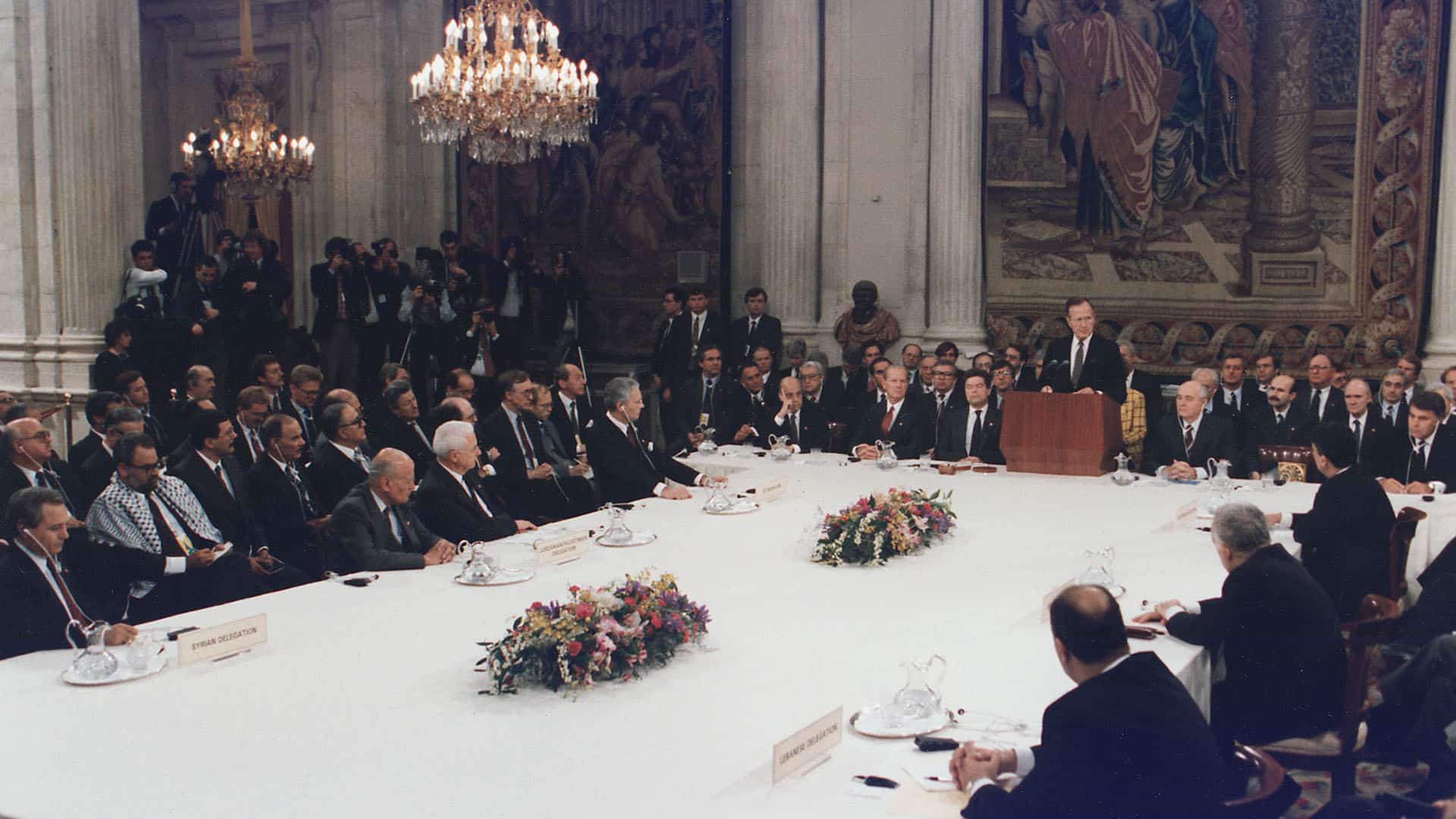

A beaming King Juan Carlos was flanked in 1991 in Madrid by US President George H.W. Bush and Mijail Gorbachov, President of the Soviet Union. The three of them and Felipe González, the Socialist Prime Minister, had dinner which turned out to be effectively the last summit held by the US and the Soviet Union before the latter’s collapse. At that moment the King was at the centre of world attention.
Juan Carlos is widely credited at home and abroad for his key role in Spain’s transition to democracy following the death in 1975 of the dictator General Franco. Yet scant attention has been paid to the significant part he played in fully ending Spain’s international isolation and stepping up to the global stage.
By the time Juan Carlos abdicated in 2014 in favour of his son Felipe, due to ill health and various scandals, which subsequently resulted in him going into self-imposed exile in Abu Dhabi in 2020, he had made some 275 state, official and working visits in 39 years. These took Juan Carlos to 103 countries and generated around 150 return visits to Spain by heads of state.
In contrast, Franco made just three official visits abroad during his 39-year regime –to meet Hitler, Mussolini and Petain– plus a single state visit to Portugal (at the invitation of fellow-dictator Oliveira Salazar), while Queen Elizabeth made 89 state visits during her 70-year reign.
Diplomatic relations were established with around 70 countries and new states during Juan Carlos’s reign: with those that had shunned the Franco regime, such as Mexico, which took the Republic’s side during Spain’s 1936-39 Civil War, or the regime had rejected, such as Israel, because of close ties with the Arab world, among other factors. In the case of Mexico, the home of the largest number of Spanish exiles and the seat of the Republican government in exile, Juan Carlos was able to be an instrument for both national and international reconciliation.
The summit photo taken during the Middle East Peace Conference, hosted by Spain, adorns the cover of Charles Powell’s exceptionally well-documented and enlightening book, El rey Juan Carlos I y la proyección exterior de España (Galaxia Gutenberg). The book is largely based on declassified US and UK diplomatic cables and documents, as well as interviews with the main protagonists of Spain’s foreign policy including Juan Carlos and the country’s past prime ministers.
But for Spain’s archaic official secrets law, which has hardly changed since it was approved by Franco in 1968 and is unworthy of a democracy, the book would have been even more superbly documented. The absence of declassified Spanish documents among the 1,357 footnotes in the book speaks volumes about the lack of transparency in Spain.
Spain was not a pariah when Franco died. It had been gradually incorporated into the West’s main institutions including the United Nations, the IMF and the OECD, and US bases had been established in the country. Yet the tourism slogan ‘Spain is Different’, first used in 1948, not, as commonly assumed in the 1960s, was still a synonym for the country’s exceptionalism, particularly regarding the lack of democracy and the relative diplomatic isolation.
But as Nigel Townson argues cogently in his new book (Spain is NOT different: La historia de un país europeo, 1898-2000, Espasa), Spain, based on a comparative context, was not in fact so different. When Franco came to power in 1939 almost all of Central and Eastern Europe already had right-wing authoritarian governments: Germany since 1933, Bulgaria, Estonia and Lithuania (1934), Romania (1937), Austria (1938) and Czechoslovakia (1939). Nor was the situation in southern Europe much different: together with Portugal and Greece, Spain formed part of the ‘third wave’ of democratisation in the 1970s.
Juan Carlos did not have a roadmap but he knew that the monarchy, which Franco had restored in 1969 when he appointed him his successor over the head of his father, don Juan de Borbón, would not be consolidated without external validation. Equally, without democracy and national reconciliation Spain could not enter the European Economic Community (EEC). Like many people of his generation, Juan Carlos fully identified with the philosopher José Ortega y Gasset’s famous dictum (1910) that ‘if Spain is the problem, Europe is the solution’.
The King wasted no time in making his intentions known. While interim head of state, because of Franco’s ailing health in 1975, the then Prince overruled the Interior Minister and ordered him to give the Socialist leader Felipe González (Prime Minister 1982-96) a passport so he could travel to Germany to attend the SPD’s annual party conference. That sent a positive signal.
So did Juan Carlos’s probable intervention to prevent the magazine Cambio 16 from being shut down by the first post-Franco government for publishing in 1976 in the aftermath of his state visit as King to Washington a cartoon showing him dressed in tails à la Fred Astaire dancing against a New York skyline. Secretary of State Henry Kissinger telephoned Juan Carlos to warn him that closing the magazine would be ‘unwise’, since ‘it would be hard to convince the American public that a government was so insecure that it couldn’t tolerate a cartoon about itself’.
Until the 1978 Constitution, the immense powers Juan Carlos inherited from Franco allowed him to play a major role in defining and implementing foreign policy and ending decades of Spain’s relative isolation and irrelevance. And after 1978 the Constitution’s vague description of his role in foreign affairs gave him more leeway than in other parliamentary monarchies, enabling him, for example, to play a significant behind-the-scenes role in Spain joining NATO (1982, reaffirmed in a referendum in 1986) and the EEC (1986).
Juan Carlos’s personal relations at the highest level, many of them established long before he became head of state, stood him in good stead in smoothing away many problems. By the time he was designated Franco’s successor, he had visited 33 countries, meeting, among others, Presidents Kennedy and Johnson. Being a member of the select club for monarchs is particularly useful.
The King helped lift two vetoes that significantly conditioned EEC membership. The first one was imposed by the British government, which established a direct link between the full restoration of communications between the British territory of Gibraltar and Spain and future approval of Spain’s accession treaty by the UK parliament. Britain had joined the EEC in 1973. Franco had closed the border with Gibraltar in 1969 and cut off telephone communications.
In the case of Gibraltar, Lord Mountbatten, Juan Carlos’s first cousin twice removed and Queen Elizabeth’s second cousin once removed, guided the King so that Spain’s EEC bid, the most important foreign policy goal, would not be shipwrecked on the Rock of Gibraltar. Juan Carlos let it be known sotto voce that Spain was not seriously seeking to regain sovereignty, although the official discourse, for longstanding domestic consumption, was otherwise.
The other veto was the refusal of some EEC member states to allow Spain to join the bloc unless it first established diplomatic relations with Israel. Juan Carlos used the close relations he enjoyed with some Arab leaders, particularly King Fahd of Saudi Arabia, to make them realise Spain had no option. That relation had also helped secure Spain badly needed oil from Saudi Arabia in 1979 during the second global oil crisis, triggered by the fall of the Shah of Iran, which hit Spain hard. The allegations of kickbacks for Juan Carlos, Powell points out, have never been proved.
Just as Spain’s parliamentary monarchy has served Spain well, by standing above the political fray, acting as a unifying force in a deeply polarised country and representing the majority of citizens, so, too, it has played a highly positive role in foreign policy. Continuity in leadership of the state enabled Juan Carlos (and now his son King Felipe VI) to get to know very well both Spain’s political leaders (seven prime ministers) and foreign leaders (including 10 US presidents and seven French presidents), accumulating over time a wealth of political knowledge and experience. This institutional memory has served successive governments well.
On occasion, Juan Carlos’s experience and the confidence he inspired got Spain out of some tricky situations. For example, when the Popular Party (PP) government in 2012 feared the US government might remove US troops from the Rota and Morón bases and station them in Morocco, because Washington had doubts about Spain as a reliable ally, Juan Carlos spoke to Secretary of State Hillary Clinton and dispelled any doubts.
Juan Carlos’s promotion of democracy in Spain and abroad helped the government to strengthen its weak ties with Central and Eastern Europe, ahead of the fall of the Berlin Wall in 1989 and the collapse of the Soviet Union.
As well as political diplomacy, Juan Carlos engaged in economic and public diplomacy. In the former he often opened the doors abroad for companies. Powell says there is no documented proof that the US$100 million Juan Carlos received from King Abdullah of Saudi Arabia was a commission in return for mediating the Mecca-Medina high-speed rail contract won by Spanish companies. It seems it really was a present. The gift represented a small fraction of Abdullah’s fortune.
Juan Carlos, aged 88, has now been in exile more than five years. Whatever his misdemeanours, the balance of his reign is indisputably positive and he should not be allowed to die in exile.