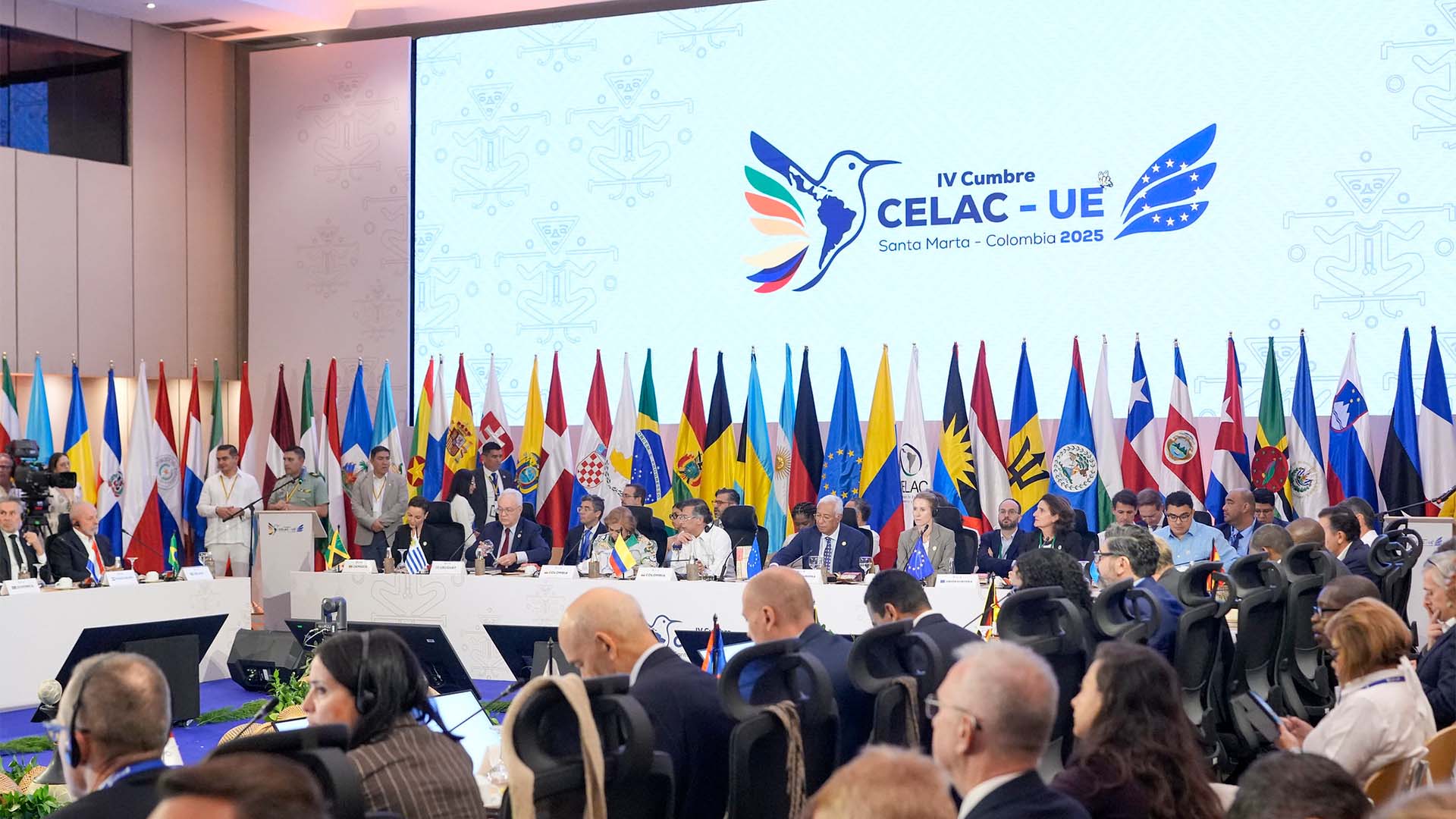

Last November, the IV EU-CELAC summit was held in the Colombian city of Santa Marta. With the Trump Administration’s departure from the Paris Agreement and multiple geopolitical flashpoints and global conflicts, there were high expectations that the summit would be a moment to show that multilateralism, global cooperation and climate action still matter. The stakes were also high with Brazil hosting COP30 around the same time.
The Santa Marta summit and the COP30 outcomes, combined with the willingness of some EU and LAC countries to lead on confronting the climate and ecological crises, should be a cause for cautious optimism.
The Santa Marta summit was co-chaired by Colombia’s President, Gustavo Petro, as the pro tempore President of the Community of Latin American and Caribbean States (CELAC) and by António Costa, President of the European Council. In April 2025 Colombia had assumed the Pro Tempore Presidency of CELAC for the 2025-26 period. For the EU-CELAC summit, Colombia sought to advance its agenda around various issues including climate action, the triple transition (energy, digital and environment) and fighting organised crime.
However, the prelude to the Santa Marta summit epitomised the proximate and broader geopolitical upheaval sweeping the world and worsening climate impacts, which increased pressure on leaders to ensure a successful summit.
Last September, the Trump Administration commenced controversial military strikes against vessels allegedly carrying narcotics in international waters off the coasts of South America. Then in late October, the US Department of the Treasury’s Office of Foreign Assets Control (OFAC) placed President Petro on a financial sanctions list for allegedly permitting drug cartels to flourish. In a further tussle, Petro denounced the US for allegedly exerting ‘strong pressure’ on Caribbean countries to skip the Santa Marta summit.
In the case of the Jamaican Prime Minister, Andrew Holness, his absence was due to Hurricane Melissa, which struck Jamaica in October. Other EU and LAC leaders also skipped the summit, including the European Commission President and the leaders of Germany, France, Mexico, Chile, Argentina and Barbados. On the other hand, the leaders of Brazil, Spain, the Netherlands, the President of the European Council and other senior European Commission leaders did attend. This lacklustre attendance was due in part to the dark shadow cast by the Trump Administration and the limited convening power of Petro, who has a few months left in office.
What were the summit outcomes on climate, environment and the energy transition?
To take advantage of European leaders attending COP30 in Brazil, the EU-CELAC summit was held between the COP30 Heads of State summit on 6-7November and COP30, which ran from 10 to 22 November.
The EU and CELAC have an impressive portfolio of climate-related work in diplomacy, development cooperation, investment and trade. Chile’s former President, Ricardo Lagos, and Brazil’s President Lula wrote in 2015 that cooperation between the EU and CELAC represented the world’s strongest bi-regional partnership on climate change.
The Joint Declaration of the EU-CELAC summit was signed by 58 of the 60 countries with the exception of Nicaragua and Venezuela. On climate, environment and energy transition issues, it recognised the need for deep, rapid and sustained reductions in greenhouse gas emissions in line with the 1.5°C trajectory. Countries also recognised the importance of just transition pathways and highlighted the importance of training and retraining for workers and communities to capitalise on the low-carbon economy. Leaders pledged to harness Global Gateway to strengthen energy interconnection in the LAC region via low-carbon energy sources. They also emphasised the need to restore and protect natural resources and ecosystems and enhancing cooperation to dismantle transnational criminal networks, including those related to illegal mining and environmental crimes. The declaration also highlighted the need for countries to address and counter disinformation and misinformation, which is relevant to climate change, where well-funded networks work to obstruct climate action. Overall, the 2025 joint declaration was more comprehensive on these issues than the 2023 declaration. However, the 2025 declaration did not explicitly mention critical raw minerals unlike in 2023.
The Civil Society Declaration that emerged from the Civil Society Forum included some text on climate change. Yet it made no reference to the 1.5°C limit and the need for a just energy transition away from fossil fuels. These omissions were surprising given that the LAC region is highly vulnerable to climate impacts and the Petro administration has prioritised a just energy transition through initiatives including the Colombia Solar Programme.
Following the summit, various civil society groups published an open letter voicing their concerns about the lack of ambition in the leaders’ declaration on the fossil fuel phase-out, climate finance, and trade and supply chain justice. They argued that the implementation of Global Gateway is failing to adhere to some of the strategy’s own principles on democratic values, equal partnerships and consultation with civil society. They called for governments to establish a permanent mechanism for civil society to track and evaluate commitments; a commitment to a just and equitable fossil fuel phase-out with differentiated timelines; placing climate justice, human rights and ecological integrity with safeguards at the centre of bi-regional ties; and prioritising public climate finance that strengthens adaptation.
Major announcements made on the summit’s margins
In relation to climate, the environment and the energy transition agendas, various announcements were made. President António Costa said that the EU had mobilised €31 billion, out of a target of €45 billion by 2027 within the EU’s Global Gateway Investment Agenda, to finance over 100 projects across the LAC region, including support for building Bogotá’s metro and the modernisation of Colombia’s railways.
The European Investment Bank (EIB) pledged new financing of €1 billion to strengthen power grid integration and clean energy across Central America. The EIB and Enel Colombia SA, part of the Italian Enel Group, announced a loan of up to US$200 million to finance two solar projects in Colombia. The EIB and Banco de Desarrollo del Ecuador (BDE) also announced a US$100 million framework loan to finance water-related projects in Ecuador.
The EU is supporting the Caribbean to transform sargassum seaweed accumulation into a sustainable economic opportunity with over €300 million in potential loans and €60 million in potential grants. As part of Stormwatch, the EU is contributing €1.5 million to establish a new Copernicus Competence Centre at the Caribbean Institute for Meteorology and Hydrology to support the Institute respond to extreme weather events.
The Development Bank of Latin America and the Caribbean or CAF, of which Spain and Portugal are the only non-regional shareholders, announced US$40 billion in investment over the next five years with a focus on climate, the environment and the energy transition.
Lastly, with EU technical support, the Mayorship of Bogotá carried out the first international issuance of a green bond by a LAC city. The green bond is structured in Colombian pesos for an amount equivalent to US$600 million (COP2.3 trillion) and will help to finance Bogotá’s Metro, among other projects.
These announcements represent an encouraging, albeit modest, step forwards. Yet surprisingly given Colombia was the host, there was no specific announcement of EU support for its Country Platform launched in January 2025. The platform, which is being supported by the Inter-American Development Bank, aims to attract investments of around US$40 billion to finance projects in areas including sustainable agriculture and renewable energy. With well under a year left in office, this was a missed opportunity for the EU to signal its support for the Petro government’s Country Platform, given that various presidential candidates in the May elections are keen to double down on fossil fuels and embrace fracking.
Looking ahead
The Joint Declaration states that substantial progress was made at the summit on the preparation of the EU-CELAC Roadmap 2025-27, which will advance both regions’ shared commitments. As this work continues, there is an opportunity to ensure it is aligned and complements the progress secured at COP30.
For example, at COP30, Brazil’s COP30 presidency announced it would create two roadmaps on the transition away from fossil fuels and on halting and reversing deforestation by 2030 respectively. Then, last December, President Lula issued a directive for his government to develop, within 60 days, a proposal outlining guidelines for a national roadmap for transitioning away from fossil fuels in a just and orderly manner.
Relatedly, Colombia announced that it would co-host with the Netherlands the first international conference on a just transition away from fossil fuels in April 2026 in Santa Marta. Colombia also spearheaded the Belém Declaration on the Transition Away from Fossil Fuels, signed by 24 countries at COP30, including various EU Member States and LAC countries, where signatories pledged to work towards a just, orderly and equitable transition away from fossil fuels, aligned with pathways consistent with the 1.5°C goal.
To build on this momentum, steps could be taken to create a dialogue for EU and LAC countries to cooperate on how to develop national fossil fuel transition roadmaps. This dialogue could complement other initiatives, such as the Beyond Oil and Gas Alliance and the Powering Past Coal Alliance, where some EU and LAC countries participate, and contribute to the preparations for the Santa Marta conference in April.
To confront misinformation and disinformation, more EU and LAC countries could sign onto the Declaration on Information Integrity on Climate Change, which was launched at COP30. At the time of writing, 21 countries have signed, including Brazil and Spain.
Finally, Europe can increase its support for the Tropical Forest Forever Facility (TFFF), launched last November. The facility aims to pay tropical forest countries US$4 per hectare (2.5 acres) of preserved forest each year with a continuing source of funding as long as forests are preserved. To date, the TFFF has secured more than US$6.7 billion in announced contributions. Yet this falls below the US$25 billion target set by Brazil for government investments, which are intended to secure investor confidence and unlock an extra US$100 billion in private financing. While reaching this target is vital, it will not be enough while illegal mining and other illicit activities, which contribute to deforestation, remain considerably more profitable than the TFFF reward payments. Both regions will also have to demonstrate their ability to cooperate to reduce illegal mining and other environmental crimes.
Final thoughts
Considering the volatile geopolitical situation, the Colombian government deserves credit for securing a reasonably successful summit.
On the way to the EU-CELAC summit in 2027, the outlook, however, is bleak. Last November, the US launched its new National Security Strategy with a strong emphasis on the Western Hemisphere stating that the US will reassert and enforce the Monroe Doctrine to restore its ‘pre-eminence’ in the region. It will deny ‘non-Hemispheric competitors’ the ability to control strategically vital assets and should ‘push out foreign companies’ that build infrastructure in the region. Then, on 3 January, the US military attacked Venezuela, capturing the country’s authoritarian leader, Nicolás Maduro, in part motivated by US interests in controlling Venezuelan oil.
This new reality poses significant risks for the EU and CELAC strategic partnership including their shared agenda on climate, environment and energy transitions. Both regions have a mutual interest in tapping into Latin America’s critical minerals and the role of European companies in developing the region’s renewable energy potential – an area where the US lags far behind China and Europe. In the short term, European and LAC governments will be focused on what this new phase of US interventionism means and the possible implications for their own ties, which could undermine climate-related initiatives.
However, with 2025 the second-warmest year on record, both regions need to creatively advance climate action, environmental protection and a just energy transition while demonstrating to domestic actors that this agenda can create jobs, investment and security. An increase in dialogue and coordination with China, while complicated, is also necessary, especially given the US has announced it is leaving the UN Framework Convention on Climate Change and the UN Intergovernmental Panel on Climate Change (IPCC).
The Santa Marta summit and the COP30 outcomes, combined with the willingness of some EU and LAC countries to lead on confronting the climate and ecological crises, should be a cause for cautious optimism. While much work lies ahead and there remains a geopolitical minefield to navigate, there is a solid basis to build upon this year.