

Key messages
- As the US, Russia and China move towards a global system structured around competing spheres of influence, Europe’s preferred open and rules-based international order is now unravelling. Consequently, the continent is being increasingly drawn into a landscape shaped by external actors rather than by its own initiative.
- However, contrary to popular belief, the EU does possess significant levers of power, especially in the economic realm. The EU controls several key strategic points in global value chains –in sectors on which the US and China are heavily dependent– that can be weaponised.
- There are 41 critical chokepoints for China and 67 for the US where imports from Europe account for more than 80% of supply, including pharmaceutical inputs, insulin and other hormones, medical technologies, extreme ultraviolet lithography (EUV) machines, and specialised industrial machinery used in agriculture, paper production, metalworking, textiles and advanced manufacturing.
- Europe can strengthen this influence even more by pooling its leverage with that of like-minded partners, thereby turning bilateral dependencies into a broader and more effective form of systemic deterrence. This pooled geoeconomic leverage should be the keystone of a new European strategy.
Analysis
The report Relearning the Language of Power has recently been published by the Geostrategic Europe Taskforce, a high-level expert group comprising representatives from 10 different EU member states. The paper is a significant step forwards in the debate of recent months regarding the geostrategic situation in Europe and the Old Continent’s ability to reshape its destiny within the global economy: it proposes shifting from the European Commission’s current perspective of defensive containment to one that actively builds the foundations of a new power strategy, relying on the negotiating power granted by international trade.
Europe is entering an international environment defined less by multilateral constraints than by strategic rivalry, coercion and weaponised interdependence. Increasingly, Europe is being pushed into an international order defined by others. The US, China and Russia increasingly behave as powers prepared to use trade, technology, finance, security guarantees and control over critical inputs as instruments of geopolitical pressure. In that world, Europe can no longer rely on the assumptions that shaped its external power model after the Cold War: markets would discipline politics, international multilateralism would neutralise power asymmetries and the US would remain a partner contributing to a rules-based order.
Europe has certainly not been independent –economically, technologically or geostrategically– from the US since World War II. However, today we see that the degree of independence Europe once enjoyed is under even greater threat. The EU has misread the nature of power in the current global order: while the US and China have built substantial economic, commercial and financial leverage, and are increasingly willing to weaponise this leverage, Europe lacks a clear vision for the future global order, and European policymakers continue to conflate sovereignty with power.
Recent policy initiatives in the EU have placed considerable emphasis on supply-chain resilience, de-risking, economic security and strengthening defence capabilities. The European Commission’s commitment to advancing an open strategic autonomy has gone even further, advocating a strategy that reduces critical dependencies, protects key sectors and encourages countries to act together in key policy areas (energy, research, health, media, technology, defence, food and industry), while maintaining its commitment to free trade and multilateralism. However, these efforts, while important, are insufficient because they remain defensive in nature. They protect freedom of action, but they do not by themselves allow Europe to shape the behaviour of others. They allow for sovereignty, but they do not build new power.
Sovereignty reduces vulnerability, power changes other actors’ calculations. Europe has concentrated on the first while underinvesting in the second. As a result, it has preserved some capacity to shield itself from shocks, yet it still lacks a credible plan for an order in which the US no longer fully sustains multilateral discipline, and China continues to build structural leverage across strategic sectors.
To build that power, we need to leverage the significant tools of control Europe holds within global value chains and take the lead in establishing new geopolitical middle-power coalitions.
Europe’s power model has become outdated and eroded
Europe’s traditional model of soft power has been based on two pillars: the scale of its internal market and the EU’s normative power. The ‘Brussels Effect’, as Anu Bradford has pointed out, allowed European rules in areas such as digital governance, consumer protection and environmental regulation to shape behaviour well beyond Europe’s borders. At the same time, the WTO-based order gave Europe, as a large open economy, a stable legal environment in which commercial interdependence generally worked to its advantage.
However, interdependence among countries has deeply changed. Trade, supply chains and regulatory asymmetries are no longer treated as a neutral arena by major powers; they are treated as instruments of systemic geostrategic competition. What is becoming more decisive today is no longer the influence derived from markets and soft power, but rather hard power and the capacity to strategically leverage interdependencies as instruments to advance geopolitical aims, rather than merely channels of mutual gain.
In the current geostrategic environment, cross-border interdependencies –such as energy flows, technological ecosystems, trade networks, financial linkages and migration routes– have been increasingly weaponised, as Henry Farrell and Abraham L. Newman have pointed out. States deliberately –and with growing intensity– exploit asymmetric links embedded in these networks to coerce, deter or influence the behaviour of others, often below the threshold of conventional military conflict. This shift reflects both heightened geopolitical rivalry and the recognition that globalisation has created dense but uneven patterns of interdependence that can be repurposed for political ends. As a result, tools such as export controls, financial sanctions, supply chain restrictions and migration pressures have become central components of statecraft, blurring the boundary between economic policy and security strategy and redefining interdependence itself as a domain of power competition. In this context, Europe’s former reliance on law, process and market attraction is now incomplete.
The decline of multilateralism has shifted international relations from rules towards power-based bargaining. And this has caught Europe off guard. Smaller and middle powers once benefited from a rules-based system, as it allowed them to negotiate more symmetrically with dominant states like the US, despite lacking comparable coercive capacity. Although rules constrained their autonomy, the gains in predictability and fairness outweighed these costs. However, as the US has retreated from this system, that balance has disappeared: institutions such as the WTO have weakened, and the Trump Administration’s tariff policy illustrates that negotiations are no longer conducted on equal terms.
This transformation reflects a broader structural change. Today the international system is increasingly shaped by conflict and instability. The resurgence of power politics can thus be seen as an adaptive response: states are moving from legality to leverage in order to secure strategic advantages and manage future vulnerabilities in areas such as trade, energy, food, water and technology.
Europe must relearn the keys to power
Contrary to what is sometimes claimed, Europe cannot be conceived as a victim of this new context. The EU already possesses considerable, albeit underutilised, geoeconomic influence, and it must change its current approach in order to relearn the language of power.
The problem is that, to date, the debate has excessively focused on risks, adopting a defensive perspective that overlooks the EU’s considerable capacity to exert influence. Consequently, policy has emphasised reducing exposure rather than actively shaping new tools of power.
In reality, the EU holds key positions (critical chokepoints) in global value chains that can be weaponised and serve as strategic leverage, just as China has done in recent years. There are numerous product categories in which China or the US depend overwhelmingly on imports from the EU. According to the report Relearning the Language of Power, there are 41 critical chokepoints for China and 67 for the US where imports from Europe account for more than 80% of supply. These dependencies are not marginal. They include pharmaceutical inputs, insulin and other hormones, medical technologies, extreme ultraviolet lithography (EUV) machines and specialised industrial machinery used in agriculture, paper production, metalworking, textiles and advanced manufacturing.
This is not to say that Europe should rush towards indiscriminate economic coercion. Rather, it is about recognising that Europe already controls instruments of deterrence and, as Tobias Gehrke has recently observed, has failed to think of them as such. The EU’s problem is not a lack of tools, but the absence of a credible strategy for geoeconomic deterrence.
Increase the geoeconomic leverage by building coalitions
Europe needs to relearn the language of power, but it must do so from a perspective that is very different from the one currently defined by US strategy: Europe must build its power by establishing broad coalitions with other countries. The EU can multiply its leverage by pooling it with other like-minded middle powers, as proposed by Mark Carney in his now famous speech at Davos.
The right response to a world drifting towards spheres of influence is not European isolation, but coalition-building around shared interests, enforceable commitments and collective deterrence. The proposed model is explicitly post-WTO. It does not reject rules or cooperation. Instead, it seeks to reconstruct them on a different basis: club-like arrangements between states willing to coordinate market access, export controls, anti-coercion mechanisms, and cooperation in the development of new markets and low-carbon industries. In that sense, the goal is not merely to harden Europe’s defensive posture. It is to imagine a new European power model capable of underpinning a renewed rules-based order among states that still value cooperation but no longer believe that cooperation can survive without leverage.
This new European power model, able to promote a renewed rules-based international order, requires also strong institutional coherence within the EU. The EU already possesses many relevant tools –trade defence instruments, anti-coercion mechanisms, critical-raw-material partnerships, inward investment screening mechanisms, export-control capacities and regulatory power– but deploys them in a fragmented way. Foreign policy, trade policy, climate policy and industrial strategy are often pursued in parallel rather than as parts of one geopolitical design. Therefore, not only are new coalitions abroad needed, but also a more integrated strategic culture within Europe itself (and this must be achieved not only between the member states themselves, but also between them and the Commission, and even within the Commission’s own Directorates-General). Only then can the EU convert scattered capacities into a recognisable power position.
The old order assumed that common rules, non-discrimination and hegemonic backing would be sufficient to stabilise globalisation. After the crisis of universalism, the new order proposed here would be narrower in membership but stronger in enforcement, more conditional in access, and less universal in form yet still internationalist in purpose.
A new strategy for Europe: deterrence through collective power
The EU’s current strategy for dealing with pressure from the Trump Administration is misguided. Trump has systematically used uncertainty about his actions –whether on tariffs, NATO or even military threats– as a bargaining tool, taking advantage of bilateral situations where the US held greater leverage. Faced with high stakes and doubts about US commitment, European leaders largely opted to limit damage, conceding on issues such as trade, defence spending and energy dependence, while avoiding retaliation even when the US withdrew from key international agreements. However, alternative strategies –based on firmer positions, credible countermeasures and clearer principles– could have yielded better outcomes, as shown in the case of Greenland.
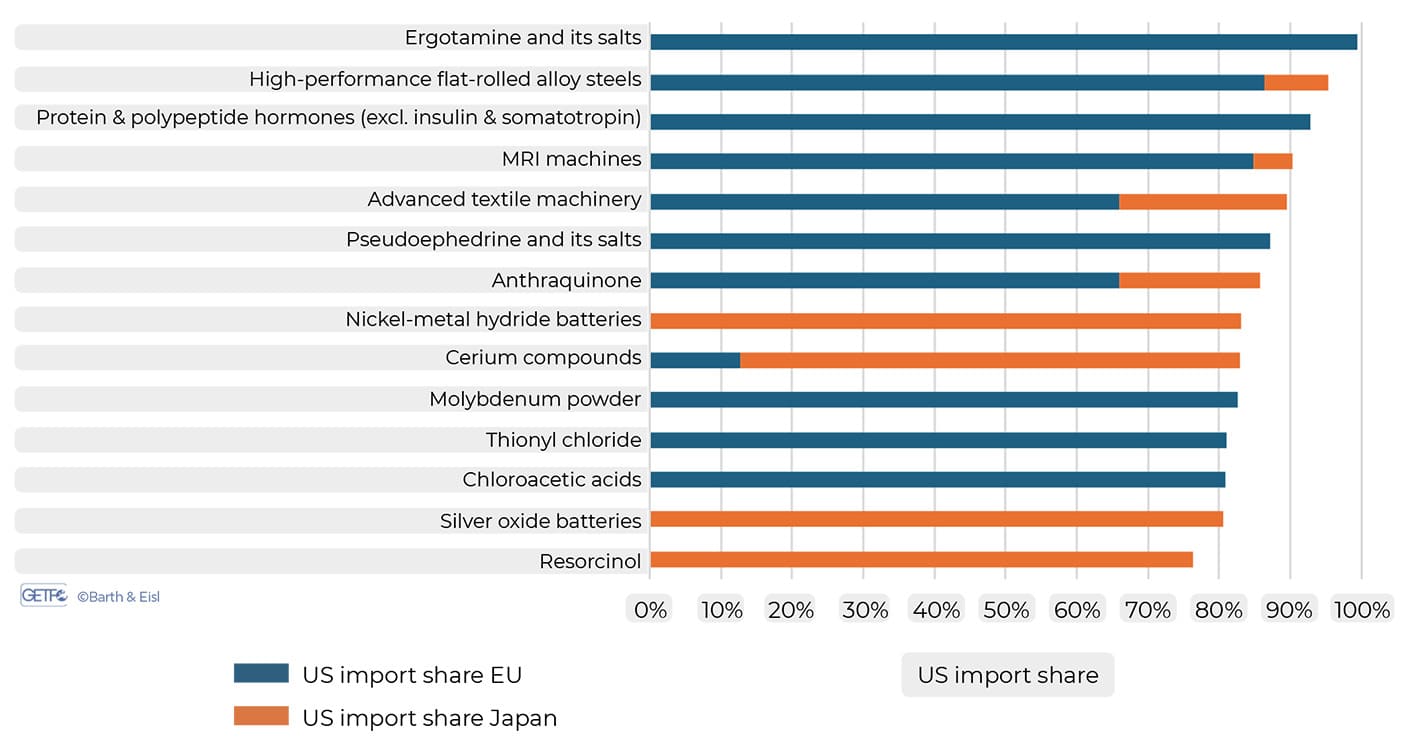
This indicates that deterrence must be the cornerstone of the new strategy to reshape the European power model and the EU’s foreign policy. As noted above, the EU can rely on the critical chokepoints it controls in global value chains to increase its strategic influence and pursue a strategy of ‘escalation dominance’ (as China has done with respect to critical raw materials). Figures 1 and 2 show the main trade bottlenecks that could be weaponised.
Economic estimates based on trade data also show that it would be a mistake to view leverage as something exercised independently, rather than in coordination with others. If the EU were able to amplify its influence by partnering with countries that control similar strategic bottlenecks and share the risk of pressure from both the US and China, its capacity for geoeconomic deterrence could be significantly strengthened.
There is currently a demand from many middle powers to move forward with this type of coalition and, as Kathleen R. McNamara and Federico Steinberg have recently pointed out, the EU faces a unique opportunity to lead this coalition and help shape a renewed rules-based international order at a time of US retrenchment and worldwide uncertainty. An alternative international order, driven by a Europe-led alliance of committed partners, could prioritise a more controlled form of globalisation, while remaining grounded in legal norms and institutional cooperation. This approach would rely on closer coordination between the EU and aligned countries, ranging from Canada and Japan to key actors in the Global South. In this context, Europe could position itself at the forefront of a more stable and foreseeable global order in a world no longer dominated by US hegemony.
Figure 1. A geopolitical coalition between the EU and Japan can increase geoeconomic leverage towards China
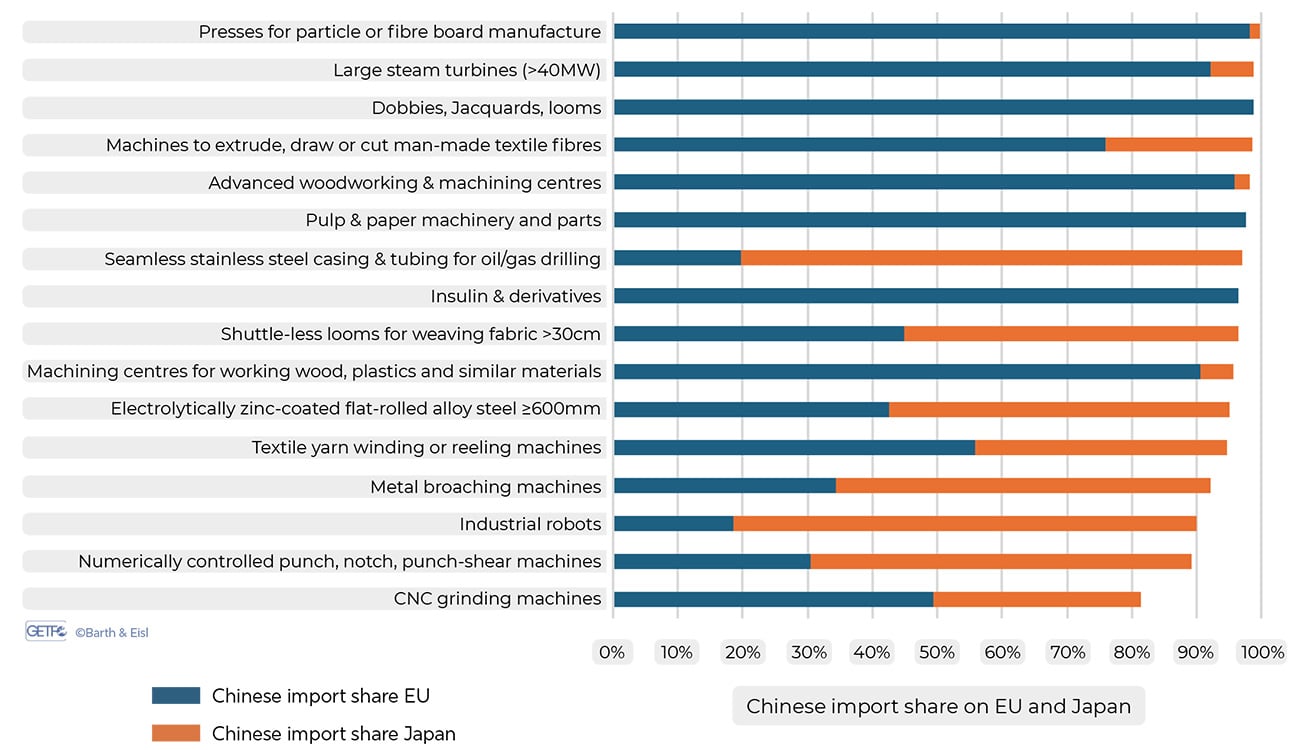
Figure 2. A geopolitical coalition between the EU and Japan can increase geoeconomic leverage towards the US
The 41 critical chokepoints for China that the EU controls could be significantly increased by creating a geopolitical coalition with Japan. Figure 1 illustrates this increase in leverage when forming the aforementioned coalition. A strategic alliance with Japan would expand the number of critical products available for deterrence from 41 (EU alone) to 37 additional items. At the same time, China’s exposure would rise markedly –by around 75%– since its reliance on combined imports from the EU and Japan would be significantly greater than its dependence on the EU by itself.
Something similar would also apply in the case of the US. The EU possesses significant leverage over the US (Figure 2) through its exports of high-value machinery, industrial equipment and key pharmaceutical inputs that are essential for US production systems, particularly in manufacturing, agriculture and healthcare. This influence is even stronger upstream, where Europe supplies critical chemical compounds, biologics and medical technologies that are difficult to substitute. When combined with Japan, the leverage expands further, increasing US dependency across a broader range of products and raising its exposure in strategic sectors.
More broadly, US vulnerabilities also stem from reliance on a small group of specialised supplier countries –such as Taiwan, Japan, South Korea and resource-rich nations– for semiconductors, critical materials and industrial inputs, highlighting a fragmented but significant structure of global dependencies. Building coalitions between the EU and these countries should therefore be a key priority of European foreign policy.
The potential deterrent effect of middle-power coalitions can be quite significant. Coordination with Japan, with Canada or with other partners –such as the UK, Switzerland, India, Indonesia, South Korea, Mexico, Brazil or Malaysia–, would sharply increase the EU’s leverage vis-a-vis China or the US, as shown in Figure 3. Europe has more room for strategic coalition-building than is usually assumed, since other middle powers can reposition themselves to be active shapers of order, not passive buffers between superpowers.
Figure 3. The EU can form geopolitical coalitions with countries to increase the geoeconomic leverage towards the US and China (based on BACI 2021-23)
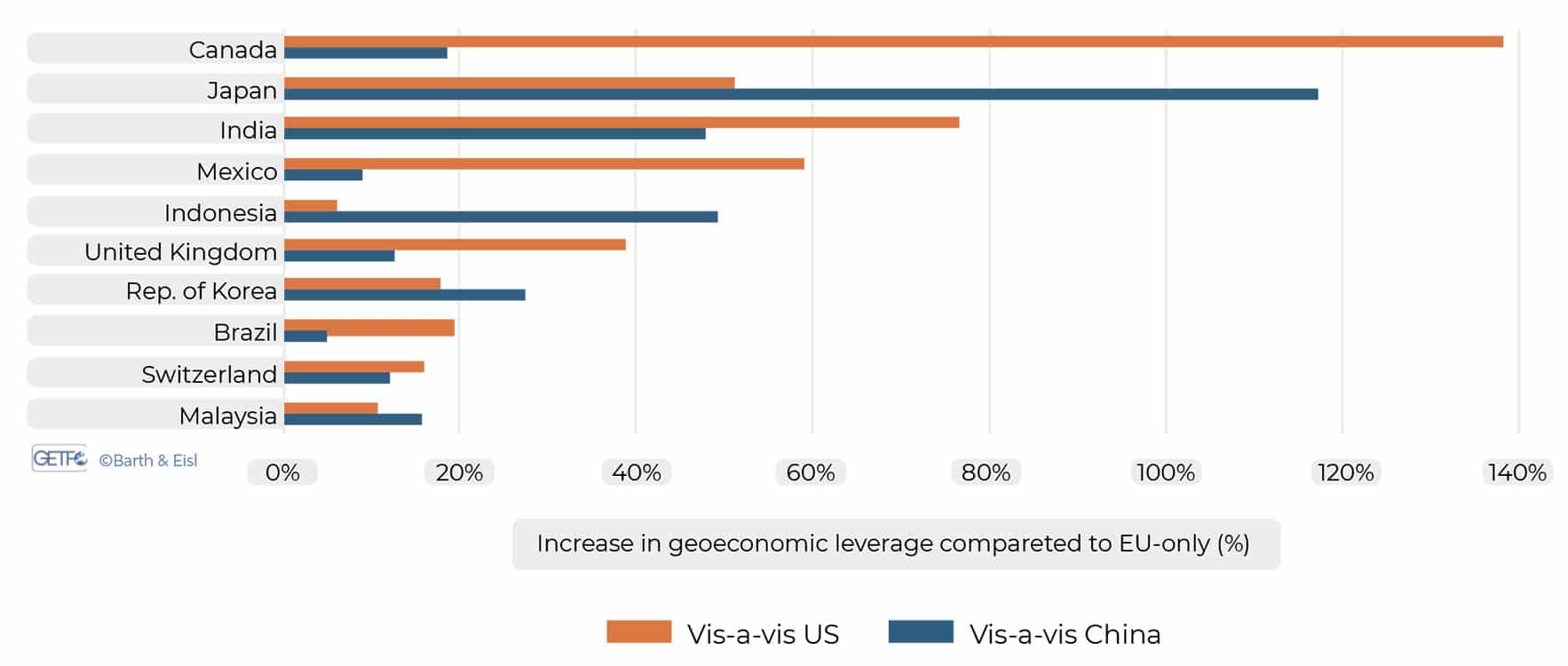
The empirical evidence provided by these data is clear and can be useful in guiding the EU’s efforts to achieve greater strategic autonomy: Europe should treat its geoeconomic leverage as a source of strategic power and organise it collectively. In practical terms, this means mapping critical dependencies, protecting chokepoints, using anti-coercion instruments, and coordinating with partners on export controls and response mechanisms. This does not imply the abandonment of multilateralism; rather, it is presented as a way to defend multilateral cooperation by raising the cost of violating it.
Achieving greater strategic autonomy will not be easy, since leverage is not self-executing. Democratic governments may hesitate to activate export controls or sanctions when domestic firms fear lost sales, retaliation or higher costs. In the EU some of these issues require unanimity, such as the enforcement of sanctions, while others, as they fall under trade policy, can be decided by a qualified majority. Moreover, coalition partners will worry about burden-sharing and about whether others will really act in moments of pressure. For that reason, there is a need for pre-agreed rules, credible commitments and even stabilising mechanisms or compensatory funds that could absorb temporary economic losses when anti-coercion measures are deployed. The new order cannot rest on rhetoric alone; it requires institutions that make coalition solidarity believable in practice.
In this sense, it must be realised that it is not the EU itself that controls the critical chokepoints in global value chains, but the individual member states. The recent case of the Dutch company ASML demonstrates the significant leverage Europe can wield if it exploits its chokepoints and uses technology as a tool of geopolitical power. But it also shows that it was a single country, acting unilaterally –and in this case under strong pressure from the US government–, that made the decision to enforce export restrictions on advanced lithography equipment to China. That is precisely why it is essential to develop a set of pre-established rules and institutional frameworks capable of effectively coordinating the responses of EU member states, fostering alignment among a critical mass of countries, and facilitating the formation of coherent coalitions with non-EU partners.
The good news is that this work would not start from scratch. There are already footholds on which to build the rules and institutions. A particularly interesting example is the EU’s Anti-Coercion Instrument (ACI) adopted in December 2023, that enables the Union to respond in a coordinated manner when a third country attempts to exert economic pressure (through trade restrictions, boycotts or regulatory measures) on a member state or the EU itself. Its rationale is clearly deterrent: before acting, the EU seeks dialogue, but if coercion persists, it may impose proportionate countermeasures such as tariffs, limitations on access to the European market, controls on investments or restrictions on participation in public procurement. The key of this instrument is not merely to react, but to raise the cost of coercion to prevent it from occurring. The EU has not yet formally used this tool for direct economic retaliation, and one of its potential limitations may lie in its governance structure: its design seeks to strike a deliberate balance between responsiveness and political control; its activation requires the Commission to initiate the process, followed by approval by a qualified majority in the Council of the EU. This prevents potential individual vetoes, but, to the extent that it requires broad political support, it sets the thresholds for its activation too high, making its use difficult. Perhaps relaxing that threshold would help to use the instrument when necessary.
It has traditionally been assumed that non-discrimination in international trade has an inherently stabilising effect. However, in a world of rising coercion, equal treatment for all actors is not neutral. It can reward defection, ignore asymmetries and expose rule-abiding states to exploitation. Europe therefore needs a more conditional external economic policy that differentiates between partners and defectors, recognising that such a distinction will not always be easy to make. Market access, financing, procurement, standards and trade preferences should be linked to compliance with shared rules. This distinction between partners and defectors is not framed as protectionism for its own sake. It is conceived as a stabilising principle in a club-based order, one that protects coalition integrity and makes cooperation more credible. Benefits would be concentrated among members eager to observe common rules, which could initially be agreed upon by a coalition of the willing. In contrast, those who defect or weaponise interdependence would face tariffs, export restrictions or other penalties.
Conclusions
We need to reframe the European debate about power. The time has come to redefine Europe’s external identity for a harsher geopolitical era. We must question the comforting assumption that Europe’s task is mainly to preserve openness, defend existing institutions and reduce vulnerabilities at the margin. Instead, we must understand that international order is already being reorganised around leverage, coercion and selective alignment, and that Europe must respond not with nostalgia but with institutional imagination.
The answer is not a European sphere of influence in the classic great-power sense. It is a coalition strategy between middle and regional powers that considers deterrence a means of building an alternative international order committed to a controlled form of globalisation, legal norms and institutional cooperation. The goal is not to join the trend of powers that simply want to compete without rules, but rather to build sufficient deterrent capacity to update and reform the rules-based international order. The goal is not to exclude the US and China from this international coalition, but rather to gradually incorporate them through the coercive deterrence of the middle and regional powers.
Europe must remain committed to rules, but rules without enforceable consequences are no longer enough. Europe must value openness, but openness should now be conditional on reciprocity and strategic balance. Europe continues to need partners, but the relevant form of cooperation is no longer the loose, compartmentalised partnership model of the past decade. It is a more political, more selective and more integrated coalition model in which trade, climate, technology and security are treated as mutually reinforcing domains of statecraft.
Europe’s traditional power model has eroded because the world that sustained it has changed. But Europe still has the economic and institutional resources to shape the next order if it is willing to relearn the language of power. That means recognising chokepoints as leverage, accepting that enforcement and conditionality are indispensable to cooperation, and building coalitions that can offer both protection against coercion and tangible pathways to economic prosperity, technological development and decarbonisation.
To advance in this direction and effectively leverage chokepoints, it is necessary to recognise that control over these bottlenecks in global value chains does not reside with the EU as such, but rather with its individual member states. This highlights the critical importance of putting in place institutional arrangements capable of ensuring effective coordination among member states and facilitating the development of coherent coalitions with partners beyond the EU.
Countries with the most to lose from a world divided into rigid spheres of influence may also be those best placed to construct an alternative. Europe, in this account, can still be one of the principal architects of that alternative.