
I recently had the opportunity to spend some time in Washington to better understand how China and the world is seen from there. I was invited by the University of Pennsylvania as part of its programme focused on transatlantic dialogue on China. The European vertex remains important in this strategic triangle, which is why they invited 20 Europeans, all experts on China, to the US capital.
We had the privilege of exchanging knowledge and perspectives with senior officials, both current and from previous Administrations, from the public and private sectors alike. These included the Department of Commerce, the State Department, members of Congress, the Office of the United States Trade Representative (USTR) and the National Security Council (NSC), as well as companies such as Intel, Nvidia, Rhodium Group and JP Morgan. We also met with several European diplomats and journalists specialising in international relations, including Tom Friedman and Edward Wong from the New York Times, and Ishaan Tharoor from the Washington Post. It was an intense week of meetings, and I am grateful to Neysun Mahboubi for the invitation.
Many issues were discussed during a difficult week for transatlantic relations, marked by the tension generated by Trump’s insistence on acquiring Greenland. I will nevertheless try to organise my reflections around four ideas.
There is no Administration
The first is that it is not possible to speak of the ‘Trump Administration’. As one European diplomat remarked, ‘there is no Administration’. What exists is a government run by Trump and a very small group of people, whose connections to the state apparatus are extremely limited. This means that very few people truly know whether there is a clear strategy in the White House regarding China, Europe, Russia or many other major international issues.
European diplomats acknowledge that they have very limited access to those who actually take decisions, and those they do speak to admit that they themselves do not have much information either. In practice, everyone wakes up in the morning and checks Trump’s Truth Social account to try to understand where things are heading, quite literally. Some have even admitted that they have attempted to activate whatever connections they might have with Trump’s family members to reach his inner circle, although with little success. This is doubly worrying, both because of the lack of access to key information and because the US increasingly resembles a Gulf monarchy rather than a liberal democracy.
The situation has many negative consequences, but the most immediate one, from a diplomatic perspective, and with tactical and strategic effects, is that Europeans do not know how to act. In the past, for any major issue, in any European capital, and this is precisely why the best people were posted there, the first step was to find out what Washington thought and what it intended to do, and only then react. That is no longer possible, and it generates a sense of disorientation and abandonment. For Old Europe, which has allowed that muscle to atrophy, having to think about how to act without knowing what Uncle Sam will do is like walking a tightrope without a safety net. It induces panic, especially when one realises that the world’s leading power is being governed by a shameless kleptocracy that, as one highly experienced international journalist put it, operates according to the ‘Dubai method’.
China is winning
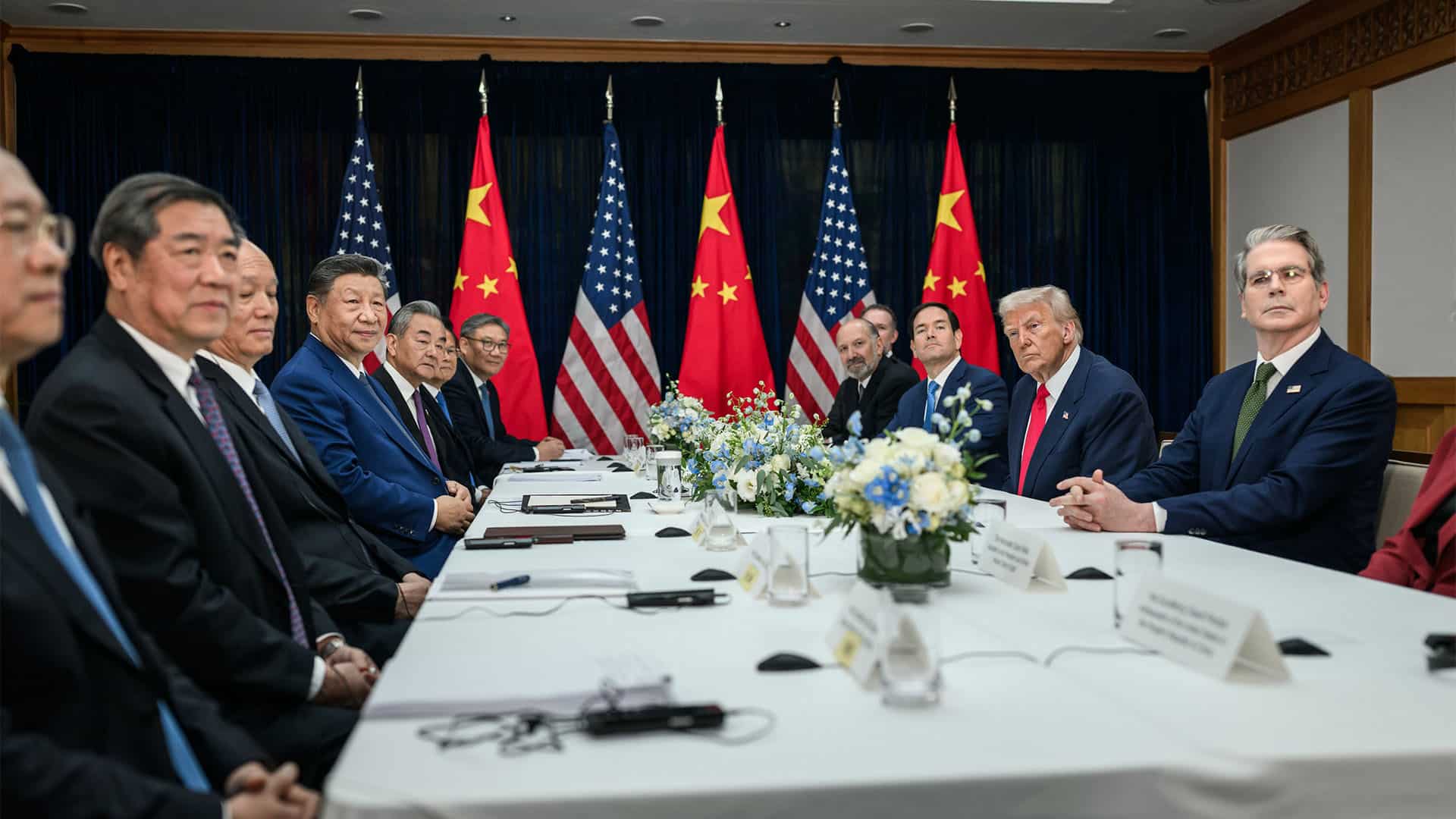
The second idea is that, contrary to what many in the MAGA camp believe, the reality is that China is winning the game against the US. The MAGA view can be summarised as follows. Thanks to tariffs, Trump has managed to bring Xi to the table and has extracted certain concessions. The most important so far is that China has already purchased 80% of the soybeans committed by Xi in Buzan. The same people acknowledge that China has pulled out the rare earths bazooka, which has exposed a choke point that the US currently cannot avoid, but that is precisely why this temporary truce has been reached. As the Treasury Secretary Scott Bessent has said, if all goes well, in 12 to 18 months the US will achieve greater independence from China in critical minerals, and at that point Washington will go back on the offensive.
Moreover, for the MAGA camp, China’s decision to activate the rare earths bazooka is in itself positive, because for a long time it was speculated that Beijing could do so, yet it refrained, showing restraint. Now, by using it, and not only against the US but against the world, China has revealed its predatory side, which will encourage many countries, including of course the Europeans, to try to free themselves from Beijing’s grip, not only in rare earths but also in other fields such as telecommunications and artificial intelligence. From this perspective, this is good news for Washington.
However, when speaking to more independent officials and analysts, particularly from the private sector, the interpretation is very different. The US is losing the race, and this has become evident over the past year. When Trump imposed tariffs of 145% on China to see whether it would bend, the volume of calls to the Administration was staggering. As we were told, the calls not only came from large corporations such as Ford, which are heavily dependent on Chinese supply chains, but also from medium sized, often family-owned companies across many sectors that cannot operate without Chinese inputs. One example was a mattress manufacturer that cannot replace a specific Chinese fabric and was desperate in the face of such high tariffs.
The reality is that China not only has the ability to strangle the US economy through rare earths. If that dependency is reduced, and no one in the private sector believes this can be achieved in less than five years, as illustrated by the Japanese case, which after 15 years has still not achieved autonomy, China will move on to another choke point, such as basic active pharmaceutical ingredients for antibiotics, for example. This would be an even more powerful bazooka, as it directly affects public health.
Even in the case of soybeans, the US gains are limited. After months of not purchasing US soybeans, China has committed to buying 12 million tonnes in 2025 and 25 million tonnes annually until 2028. Yet between 2020 and 2024 the annual average was 29 million tonnes. Since COVID, China has significantly reduced its dependence on the US for soybeans, sourcing most of them from Brazil.
China’s power is also evident in high technology. Since Trump’s first Administration, and continuing under the Biden Administration, the US has attempted to slow down China’s progress in semiconductors through export controls. The results have been poor or even counterproductive. US companies in the sector are clear on this point. If they are not present in China, they will lose substantial revenue and, worse still, they will push China to accelerate rather than slow down its ability to design and manufacture cutting-edge semiconductors. Companies such as Huawei and SMIC are now investing hundreds of millions of euros in semiconductors, and the gap is narrowing steadily, or even tilting in China’s favour thanks to its open artificial intelligence model. As one interlocutor put it, ‘you have to be in China to stay ahead of your competitors there’. This helps explain why Trump has decided to allow Nvidia to export its H200 chips to China, while insisting that it pays its dues, in true Dubai style.
The current paradox is the following, and this emerged repeatedly in our meetings. Both Europe and the US suffer from serious internal problems that make them insufficiently competitive vis à vis China. In China, however, the situation is the opposite. The country’s very acute internal problems (the bursting of the property bubble, severe debt issues, ageing and weak consumption) are pushing the Chinese government to focus even more strongly on industry and technology, which makes China highly competitive. The trade surplus of no less than US$1.2 trillion in 2025 is a clear illustration of this. Projections suggest that by 2030 China will account for around 45% of global manufacturing output. Ironically, the weaker China is internally, the stronger it becomes externally. Meanwhile, very few people in Washington believe that the US will re-industrialise under Trump.
The reactionary take-over
This leads to the third idea. No one knows whether Trump and his MAGA circle have a grand strategy, but if they do, and my conversations in Washington lead me to believe this might be the case, it would look as follows. The strategy has both an ideological and a material dimension. The ideological one reflects a clear rejection of liberalism and free trade. As someone who worked with Trump during his first term explained to us, from the MAGA perspective the transatlantic political and public space encompassing the US, Canada, the UK and the EU has been dominated over the past 40 years, since Bill Clinton, by a single party, the party of the (neo)liberals, noting that in the US liberal means left-wing.
In other words, when they speak of a single party, they refer to the grand coalition of centre-right and centre-left that has dominated this space and has promoted globalisation and a progressive agenda. This could also be described as the party of ‘wokeness’, or of the ‘anywheres’ as opposed to the ‘somewheres’, using David Goodhart’s conceptualisation. The former are liberal cosmopolitans who can live anywhere, the latter are nativist patriots rooted in their land. The goal of the MAGA movement is to dismantle this single party, which it sees as the source of Western decline, and to establish a hegemony based on traditional values. ‘Reactionaries take power’ could well be the slogan. The new national security strategy is a call in that direction.
This vision also has a material component. In order to compete with China, many in Washington have realised that the US needs greater scale. This is made explicit in the newly published national defence strategy. Hence the insistence that the entire Western Hemisphere must be dominated, directly or indirectly, by Washington, from Greenland to Tierra del Fuego, and of course also including the UK and the EU.
Discussions on Greenland were, unsurprisingly, particularly tense. Our interlocutors were unequivocal in defending Trump’s position that Greenland must become a US possession, no matter what. When confronted with the possibility that this could fracture NATO, their reaction was dismissive. They believe that military, commercial, investment, interpersonal and value-based ties on both sides of the Atlantic are too strong for the transatlantic alliance to break. When we pointed out that the values currently defended by the White House differ significantly in terms of separation of powers, civil rights, freedom of the press, international law and state sovereignty from those defended by Europeans, they conceded that this might be the case. They argued that they defended the same values, but from a different perspective, and that, as in any family, disagreements may arise but should not lead to separation. All of this was said while insisting that Greenland and the entire Western Hemisphere constituted their national security space, thus fusing the ideational with the material.
As if this were not enough, perhaps the most worrying aspect was hearing senior figures from the Biden Administration express their frustration over years of negotiations with Europeans on China that failed to produce substantial results. Their interpretation is that Europeans do not take the Chinese threat seriously and have failed to align, despite repeated efforts. One interlocutor reminded us that discussions with Japan on 5G and Huawei lasted three weeks, whereas with Germany they dragged on for 24 months without significant progress.
Some of us pointed out that Japan was not the best comparison, given its much stronger perception of the threat from China. Thus, the US was preaching to the choir. Moreover, Europe, or at least European countries, had agency, and transatlantic dialogue could not consist of the US imposing and Europe obeying. There is a clear difference between the US view of China as a race to be number one globally, and the European view, which is not framed in those terms. This did not please our interlocutors at all and led them to argue that, after the Biden Administration’s experience, it was entirely logical for the Trump Administration not to invest time or effort in dialogue and coordination with Europeans. This, in their view, largely justified Trump’s harshness.
A world without China
Finally, the fourth idea. The so-called Global South, or Plural South, which is a better term, barely featured in the discussions, and when it did, it was mainly from the European side. On the US side, India was mentioned, but only to describe it as a difficult and unreliable country that plays multiple sides and is too deeply integrated into Chinese value chains. The most striking response came in the US Congress when confronted with the following argument: ‘We Europeans understand that you do not want countries to purchase Chinese technology, but the reality is that today many Chinese industrial goods and technologies are equal or even superior to European ones, and cheaper, so it is entirely normal for many countries in the Plural South, and even in Europe, to buy that technology’. The response was: ‘That may be true, but it is a very short-sighted attitude. At some point those countries will realise that China is a dictatorship and cannot be trusted’. This is an interesting response in a world increasingly populated by authoritarian regimes, and at a time when there are growing doubts about the solidity of US democracy, especially from a European perspective.
The desire to build a world that excludes China goes further. A White House adviser on trade issues told us very clearly, and this now appears to be a consensus in Washington, that the World Trade Organisation (WTO) is dead for the US because it was designed for market economies, not for a state capitalism like China’s. This official had negotiated with China for years and expressed deep frustration at the failure to change the country. He said plainly that almost no one in Washington still believed this was possible. Another adviser acknowledged that while during Trump’s first term the goal was to negotiate a phase one deal focused on reducing the trade deficit, followed by a phase two aimed at reducing the role of the state in the Chinese economy, the objective now is purely transactional. China should buy more from the US, the latter should sell more to China and China should not progress in ways that would make it a threat to the US.
Under this logic, Trump has four priorities regarding China and the world: trade, trade, trade and deterrence. He wants allies, Europe, Japan and South Korea, to buy more US products, spend more on defence and align against China. According to one of these advisers, the plan is working. Using the hammer of tariffs, Trump has pushed many trading partners to lower both tariff and non-tariff barriers and to increase defence spending, from Japan to Europe. This, he argued, is only the first phase, rebalancing the global trade system. The second phase, possibly in the next term, would be to propose the creation of a new global trade organisation, this time without China, since many countries see their industries threatened by China’s industrial capacity.
Once again, the proposal was met with surprise and disbelief among the European participants. As one colleague remarked, the idea that one could create a global trade organisation without the world’s second largest economy, the largest in purchasing power parity terms, which currently produces around 30% of global manufactured goods and will soon reach 40% or 45%, is a fantasy. The prevailing sense is that Washington has lost its way. In a sense, however, this reflects the MAGA movement’s self-conviction.
Conclusions: between Draghi and Carney
The leaderships of both China and the US believe that they are winning the battle, and this brings the world closer to the Thucydides Trap. Thucydides did not argue that war occurs because the established power fears the rising one. Fear was not the dominant sentiment, but rather hubris on both sides: the belief that ‘our system, our country, is superior’. This is what the MAGA movement believes, and increasingly also many in Beijing, especially when they observe developments in the US. This is highly dangerous. Either power, out of arrogance, could engage in actions so humiliating to the other that they trigger a larger confrontation. Internal weaknesses may also be exposed to such an extent that the only way to conceal them would be to intensify confrontation with the other superpower, in a headlong rush forwards.
Trump and Xi may meet up to four times this year. The outcome of the meetings remains to be seen. The EU would do well to take the implementation of the Draghi plan seriously and adopt the Carney Doctrine, because pressure from both powers will intensify this year and in the years to come.