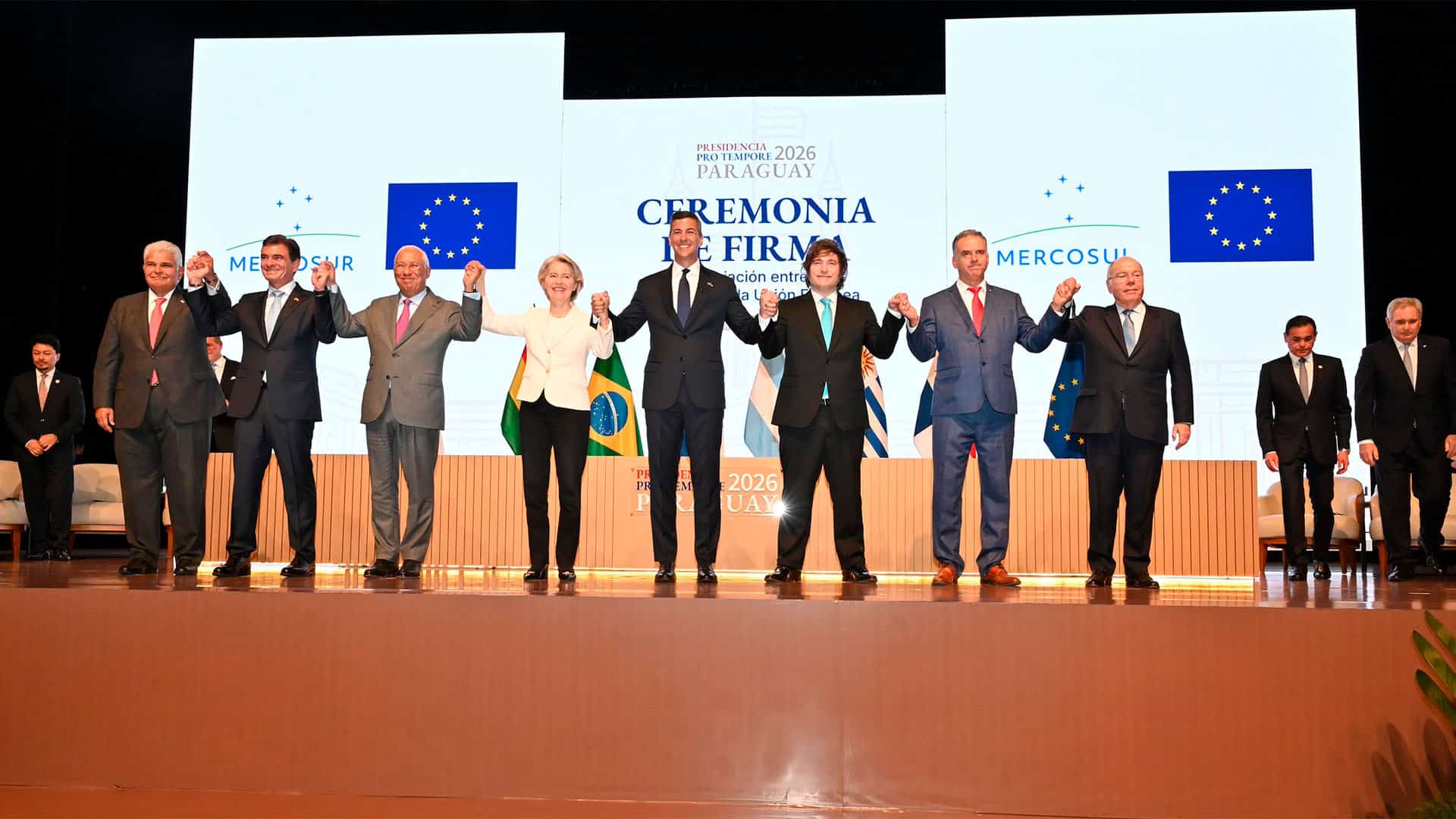


In Asunción, on Saturday 17 January, with Paraguay holding the pro tempore presidency of Mercosur and in the presence of Ursula von der Leyen, President of the European Commission, the official signing ceremony of the EU-Mercosur agreement finally took place.
For this reason, Saturday’s ceremony should not close with a ‘finally’, but open with a ‘what next?’
It is important to emphasise from the outset: signing does not mean entry into force. Rather, it opens another delicate phase of the process: ratification by the European Parliament and subsequent formal approval by the Council of the EU. All this is taking place amid internal political pressure in Europe and the mobilisation of the agricultural sector, visible in recent days in countries such as France and Spain. Once these stages are completed, the Interim Trade Agreement –an area of exclusive EU competence– will enter into force. The interim agreement will operate as a stand-alone text until the Association Agreement fully enters into force. The Association Agreement, in addition to its trade pillar, includes political dialogue and cooperation pillars and must be approved by the 27 national parliaments.
That said, the signing of the agreement is not just another stage in the diplomatic calendar. When viewed in perspective, it will mark a clear before and after, because behind the ceremonial formalities lies something deeper than a trade agreement: the role Europe wants to play in a world of geopolitical competition between major blocs, and the development model Latin America seeks to embrace to capitalise on its vast wealth of natural resources.
For this reason, the agreement should be read as a foundational decision. In a context of geopolitical rivalry, in which considerations of economic security and supply-chain resilience play a central role, Europe needs partners that offer scale, resources, affinity and reliability; and Mercosur needs investment, technology and stable access to a large market in order to upgrade and diversify its productive matrix and promote development grounded on a language of rights, environmental standards, decent work, social protection and multilateralism –all elements that form part of the aspirational agenda of most societies in the regional bloc–.
What the EU-Mercosur agreement is about
A common misunderstanding should be dispelled: EU-Mercosur is not just another trade agreement. It is a broad association agreement structured around three pillars: trade, political dialogue and cooperation –with geopolitical, economic, trade, regulatory and industrial policy implications–.
In terms of market access, the core is clear: the elimination of more than 90% of bilateral tariffs, accompanied by the reduction of non-tariff barriers and regulatory harmonisation. Mercosur, traditionally a protected market for European exports –with high tariffs on automobiles, machinery, chemicals and pharmaceuticals– will eliminate import duties on more than 91% of EU exports to the bloc (with longer phase-out periods for sensitive sectors). In turn, the EU will expand access to its market through a design that combines liberalisation, tariff-rate quotas and safeguards for particularly sensitive agricultural products.
The agreement also structures how contemporary trade operates: customs procedures and trade facilitation, rules of origin, technical barriers, sanitary and phytosanitary measures, and public procurement disciplines. In the latter area, opening public tenders in Mercosur countries to European companies on more equal terms could become an underutilised lever for infrastructure, digitalisation and energy transition projects.
There is also a dimension often overlooked in public debate: geographical indications (GIs). According to the European Commission, Mercosur will recognise 344 European geographical indications, strengthening the protection of products with specific origin and quality. Conversely, the agreement also protects around 220 Mercosur geographical indications. This consolidates high value-added trade and reduces the space for imitation.
Finally, there is the issue that today defines the political margin of any trade agreement: sustainability. The text integrates the Paris Agreement as an essential element of the relationship, incorporates commitments to combat deforestation and includes obligations linked to labour standards (ILO), as well as monitoring, participation and oversight mechanisms involving civil society. This chapter is accompanied by support instruments: the European Commission has proposed a reinforced cooperation fund worth €1.8 billion under the Global Gateway framework to support the green and digital transition.
In quantitative terms, the promise is also significant. Recent estimates suggest that, once implemented, the agreement could substantially increase bilateral trade flows –around 40%– with limited adverse effects on trade with other regions.
The agreement’s geopolitical and economic importance
In EU-Mercosur, geopolitics enter through the front door, in a space where three models compete: the US model, which views Latin America as a security perimeter; the Chinese model, which sees it as a source of strategic resources; and the European model, which conceives it as a strategic partner.
The EU is the largest investor in Latin America and the Caribbean, with a stock of foreign direct investment exceeding €810 billion, with Spain as one of its major corporate vectors. This investment presence –banking, telecommunications, infrastructure, services and renewable energy– is a strategic asset: it implies local knowledge, networks, employment and the capacity for productive transformation and multiplier effects.
The signing of the agreement also completes a normative architecture of a preferential EU presence. Once ratified, the EU will have a network of trade agreements in Latin America and the Caribbean covering around 95% of regional GDP, giving it a normative anchor and a density of ties far greater than that of other major actors. In parallel, EU-Mercosur trade already rests on a substantial base: €100 billion in goods trading and over €42 billion in services trading.
The agreement also reflects a complementarity few regions can offer today. Mercosur provides food, critical minerals and renewable energy essential for the green and digital transition; Europe, in turn, provides capital, technology and know-how to jointly develop clean bi-regional production chains –from critical minerals and renewable energy to batteries and electric vehicles, green hydrogen, decarbonised manufacturing and digital infrastructure– all under high environmental, labour and social standards.
The future: EU-Mercosur as a platform
The signing in Asunción should be read as a point of departure, not of arrival. The enormous potential of EU-Mercosur emerges when it is conceived as a platform for deeper integration between the EU and Latin America and the Caribbean (LAC), aimed at creating an integrated and dynamic bi-regional economic area.
The main obstacle, paradoxically, is not ideological but technical: the fragmentation of rules of origin across the different agreements already in force. Currently, it is often impossible to combine inputs from different Latin American countries or blocs that have bilateral agreements with the EU and with each other, while simultaneously maintaining a preferential access to the European market. Hence the importance of interconnecting existing agreements through a flexible diagonal cumulation that, without the need for renegotiation, makes it possible to ‘produce together’ and ‘export as one’ in all directions –across the Atlantic and within Latin America–.
If such an interconnection progresses, the horizon change scale: an EU-Latin America and Caribbean space of around 1.1 billion people and a GDP comparable to that of the US. In this logic, the EU-Mercosur agreement could be the first building block of a larger project that recent estimates suggest could significantly increase both bi-regional trade and intra-regional Latin American trade. The EU-Mercosur agreement not only opens markets, it opens the door to the future.
Conclusions
The signing of EU-Mercosur in Asunción on 17 January encapsulates more than a quarter century of negotiations and conveys two messages. First, that the EU can still conclude large-scale agreements in an adverse international environment and a hostile domestic climate, where normative ambition and sustainability become enablers of trade, investment, economic security and development. Secondly, Mercosur is committed to a demanding development model in terms of standards and institutional modernisation, grounded in a language of rights, environmental norms, decent work, social protection and multilateralism that forms part of the aspirational agenda of most societies in the bloc.
For this reason, Saturday’s ceremony should not close with a ‘finally’, but open with a ‘what next?’: ratification, effective implementation and a leap towards technical interoperability between existing agreements concerning the EU and Latin America and the Caribbean to create an integrated and dynamic bi-regional economic area.
If that step is taken, the photo-op in Asunción will not only be historic, it will be foundational.