
Key messages
- The capture of Nicolás Maduro marks a turning point that goes beyond Venezuela. The US operation not only abruptly changes Venezuela’s internal political balance; it also clearly exposes the structural tensions of today’s international system. Rather than engaging in a normative debate –legitimate and necessary– about the legality or legitimacy of the operation, this paper focuses on what the episode reveals about how central actors actually behave in a context of geopolitical competition, where power and strategic interests prevail.
- Donald Trump must be taken very seriously. Far from being erratic or merely reactive, the Trump Administration’s foreign policy follows an explicit prioritisation of national interests, clearly laid out in the National Security Strategy. The intervention in Venezuela fits that framework almost perfectly and was foreshadowed by it: a narco‑dictatorship, institutional and economic collapse, mass migration, the presence of hostile actors and abundant strategic resources.
- The US still needs a legal framing to exercise power. The Trump Administration does not act constrained by international law, but it deems it politically indispensable to package the unilateral use of force within a legal narrative. The legal basis does not explain the action; it is built after the fact to manage political costs, keep allies from breaking ranks and preserve the ability to challenge similar conduct by strategic rivals. The law thus operates less as a material constraint and more as an instrument for managing power.
- The operation entails an explicit return to Realpolitik. The sidelining of Venezuela’s democratic opposition and the willingness to bargain with the regime’s apparatus show that Washington’s priority is stability, control of strategic resources and geopolitical alignment –even at the cost of sacrificing the immediate restoration of popular sovereignty–. Venezuela is emerging as a client state of the US, where the democratic credentials of this circumstantial ‘partner’ are secondary to its strategic usefulness.
- The Latin American left defends principles selectively and loses credibility. While condemnation of the US unilateral action is to be expected, the joint statement by several left‑leaning governments of Latin America fail to clearly condemn Maduro’s regime and to recognise the government elected in 2024. This selective defence of principles –severe towards those they disagree with and lenient towards like‑minded regimes– undermines their moral authority and condemns them to irrelevance in an international system increasingly structured in blocs, where medium and small actors preserve autonomy only if they are consistent and predictable in defending norms.
- The EU’s response reflects a pragmatism consistent with its nature. The EU reaffirms international law while avoiding a direct confrontation with Washington, mindful of its military limitations and strategic dependence. Its main strategic asset remains its identity as a normative power. In a global order dominated by hard power, the EU’s most rational strategy is not to dilute but to reinforce –without ambiguity– its defence of rules, institutions and procedures that define its identity, underpin its internal cohesion and serve as its primary calling card to third parties. It is also the only credible basis from which it can rally intermediate powers and medium and small countries that see their security, prosperity and autonomy depending less on forced alignment with one bloc or another than on the effective vitality of institutions, norms and limits on the arbitrary use of power.
Analysis
A turning point in the Venezuelan crisis was reached on 3 January 2026. The US operation that led to the capture of Nicolás Maduro not only abruptly altered Venezuela’s internal political balance; it also sharply exposed some of the structural tensions that now run through the international system.
Beyond the valid and necessary normative debate on the legality and legitimacy of intervention, this article proposes a deliberately analytical exercise. Based on this episode, five key insights are offered that aim to understand not so much how international actors should behave, but how they are actually behaving. In other words, it is an analysis of the reality, rather than the ideal, of international relations in a context of competition between blocs.
1. Trump must be taken seriously
It is common to hear voices dismissing President Trump’s announcements as empty threats intended, at best, to strengthen his negotiating position, or to qualify his actions by arguing that he almost always backs down in the end (the famous TACO). Recent events in Venezuela show that this is a mistake.
The Venezuelan episode confirms that the Trump Administration’s foreign policy is neither erratic nor purely reactive; it responds to an explicit hierarchy of national interests defined in advance. Taking Trump seriously does not mean sharing his methods or objectives, but rather recognising that his international conduct is consistent with a worldview in which power, control of strategic resources, and direct deterrence prevail over normative considerations.
The National Security Strategy document published last November clearly sets out the objectives of US foreign policy:
‘The purpose of foreign policy is the protection of fundamental national interests; that is the sole purpose of this strategy (…) The affairs of other countries concern us only if their activities directly threaten our interests.’
And with respect to Latin America it states:
‘We want to ensure the Western Hemisphere remains reasonably stable and well governed enough to prevent and deter mass migration to the US; we want a hemisphere whose governments cooperate with us against narcoterrorists, cartels, and other transnational criminal organizations; we want a hemisphere that remains free of hostile foreign incursions or ownership of key assets, and that supports critical supply chains; and we want to ensure our continued access to key strategic locations.’
What has just happened in Venezuela follows that script to the letter and is a textbook example of the implementation of this strategy: a country with an illegitimate government that stole last year’s election and is not recognised by the major Western countries; a narco‑dictatorship that organises and facilitates drug trafficking and other illegal businesses; a regime that silences, imprisons and tortures political opponents and has impoverished its people, triggering mass outflows of migrants fleeing persecution, poverty and lack of prospects; a regime that provides cover and operational capabilities to terrorist groups such as Hezbollah and serves as a beachhead for China and Russia to project their influence in the region; and a country endowed with enormous oil wealth and mineral resources.
Trump must be taken seriously.
2. The US still regards a legal framework as essential to legitimate its actions
More than a substantive belief in the binding force of international law, the Venezuelan episode reveals something else: the US still considers it fundamental –politically and strategically– to wrap the use of power in legal language. Not because that shell decisively conditions the decision to act, but because it is part of how the Trump Administration wields power and communicates it.
The legal legitimacy invoked by the US is articulated, broadly, along the following lines: characterising Maduro’s detention as a law‑enforcement operation linked to criminal proceedings; denying him immunity due to lack of recognition as head of state; the absence of a Venezuelan authority capable of exercising effective jurisdiction; the lack of viable alternative means to capture and detain Maduro; and the limited, selective and proportional nature of the operation, presented as distinct from regime change or a sustained military intervention.
However, the operation against Nicolás Maduro is not explained by the existence of a prior legal foundation; the foundation is constructed after the fact to organise the narrative, reduce political costs and manage the consequences. The law thus operates less as a material constraint on power than as an instrument for managing it, allowing an exceptional action to be presented as compatible –however forcibly– with a formal normative order.
From this perspective, the effort to give legal standing to an essentially unilateral act is not aimed at convincing international jurists or satisfy a demanding normative standard. It is aimed, above all, at three specific audiences. First, the domestic audience: to avoid congressional scrutiny and minimise the risk of judicial challenges, consistent with the fact that Trump, even while testing the limits, has tended to comply with US court rulings. Secondly, allies: to offer them a minimum argument that makes it politically feasible not to break ranks with Washington. And third –perhaps most importantly–, strategic rivals: by building a legal narrative, even on shaky grounds, Washington seeks to preserve the balance between acting with discretion and not having to declare the total irrelevance of norms.
In this way it retains room to question –elsewhere– equivalent actions by China or Russia as illegitimate, even when in practical terms they respond to a similar logic. As Gideon Rachman has suggested, Moscow and Beijing can condemn Maduro’s fall while also arguing that it sets a precedent –for Taiwan or Ukraine– if the reading is that the great powers have abandoned any pretence of normative framing.
That the White House worries about the legal narrative, rather than limiting itself to an explicit logic of ‘I do it because I want to, because I can, and because this is my neighborhood’, does not reflect normative attachment. It reflects strategic calculation. And it is precisely that calculation –more than the legal content itself– that matters when assessing the likelihood of similar actions in other scenarios (Greenland, for example) and, more broadly, in understanding how the unwritten rules of competition among major blocs are being reconfigured.
3. Realpolitik reappears on stage
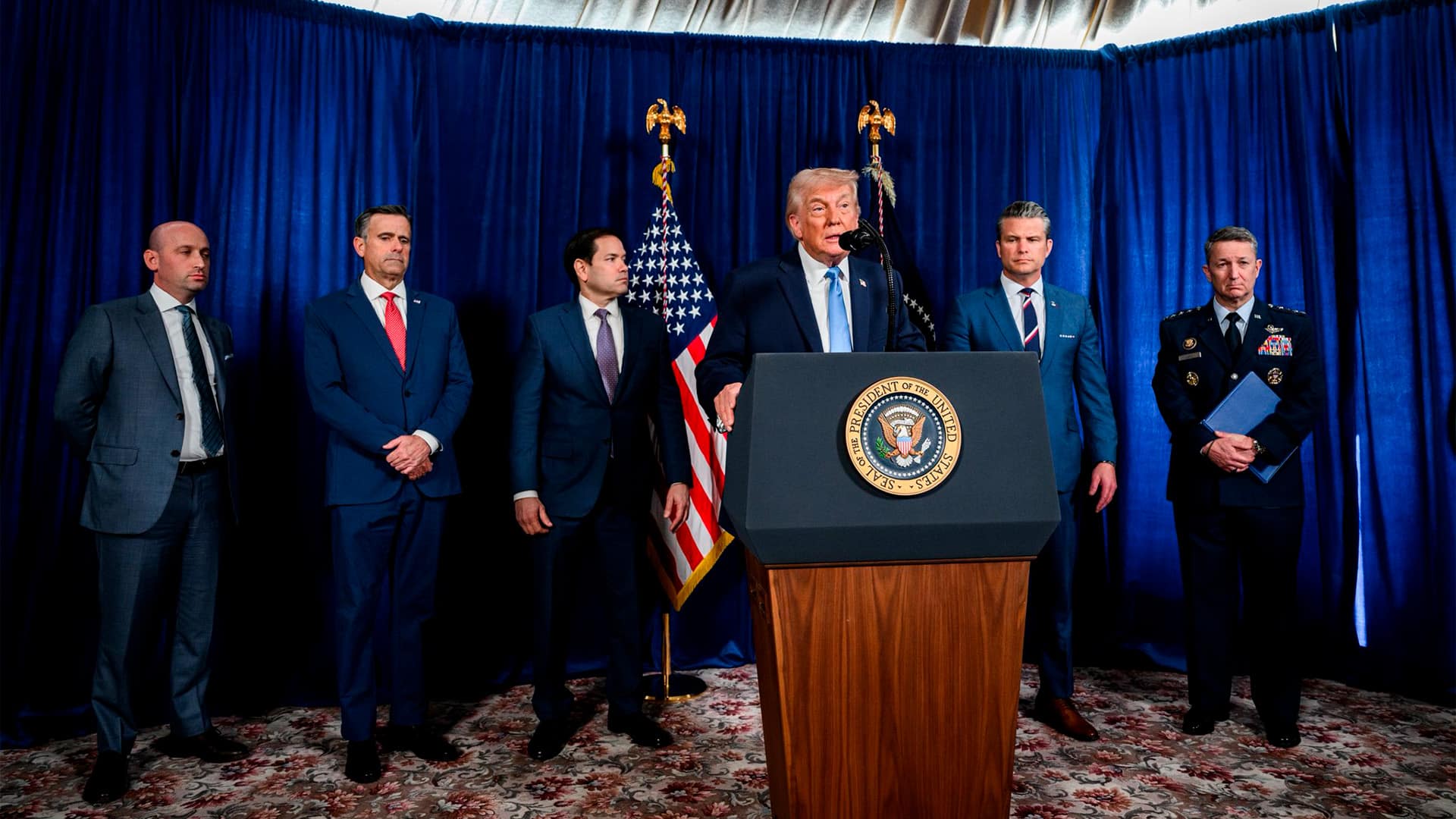
At the first press conference following Maduro’s capture, Trump dismissed María Corina Machado, leader of Venezuela’s democratic opposition and 2025 Nobel Peace Prize laureate, by stating explicitly that she ‘does not have the support or respect’ needed within Venezuela to govern. At the same time, he hinted at his willingness to reach an understanding with the regime’s apparatus insofar as it aligns with US strategic interests, beginning with control of oil resources.
Venezuela is thus headed towards becoming a kind of client state: one that does not fully exercise its sovereignty and is subject to external US supervision, direction and control. It is not a minor detail that Washington warned Diosdado Cabello, feared repressor and the regime’s number two, that he would be the next target if he does not cooperate in the transition and the maintenance of order after Maduro’s fall. In response, Delcy Rodríguez, Maduro’s Vice-president and acting President, has decided to surround herself with the regime’s hardest elements, while in official statements showing a willingness to work jointly with the US, especially on trade. It is not obvious that a marriage conceived in this way will end well. But it is clearly the Trump Administration’s bet.
The dismissal of María Corina was unfair and, if I may say so, even cruel to a woman who is not only representative of the aspirations of most Venezuelans but also extraordinarily brave. But it was deliberate. And it dealt an almost definitive blow to the expectation that this operation would immediately restore sovereignty to the Venezuelan people by installing in power the elected officials who won the 2024 election by a wide margin –an outcome Maduro chose to deny–.
The Trump Administration argues that the goal is to avoid a power vacuum in Venezuela by keeping those who control the state security apparatus in charge, thereby preventing the violence and anarchy that erupted after Saddam Hussein’s fall. Moreover, as Secretary of State Marco Rubio announced when presenting the Trump Administration’s plan for Venezuela to senators in Congress, this bargaining stage with the regime is conceived as the first phase of a sequence: first, stabilisation (especially economic); then recovery, with an emphasis on national reconciliation; and, finally, transition and normalisation towards holding elections. In the process, the US would retain indefinite control of oil.
It would be premature to assume that this will inevitably be the natural sequence of events. In the cold logic of a context in which the dominant blocs prioritise geopolitical alignments, regional stability, access to critical energy and minerals, control of routes, immigration and terrorism, and counterbalancing the influence of strategic rivals, alliances with ‘politically toxic’ partners will become increasingly frequent if they deliver critical capabilities. And the promotion of democracy and human rights as a universal and absolute value –even when applied with cracks and exceptions– will no longer be the guiding principle.
Striking a deal with Venezuela’s regime and keeping it in place is a return to Realpolitik, where the moral quality of the occasional ally is secondary if it contributes to strategic goals. The phrase attributed to Franklin D. Roosevelt regarding the Nicaraguan dictator Anastasio Somoza –‘He is a son of a bitch, but he is our son of a bitch’– serves as a rhetorical shortcut, in vulgar but precise language, to describe a doctrine that prioritises strategic ends over normative affinity.
4. Latin America’s left clings to principles, selectively
It is not surprising that Latin American governments on the right of the ideological spectrum have aligned, to varying degrees, with the Trump Administration, prioritising the fall of an authoritarian and criminal regime over a rigorous reflection on respect for international law and the legitimacy of unilateral US action. That position is consistent with their prior diagnosis of the Venezuelan regime and with their strategic alignment with Washington.
Nor is it surprising that left‑leaning governments have condemned the intervention. What is striking is the tone, content and, above all, the omissions of the joint communiqué issued by Brazil, Mexico, Colombia, Chile and Uruguay. As expected, the text expresses ‘deep concern and rejection of the military actions executed unilaterally on Venezuelan territory, which contravene fundamental principles of international law’, reaffirms that ‘the situation in Venezuela must be resolved exclusively by peaceful means, through dialogue, negotiation, and respect for the will of the Venezuelan people’, and warns against ‘any attempt at external control, administration, or appropriation of natural or strategic resources’.
However, if the intention was to maintain a principled position, the communiqué fails precisely where it mattered most. First, it avoids clearly and unequivocally condemning Nicolás Maduro’s regime, which bears ultimate responsibility for the country’s institutional, humanitarian and economic collapse. Secondly, it avoids recognising the legitimately elected government in 2024, whose victory was widely documented. These omissions are not minor: they undermine the moral authority of the critique.
Defending principles selectively –condemning violations of international law forcefully when the actor is an ideologically distant power, while downplaying or silencing systematic violations of human rights and democratic order when committed by an ideologically aligned regime– condemns these countries to strategic irrelevance. In an international system increasingly structured in blocs, medium and small actors preserve autonomy only if they are coherent and predictable in their defence of norms.
5. The EU’s response reflects pragmatism consistent with its identity
The EU’s response is, in fact, the only one that can be expected from an actor of its nature, capabilities and limitations. Among the major blocs, the EU is the one that has most explicitly built its strategic identity as a normative power: an integration project whose legitimacy derives from defending an international order based on institutions, rules and procedures, rather than the unilateral use of force. That vocation is the core of its internal cohesion and its principal calling card towards third parties.
At the same time, the EU is a major economic actor, comparable in size to China. But it lacks military autonomy and is not positioned at the vanguard of the technological frontier. In both domains it depends heavily on the US. This structural asymmetry constrains its room for manoeuvre: it can hardly sustain on its own a strategy of hard confrontation with Washington without paying a significant price.
It is in that context that the statement of the High Representative for Foreign Affairs and Security Policy should be read. On the one hand, it urges respect for the principles of international law and the UN Charter; on the other, it avoids explicitly condemning the Trump Administration for its actions in Venezuela. At the same time, it tries to remain consistent with Europe’s normative vocation: it declares that Nicolás Maduro lacks the legitimacy of a democratically-elected president, stresses the priority of fighting transnational organised crime and drug trafficking, and calls for respecting the will of the Venezuelan people as a condition for restoring democracy and resolving the crisis.
It may be frustrating that the EU is not more emphatic or confrontational. However, in an international system increasingly structured in blocs and dominated by hard‑power logics, the EU cannot –and does not intend to– behave as a revisionist power. Its influence does not rest on military coercion or technological dependence, but on its capacity to articulate consensus, set standards, offer predictability and keep open the space of international legality as a foothold for third parties.
Precisely for that reason, the most rational strategy for the EU is not to dilute its profile but to reinforce it. Championing –without ambiguity– the defence of a rules‑based order is its main strategic asset. It is also the only credible basis from which it can rally intermediate powers and medium and small countries that perceive their security, prosperity and autonomy as depending less on forced alignment with one bloc or another than on the effective vitality of institutions, norms and limits on the arbitrary use of power.
Conclusions
What has happened in Venezuela is not an isolated episode or a temporary anomaly, but rather a privileged window through which to observe the reconfiguration of power and international relations. Nicolás Maduro’s capture starkly reveals how, in a context of competition between blocs, the exercise of power is once again being organised around hierarchies and strategic interests, rather than consistently applied universal principles. International law does not disappear, but it is instrumentalised; democracy is not rhetorically abandoned, but it is subordinated; and the normative coherence of actors such as the EU, as well as other medium and small actors, becomes a scarce but decisive asset for preserving autonomy and relevance.
In this context, Venezuela is no longer just another episode in President Trump’s journey, but rather a test case for a global order in transition, where Realpolitik is making a comeback without any reservations and the rules are adapted to power, rather than power to the rules. For Europe and Latin America, the challenge is not to choose between normative naivety and strategic cynicism, but to understand that the credible defence of principles requires consistency and awareness of our own capabilities. The signing of the EU-Mercosur agreement, just days after the intervention in Venezuela and 25 years after negotiations began –completed despite strong internal opposition within the EU, not least from France– is the crown jewel of that strategy.