

Key messages
- While there is consensus on the need to accelerate the EU-India strategic partnership and bring it to new levels, there are competing issues that must be addressed for the partnership to evolve.
- The current global competition between the US and China is pushing Brussels and New Delhi to seek partners to help reduce their reliance on these great powers, while simultaneously balancing their respective bilateral relationships with Washington and Beijing.
- The EU has a pivotal role in advancing and leading global governance reform to improve its credibility in the Global South. It thus needs to match rhetoric with action, not just with India, but also with other partners in Asia, to foster cooperative trade frameworks and enhance infrastructure to ensure open and secure trade routes.
Analysis
Introduction
In this second contribution by young scholars, we explore the bilateral relationship between the EU and India in a shifting global context. For the EU, the fragmentation of the liberal international order (LIO) and Russia’s invasion of Ukraine are crucial turning points that force it to re-evaluate its international role. India, in turn, prioritises its strategic autonomy to safeguard its interests, foster development and consolidate as a global actor.
The intensification of the US-China great power competition (GPC) is generating a less cooperative, more fragmented and conflict-prone environment, marked by resurgent nationalism and zero-sum dynamics that damage the interests of middle powers. The US no longer serves as a guarantor of democracy, the rule of law, open trade and institutionalised multilateralism, as it is increasingly perceived as unreliable and unpredictable by both the EU and India. The weaponisation of economic interdependence and of technological innovation further damages trust, making international relations increasingly transactional.
It is in this context that the EU and India seek to uphold multilateralism, economic openness and cooperation. The EU is an economic powerhouse, with an attractive single market, while India, home to a sixth of humanity, is poised to become the world’s third-largest economy, with sustained robust growth and offering a vast market. Both actors are set to defend the very elements that underpin the principles of their success, with a special focus on economic security and supply-chain resilience.
The following contribution addresses critical aspects of the partnership, from the challenges to security and trade-related infrastructure as a means to mitigate the GPC dynamics, to long-term implications of EU-India cooperation for governance and norms in European countries in the global scenario, as well as the challenge of reforming global governance to make it more inclusive of countries in the Global South. For that, the EU would have to articulate a proactive global role, engaging India and other partners on equal terms to promote a more equitable international order.
Four challenges to EU-India relations
The relationship between the EU and India has been a long-standing one and is based on a broad array of factors. Recently, interest in the relationship has increased as India is aspiring to acquire an enhanced role in global trade, keen to deepen the ties with the EU. Such an effort would take place (also) through the India-Middle East-Europe Economic Corridor (IMEC), starting from Indian ports and arriving to one or more European ones. Nevertheless, there are a number of –also recent– challenges, that put potential obstacles in the way of the EU-India relationship, and the present analysis aims to discuss them.
As IMEC is a corridor that aims to develop the trade relations between the EU and India, the first pillar of this paper revolves around trade. The EU and India have been trying to negotiate and sign the so-called Broad-based Trade and Investment Agreement (BTIA) for some time now, but disputes over market access, trade standards and regulatory concerns have jeopardised the process. Furthermore, in 2025 the European Parliament highlighted several developments that might act negatively in the EU’s relations with India: first, the strengthening of the relation between India and the US, with an ongoing negotiation on an India-US Bilateral Trade Agreement (intended to be adopted by the end of 2025) that has created more frustration over the deadlocked EU-India BTIA. Moreover, the verbal intention of the IMEC’s final destination being the US –despite the complex logistics this would need– can possibly create tensions between the EU and its counterparts. Secondly, the closer-than-comfortable relations between India and Russia have also caused concerns and debate in the EU, as deeper trade relations are expected to be taking place between the two countries. Additionally, the EU is also worried about India’s stance against the Russian invasion of the Ukraine. India has been abstaining in votes against Russian aggression in the UN, confirming, in a way, the growing cooperation between the two countries. Nevertheless, the concerns of the European Parliament might be obsolete already, as the US imposed 50% tariffs on several Indian products in late August 2025, further linking this decision to India’s purchase of Russian oil. Commentators noted that ‘President Trump evidently does not value India as a partner in balancing China as much as the previous presidents’. This situation also creates uncertainty for EU-Indian relations.
The second challenge is their diverging perspective on how the multipolar world should work. In this instance, India appears to have a more revisionist stance, claiming that the UN and other international institutions need to be reformed and democratised further, in order for India –and possibly others– to play a more active role. In contrast, the EU promotes a rules-based world order within existing frameworks, not wanting to engage in a discussion that would create tensions both within and outside the EU.[1]
The third point of potential contention that is discussed regularly in the EU is the level of protection of human rights in India and, by extension, of the operation of its democratic system. Situations such as the one in Manipur or policies against Muslims, Christians and other minorities, as well as some restrictions imposed on the rights to freedom of expression and peaceful protests have led to unease between the two players.
India currently attempts to develop trade relations with all possible actors, with one of its main goals being to become a developed economy by 2047. In this context, India has understood that the EU is one of the biggest trade players in the world, as it imports a large amount of goods. Thus, India is interested in entering the European markets in order to gain at least a fair share of its imports (mostly against China) and is exploring its potential opportunities. With that, a fourth challenge arises, which has to do with India’s climate policy, which is not compatible with the goals under the Paris Agreement. Although India is extensively using renewable energy, independent research (Climate Action Tracker) shows that the efforts to achieve the net zero target of greenhouse gas emission by 2070 that India has pledged to is highly insufficient, due to the extensive use of coal plants to cover its sizable energy needs.
As the EU is finding an increasingly greater difficulty (due to several key aspects of its identity-led characteristics taking a second seat at the global level), India is pursuing a more active role globally. The latter, using the multipolarity that the current system allows, is looking for willing actors to collaborate, and the EU will need to make some difficult choices if it wishes to enjoy the fruits of a new (economic/trade) cooperation. As India will gain a greater share of world trade and the EU will continue to be one of the biggest importers of goods globally, the EU’s needs will possibly lead –once more– to the jeopardising of its stance regarding what it preaches and what it actually does. For example, the EU will accept goods manufactured in India, regardless of the latter’s performance in fields such as climate change or human rights. Thus, although –at least for the time being– there seem to be mixed feelings in the EU bubble towards India, connectivity becomes more and more abstract today, allowing a fluid cooperation that serves à la carte interests.
The EU’s engagement with India and the Brussels-Washington-Beijing triangle
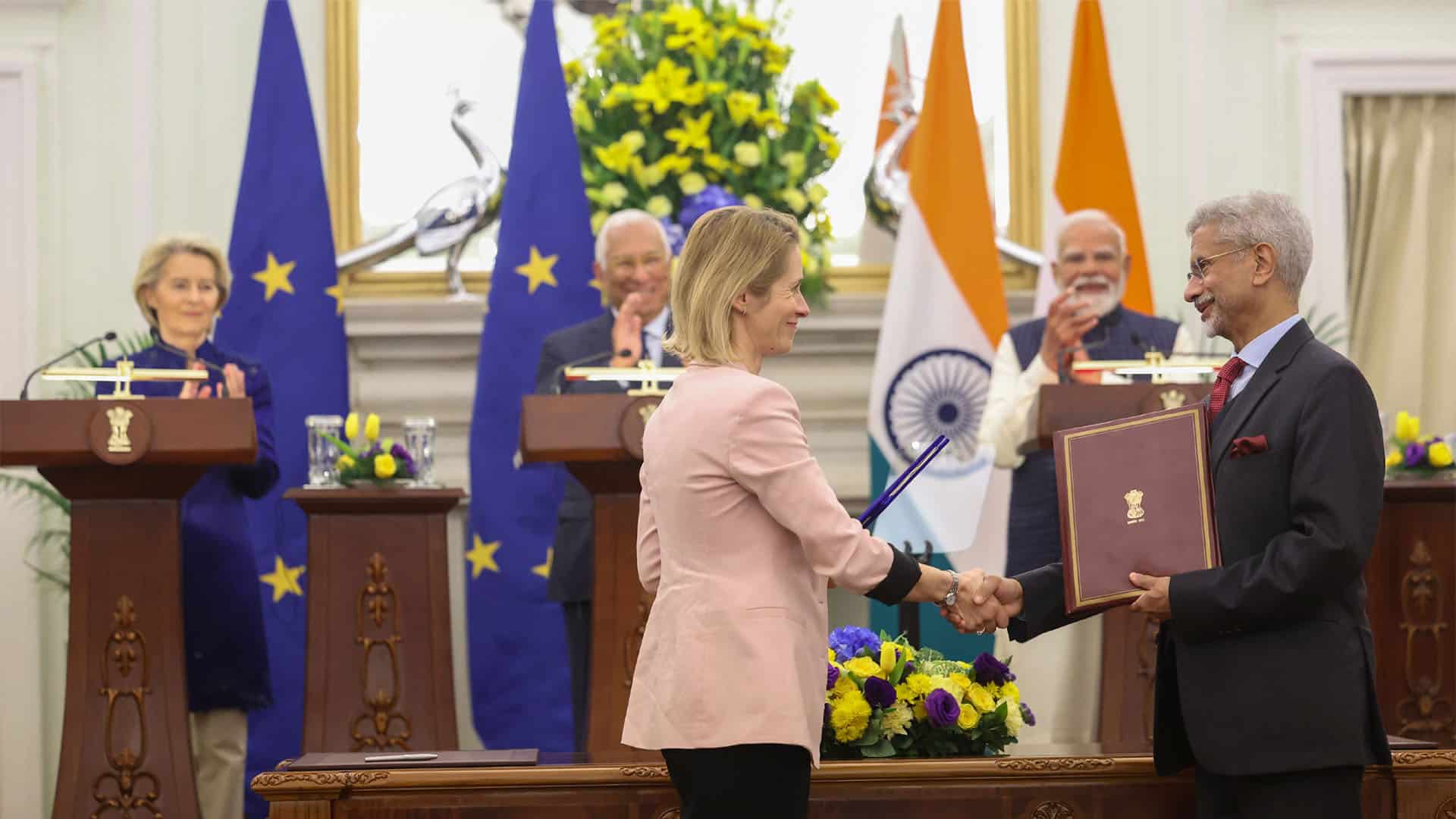
On 17 September 2025 the European External Action Service published its Joint Communication on a New EU-India Agenda. The document, which follows European Commission President Ursula von der Leyen’s visit to New Delhi in February 2025, charts the way forward in the relations between the two sides, following the conclusion of the previous Roadmap to 2025 launched in 2020. This joint communication outlines a five-pillar framework to ‘raise the strategic partnership to a higher level’, beyond the current negotiations over bilateral agreements on free trade, investment protection and geographical indications, which started in 2022 and are now expected to be completed by the end of the year. The five pillars are ‘prosperity and sustainability’, ‘technology and innovation’, ‘security and defence’, ‘connectivity and global issues’ and a cross-domain area deemed to be ‘enablers across pillars’.
The ongoing negotiations over a new framework for EU-India relations are inevitably tied to the EU’s own increasingly complex geopolitical environment and geo-economic position in the aftermath of the return to power of Donald Trump in the US. The trade war unleashed by the White House on 2 April has ultimately resulted in a ‘bad deal’ for which the EU has been criticised because of its restrained approach in negotiations with Washington, although some estimates of the impact to the union’s GDP amount to a very manageable -0.13%.
In fact, more than the economic impact of the trade war itself, it is the compounding impact of the Trump Administration’s adversarial approach against the EU that has led to the perception of a ‘twilight’ in transatlantic relations, as well as to a new round of debates on the meaning, direction and feasibility of the Union’s ‘strategic autonomy’. As a corollary to the fraying of ties with the US, there have been calls to reset relations with China in order to rebalance transatlantic relations. Such calls, however, clash with the persistence of national and regime security drivers that continue to shape China’s industrial policies and their negative implications for Europe. They also clash with Beijing’s own broader geopolitical calculations, which motivate its benevolent neutrality towards Russia in the context of its war of aggression against Ukraine.
Against such a backdrop, there is ample room for a significant geo-economic convergence between the EU and India. Both sides need to re-evaluate their relations with the US under Trump, remain concerned over structural dependencies from China and their security implications, and maintain interests in enhancing connectivity, including through the proposed India-Middle East-Europe Corridor, even though New Delhi’s relations with Russia remain a problem for Europe.
Noticeably, this transitional moment in EU-India relations provides in turn an opportunity for actors –operating both within and outside EU institutions– who argue for tying progress in the negotiations for the bilateral free trade agreement and the corollary accords to a concrete shift in the domestic trends miring Indian politics over the past decade. These trends are well known: the weakening of the rule of law, the rise of digital authoritarianism at home and of transnational repression abroad, as well as contentious policies inflaming ethno-religious divides in areas such as Jammu and Kashmir and Manipur. However, what is missing is the political will to do so in Brussels. Simply put, caught in a geopolitical triangle with the US and China, and pressed by Russian imperialism at its doorstep, delusions about the EU’s capacity to fundamentally change the behaviour of the Indian government and its ruling party, the BJP, should be dispensed with.
But is there a way forward to avoid a complete separation of ‘politics’ and ‘economics’ for the EU in its relationship with India? A minimalist agenda could focus on tying current negotiations to some form of Indian guarantees that New Delhi would refrain from exerting transnational repression targeting diasporas within EU Member States. This is particularly relevant because, while transnational repression has so far primarily targeted English-speaking countries, increasing migration flows from India to Europe will likely render this issue more topical in the coming years. At a broader level, Brussels may search for guarantees that New Delhi would also refrain from operations in the EU information environment, in particular when it comes to what the EU defines as Foreign Information Manipulation and Interference (FIMI), a conceptualisation of threats in the information domain that has replaced the more widely known concept of ‘disinformation’. More ambitiously, Brussels could also aim to make use of negotiations to partially rein in some of the more blatantly anti-Western elements of its political communication over the War in Ukraine, given the EU’s continuing difficulties in making its voice heard in the so-called Global South on this issue.
Navigating multipolarity: the EU-India partnership and the reform of global governance
The EU faces a dual test of credibility and effectiveness: the urgent need to reform the multilateral governance system and the parallel imperative to restore its legitimacy in the eyes of the Global South. Crucially, efforts to reinvigorate global governance will fall short unless legitimacy is meaningfully addressed. While the EU’s 2021 strategy on strengthening multilateralism set out a pragmatic vision, engagement with the Global South was notably absent. Since then, awareness has grown within the EU of the need to ‘win back’ the trust of its partners in the Global South.
Strengthened ties with India offer a concrete opportunity for the EU to demonstrate its commitment and capacity to move beyond rhetorical ambitions and promote a more inclusive global order. EU officials have described the EU’s relationship with India as having the potential to be ‘one of the defining partnerships of this Century’ that can help Europe ‘save multilateralism’. Yet a more measured and realistic assessment is now taking shape in Brussels. The EU openly recognises that there are ‘clear areas of disagreement’ with India but the New Strategic EU-India Agenda underlines that even without full alignment, there remains ample room for constructive and mutually beneficial cooperation.
Similarly, for India, cooperation with Europe fits within its multi-alignment strategy, contributes to de-risk its foreign policy and provides an agility to respond to geopolitical pressures. Hence, with a shared interests in making the partnership more active in global affairs, and a stronger institutional framework to support it, EU-India cooperation provides a timely platform to translate convergence in security, connectivity and UN institutional reform into concrete outcomes beyond the bilateral level.
Both sides have expressed an interest in trilateral cooperation projects in the Indo-Pacific. The EU’s Indo-Pacific strategy recognises the region’s importance for the governance of the maritime and digital domains. The potential conclusion of the EU-India Security and Defence Partnership could help consolidate bilateral initiatives and project them onto a broader stage. Maritime security stands out as a shared priority, with the Indian Ocean being a strategic focus for both sides. The EU has taken several steps to strengthen its involvement in regional frameworks, and there is a potential for more, while India’s role is pivotal as the host of the Information Fusion Centre (IFC), and a priority partner in the EU’s Enhanced Security Cooperation in and with Asia (ESIWA) project and its successor, ESIWA+. The latter offers a solid base for expanding joint efforts as it is explicitly geared towards advancing discussions on global governance and has already served as a platform for trilateral cooperation with other countries in the region, such as Australia or Japan.
Beyond the maritime domain, the EU and India are also expanding their cooperation in emerging areas of governance, which are central to ESIWA+. They maintain an established conversation on cybersecurity, and they have committed to launch another dialogue on space security. Both actors are increasingly visible in global debates on the governance of these domains, with a shared focus in capacity-building and cooperation in multilateral forums. While their views may not always align, engagement in these areas can strengthen each other’s understanding of their strategic priorities and worldview.
The New Strategic EU-India Agenda also builds on the Connectivity Partnership while the Trade and Technology Council (TTC) also offers complementary frameworks for advancing digital and development priorities. Under the TTC, both sides are working on the interoperability of their respective digital public infrastructures and to develop solutions tailored to the needs of developing countries. ASEAN, with which the EU has a long-standing cooperation on connectivity, has encouraged India to support its Master Plan on ASEAN Connectivity. These efforts would align with the EU’s ambition to deepen its development partnership with India in third countries.
Beyond the regional level, both the EU and India share an interest in multilateral reforms and converge in their calls to improve the efficiency, transparency and coherence of the UN. This includes support for the revitalisation of the UN General Assembly and the reform of the UN Security Council, particularly by improving access to information about Council deliberations and enhancing the presence of under-represented regions, notably Africa. Both actors share the view that UN efforts in peace and development should be strengthened, particularly through a better-resourced and more strategic role for the Resident Coordinators, along with improved oversight and accountability in the UN’s financial operations.
Similarly, both actors consider that the Peacebuilding Commission (PBC) should be equipped with adequate resources to ensure the sustainability of UN efforts. This shared understanding can facilitate the EU’s aims to enhance its engagement with the PBC, where India has maintained a consistent and influential presence. Both were actively involved in the 2025 Peacebuilding Architecture Review (PBAR) and have the potential to play a more coordinated role within the 2026 review of the Economic and Social Council (ECOSOC), which the EU has identified as a key opportunity for reform and in which India will serve as a member during this period.
In short, the EU sees effective multilateralism as contingent on three parallel tasks: reinforcing what works, reforming what does not work and extending global governance to new areas. While it is important not to overstate the degree of convergence and the extent to which it can translate into substantive collaboration, there is nonetheless potential for cooperation with India across all three dimensions.
Conclusions
Shared challenges have accelerated the EU-India strategic partnership, despite its slow start in 2004. As economic and security interests grow increasingly intertwined, both actors will have to, at some point, confront persisting normative divergences in global governance, whether concerning reforms or rules of international institutions, regulatory frameworks, or the implications of their respective relationships with Russia, the US and China. Failure to address the persisting issues highlighted in these two papers risks perpetuating the bilateral relationship’s underperformance.
For the EU, securing India’s alignment will require a genuine commitment to reforming the international order. Understanding that New Delhi will not support a system that denies equal power or representation is essential to temper expectations of its role as a partner. The same extends to third parties and calls for a renewed way of engaging globally: one that moves beyond (already outdated) blocs or alliances towards flexible coalitions of the willing, centred on shared priorities.
[1] Some recent developments due to ongoing wars in the Western hemisphere came to light, according to a statement by the EU Ambassador to the UN: he said that the EU supports a ‘reform of the UN Security Council to make it more effective […]’ and give voice to ‘underrepresented regions, especially Africa’. Nevertheless, according to the European External Action Service website, the EU remains a supporter of a multipolar system based on international law and the protection of human rights; within this framework, it supports the ‘UN80 initiative’ of the UN Secretary General, which is a holistic approach to broader UN reforms for the coming decades.