
Key messages
- This paper analyses the content of the global governance model put forward by Xi Jinping, highlighting both its more attractive and its more problematic aspects.
- It also examines the possible ways to approach this model, which is neo-Westphalian in nature and liberal in narrative, in a context characterised by more explicit and direct threats to the liberal international order.
- Rather than roundly rejecting or ignoring Chinese initiatives to reform the current international architecture, it is proposed that they could be seized as an opportunity to build a more inclusive and effective global order.
- To this end it is suggested that the focus should be placed on the appropriateness of the terminology they use and on the values upon which they rest, while the Chinese leadership is at the same time urged to devise a foreign policy consistent with its own narratives. This could facilitate the EU’s coordination with the bulk of Global South countries that yearn for the strengthening of the multilateral rules-based international order.
Analysis
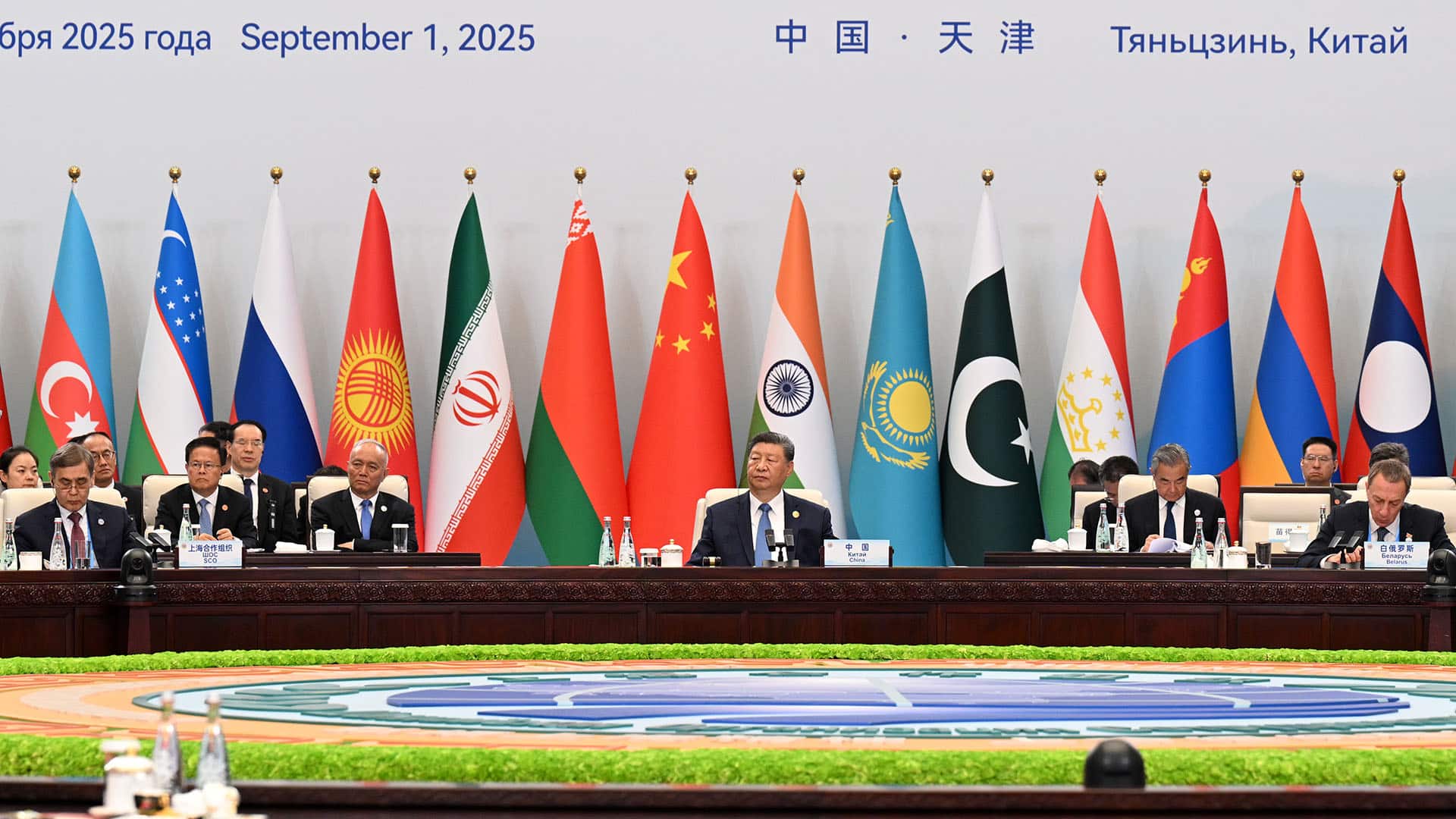
As if the Global Governance Initiative, unveiled by Xi Jinping on 1 September 2025, were not sufficiently important in itself, the setting at which it was announced, the enlarged summit of the Shanghai Cooperation Organisation (SCO), calls for serious consideration of its implications for the international order, particularly for the EU and Spain. The meeting held in Tianjin, the largest in the history of the SCO, brought together 24 heads of state and government –among them the Indian Prime Minister, Narendra Modi, absent from China since before the pandemic– as well as leaders of international organisations, including the UN Secretary General, António Guterres. Just two days later, Xi was joined by Vladimir Putin and Kim Jong-un to review the military parade in Beijing for the 80th anniversary of the Japanese surrender and the end of the Second World War, an exhibition of the Chinese arsenal and its alignment with two leaders involved in the war of aggression in Europe.
These initiatives illustrate the application of the great-power foreign policy with which Xi cast off the ‘low-profile’ approach of Deng Xiaoping’s diplomacy, opting instead for an assertive activism geared towards placing China at the centre of the international stage. At the 19th National Congress (2017), Xi announced a roadmap that combines material and regulatory ambition: turning China into a ‘developed country’ by 2035 and into a ‘first-order power’ with a ‘world-class army’ by 2050, while simultaneously increasing its influence in global governance and promoting China as a supplier of global public goods. This attitude, more proactive and self-confident than its predecessors, is rooted in the spectacular rise of China’s economic, technological and military capabilities and in its interpretation of the international dynamic, characterised by the decline of the West and the rise of the East and the Global South.
The ideological substrate of this re-emergent China is twofold and sets it apart from that of a classic revisionist power. First, the Chinese authorities recognise the benefits of the prevailing international order for their country, which should contribute to global public goods (climate, peace and trade). Secondly, they believe that certain aspects of the liberal order, such as the active promotion of democracy, the encroachment on a country’s national sovereignty in the name of defending human rights and the imposition of unilateral sanctions, threaten the stability of the Chinese Communist Party (CCP) regime and justify a Westphalian reform agenda of the international rules that strengthen the sovereignty of states and respect for political regimes that are not liberal democracies. Hence the criticism of Western over-representation in such institutions as the International Monetary Fund (IMF) and the World Bank and support for a recalibration that gives greater voice to the ‘Global South’.
By way of a framework, since 2021 Chinese diplomats have set out a package of ‘global governance’ initiatives that seek to rearrange agendas and principles in accordance with their preferences: the Global Development Initiative, the Global Security Initiative, the Global Civilisation Initiative, the Global AI Governance Initiative and the Global Governance Initiative.
Figure 1. Main global governance initiatives launched under Xi Jinping
| Initiative | Date | Event/venue |
|---|---|---|
| Global Development Initiative | 21/IX/2021 | General debate at the 76th regular sessions of the UN General Assembly (New York, speech by video link) |
| Global Security Initiative | 21/IV/2022 | Boao Forum for Asia, opening ceremony (Boao) |
| Global Civilisation Initiative | 15/III/2023 | High-level dialogue between the CCP and the world’s political parties (Beijing, intervention by video conference) |
| Global AI Governance Initiative | 18/X/2023 | Opening ceremony of the 3rd Belt and Road Forum for International Cooperation (Beijing) |
| Global Governance Initiative | 1/IX/2025 | Enlarged summit of the Shanghai Cooperation Organisation (Tianjin) |
This narrative is accompanied by practical evidence of being a ‘responsible power’, as exhibited at the UN General Assembly’s most recent cycle of sessions, where China announced its intention to renounce its status as a developing country at the World Trade Organisation (WTO) and a reduction in its greenhouse gas emissions of 7%-10% between now and 2035. This effort to present itself as a guarantor of global public goods is especially beneficial for Chinese diplomacy thanks to Donald Trump’s explicit rejection of multilateralism and the rules-based international order.
In a forthcoming article to be published in International Organization (‘Further back to the future: neo-royalism, the Trump Administration, and the emerging international system’), Stacie Goddard and Abraham Newman describe the Trump Administration’s modus operandi as ‘neo-royalism’, which could give rise to a ‘neo-courtesan’ international order. Such an order would not be founded on either states or institutions, but rather on personalistic entourages, closed networks of political, and economic and military elites that revolve around leaders who perceive themselves as absolute sovereigns. This neo-courtesan paradigm is the antithesis of liberalism, since it advocates arbitrariness and hierarchy as the guiding principles of the system, as opposed to equality before the law, institutional predictability and the legitimacy stemming from the universal rules underpinning the liberal order. In such an international scenario, so removed from the ideal liberal order, which faces more explicit and radical challenges than the global governance model being proposed by Beijing, it is essential to adopt more sophisticated interpretive approaches to this foreign policy initiative than a simple outright rejection.
1. A governance framework weaned on the Global South
The global governance initiatives announced by Beijing since 2021 are an updated version of the anti-hegemon rhetoric that the People’s Republic of China, like many countries in the Global South, has been articulating with varying degrees of intensity since its foundation. This fragment of a speech Xi used to launch the Global Civilisation initiative serves as an example:
‘We firmly oppose hegemony and power politics in all their forms. We advocate solidarity and a win-win mentality in handling complex and intertwined security challenges to set up a fair and just security architecture that is built and shared by all. The world does not need a new Cold War. The practice of stoking division and confrontation in the name of democracy is in itself a violation of the spirit of democracy. It will not receive any support. What it brings is only endless harm. A modernised China will strengthen the force for world peace and international justice. No matter what level of development China achieves, it will never seek hegemony or expansion.’
Speaking in Bandung (1955), Zhou Enlai identified China with the emerging ‘Third World’ and emphasised how the colonial powers’ economic and political control had subjected Asia and Africa to under-development and suppression, anchoring China’s international outlook to an explicitly anti-imperialist and non-aligned ideology. This manifested itself in ‘five principles of peaceful coexistence’: (a) sovereignty and territorial integrity; (b) non-interference; (c) equality; (d) mutual benefit; and (e) peaceful coexistence. These principles continue to form the normative bedrock of China’s foreign policy. In 1964 Zhou also set out the eight guiding principles of Chinese international aid (low interest rates, equal treatment, etc), which it used to present itself as an alternative and supposedly more attractive partner than the traditional powers. The echo of these normative principles continues to be heard in China’s foreign policy and goes down well beyond its borders, especially among those Global South countries with which it does not have territorial disputes. There are various reasons that account for this strategy.
First, there are reasons of principle: China’s emphasis on non-interference and recognition of the various trajectories modernisation takes provides an alternative narrative to liberal institutions’ lists of political and economic conditions, especially prevalent after the end of the Cold War. In contrast to a liberal architecture perceived as hierarchical and determining, Beijing presents itself as a promotor of a more plural and inclusive order, based on states’ autonomy and the non-imposition of political or economic models. This message resounds forcefully among people of a decidedly anti-imperialist hue and proves especially attractive to authoritarian political elites whose political models are rejected on democratic grounds. Secondly, there are instrumental reasons. China offers financing, investments and security cooperation that come less constrained by governance and human-rights standards, thereby providing elites seeking to strengthen their domestic autonomy with room to manoeuvre. Thirdly, there are strategic reasons. Strengthening ties with Beijing enables other countries to diversify their dependencies not only on the West but also on regional hegemonic actors and broaden their access to markets, technology and vaccines, as became evident during the pandemic. This third factor is especially significant when the US is withdrawing from many parts of the Global South and the EU either has no presence or is not expected to appear in multiple sectors and countries.
2. What is the content of these initiatives?
These five initiatives –Global Development, Global Security, Global Civilisation, Artificial Intelligence (AI) Governance and Global Governance– form a coherent, systematic programme that seeks to express a comprehensive vision of the international order using four vectors: development, security, values/identities and norms/institutions. Although each text issues from distinct contexts and needs, they share the same language, principles and implementation mechanisms, and constantly refer to the UN framework and the idea of a ‘global community of shared future’. This latter term describes the world that China officially wants to promote, made up of interdependent countries that share benefits and responsibilities and that cooperate to address global challenges. Moreover, as was initially the case with the Belt and Road Initiative, the documents announcing them are extremely brief and general, giving considerable subsequent scope for more detailed development that can accommodate variable and changing circumstances.
There are also differences between these texts, although they are fundamentally restricted to their functional aspect and their level of specificity. Each initiative is concerned with a different area of international policy and suggests instruments in line with the field involved. Taken as a whole, they constitute a coherent narrative and a series of proposals that are set out as complementary contributions to the gradual reform of the international order, not its replacement.
The 2030 Agenda is the departure point for the Global Development Initiative, which sets out eight core principles: the prioritisation of socio-economic development as a panacea for resolving human conflicts and fulfilling humankind’s yearnings for such important things as world peace and respect for human rights; a people-centred development model; leaving nobody behind; harmony between humanity and nature; innovation-based development; a global development association of a multilateral nature; results-oriented actions; and synergies, for example with the Belt and Road Initiative. The document also sets out eight priority areas comprising poverty, food security, vaccines, financing, climate, industrialisation, the digital economy and connectivity. Everything is accompanied by the idea of hastening post-COVID recovery and closing the development gap between north and south.
The Global Security Initiative identifies security as a universal good that rests on six commitments: (a) ‘common, comprehensive, cooperative and sustainable’ security; (b) respect for sovereignty and territorial integrity; (c) abiding by the purpose and principles of the UN Charter; (d) taking the ‘legitimate security concerns’ of all countries seriously; (e) peacefully resolving disputes between countries through dialogue; and (f) maintaining traditional and non-traditional security (terrorism, climate, cyber- and biosecurity). On this basis, it sets out a catalogue of 20 lines of cooperation, several of them linked to the UN system, including support for its peacekeeping architecture, nuclear non-proliferation, light weapon controls, the peaceful resolution of active conflicts (including Ukraine), maritime, energy and climate security and the fight against cross-border crime. Five international cooperation platforms, where China plays a prominent role, are set out in the final section of the document.
The name given to the Global Civilisation Initiative might suggest that it is a predominantly cultural document. It is essentially political however, as borne out by the fact that it is presented on one of the CCP’s platforms of dialogue with parties from other countries. This document has a normative emphasis: respect for the diversity of civilisations; promotion of ‘shared human values’ (peace, development, equality, justice, democracy and freedom); and ‘people-centred’ modernisation that is not replicable by machines and harmonises material and moral prosperity with nature. The proposal advocates fostering ‘inter-civilisation’ networks of dialogue, avoiding the imposition of value models and opposing zero-sum mentalities and new ideological blocs. The text links this relativist agenda with the Chinese route to modernisation and the execution of the Global Development Initiative, highlighting a narrative of openness, mutual learning and rejecting the hegemony of one civilisation that deems itself superior to all the rest.
The Global AI Governance Initiative transfers the same principles to the technical-regulatory space. It advocates ‘open, fair and efficient’ governance of AI, based on dialogue between state and non-state actors to find a balance between the development of AI and human safety. In this regard, it advocates global frameworks and standards of a technical nature to ensure the traceability and development of AI, such that it remains trustworthy and always under human control. It also prioritises privacy and non-discrimination in data and algorithms, advises prudence in military uses and calls for all countries (especially developing countries) to have a say and input into the governance of AI. It also opposes the creation of ideological blocs, technological monopolies and unilateral coercion to create fractures in supply chains.
Lastly, at least for the time being, the Global Governance Initiativeserves as a general framework for all the preceding initiatives. This document presents itself as an attempt to contribute to reforming the prevailing international order to make it more representative and effective. To this end it diagnoses three deficits in the current system of world governance: under-representation of the Global South, erosion of the authority of international law (including the resolutions of the Security Council) and inefficacy in executing the 2030 Agenda and regulating new fields (AI, cyberspace and outer space). Moreover, in order to resolve this situation, it suggests five guiding principles, which it explicitly identifies with the UN Charter: (a) sovereign equality; (b) the international rule of law; (c) multilateralism; (d) a ‘people-centred’ approach; and (e) results-oriented actions. It also indicates the sectors in which the reform of global governance is most urgent: the architecture of international finance, AI, the climate, trade and outer space, advocating the centrality of the UN being strengthened in all of them, and the implementation of its Pact for the Future.
3. What should concern us?
On paper, the Chinese proposal for reforming global governance fits reasonably well with views propounded in the EU and Spain. Proof of this is Spain’s Foreign Action Strategy 2025-28, which emphasises the need to construct a more efficient and representative multilateral world order. Nonetheless, attention should be paid to various problematic issues that may be summarised thus: different meanings applied to the same term and China’s lack of credibility.
The Decoding China Dictionary sets out the precise ways in which Chinese diplomats use many key terms in international policy with a meaning that differs from that of the normative framework of the EU and the UN. Some of these terms, such as good governance, civilisation, cooperation, democracy, human rights, international law, development, modernisation, multilateralism, sovereignty and transparency, are so fundamental that a substantially divergent interpretation of them leads to a substantially different conception of the international order. It is thus evident that China’s positions are in many cases closer to those of the Westphalian international order than they are to the liberal international order.
The terms ‘sovereignty’ and ‘multilateralism’ are a case in point. According to prevailing international law, state sovereignty is defined as the exclusive right of each state to govern within its own territory without external interference. This entails political independence, control over its internal affairs and respect for recognised borders. In the United Nations system however, this sovereignty is not absolute; instead, it is limited by such principles as the responsibility of protecting populations against genocide, war crimes, ethnic cleansing and crimes against humanity. By contrast, the Chinese authorities take a more absolutist view of sovereignty whereby the state, which in China effectively means the Party, has absolute power over what takes place within its frontiers and even over its citizens located beyond them, something the active repression Chinese citizens are transactionally subjected to makes abundantly clear.
As far as multilateralism is concerned, in the UN and EU system it is understood as referring to coordinated cooperation between three or more states within an institutional framework based on shared norms and universal rules that guide and delimit its scope. From this perspective there is a commitment to making organisations as representative as possible in order to arrive at collectively agreed global standards, like the 2030 Agenda and the Paris Agreement. This approach sees the legitimacy and efficacy of the international order as depending on the rules agreed by all the participants, thereby ensuring sovereign equality and the international common good. Chinese diplomacy by contrast understands multilateralism as a sort of multi-bilateralism in which, rather than universal norms, bilateral agreements based on consultations between multiple parties are favoured. This is exemplified by the way the Chinese authorities have implemented their Belt and Road Initiative and have handled the territorial disputes in which they are engaged with various countries around the South China Sea.
In addition, there are doubts as to whether China is going to adhere to the principles it is itself propounding. These doubts go beyond the double standards and selective approach to international law that is so typical of great powers’ foreign policy, and are related to the head-on collision between some of the five guiding principles formulated by Chinese diplomats for global governance and the way that their country is run domestically. This is particularly conspicuous in relation to the concepts of the ‘international rule of law’ and a ‘people-centred approach’.
The absence of a genuine rule of law in China makes it barely credible that the country would be able to defend such a principle on the international stage. According to the liberal concept, the rule of law entails that all individuals and institutions, including the state, are subject to fair laws, applied independently and in a way that is consistent with human rights. The ‘rule of law’ in China, however, means governing in accordance with the law, but under the leadership of the Party. Rather than limiting the power of the authorities, the Chinese legal system is used as an instrument for maintaining political stability and strengthening the Party’s control. Moreover, this instrumental use of the law, manifest in such measures as the Hong Kong National Security Law, demonstrates that Chinese leaders conceive of the law as tool of power, not as a constraint upon it. The credibility of Chinese diplomacy as a bulwark in an authentic international rule of law is therefore minimal. A case in point is its public defence of the WTO combined with frequent use of economic coercion to exert pressure on other international actors such as Australia, South Korea, the Philippines, Japan, Lithuania, Norway and the EU.
As far as the centrality of people is concerned, the Global Governance Initiative maintains that they are ‘the fundamental actors in global governance, and their well-being is its ultimate benefit’. Any analysis of China’s domestic situation shows that just as conspicuous as its population’s spectacular increase in material well-being over the last 45 years is its lack of participation in political processes under an authoritarian regime that does not recognise their fundamental political rights. This calls into question the commitment by Chinese diplomacy to promote inclusive and participative global governance beyond the involvement of states. This is apparent, for example, in Chinese development aid, which systematically focuses on inter-governmental relations, avoiding contact with local communities.
4. Between a liberal, Westphalian and neo-courtesan order
The global governance model engendered by Xi Jinping rests on fundamentally Westphalian principles, despite being presented in liberal language and packaging. Ultimately, its political and normative architecture is based on absolute state sovereignty, non-interference and a balance between great powers, elements that link it directly to the reasoning behind the Peace of Westphalia of 1648. China has realised, however, that the success of its project relies on draping it in the principles of universalism and cooperation, strategically helping itself to the vocabulary of the international liberal order.
Concepts such as multilateralism, international law and global public goods are thus re-purposed to serve an agenda that seeks to reform the system from within, not replace it. Beijing invokes a ‘community of shared future for humanity’ and ‘genuine multilateralism’, but in reality propounds an order in which sovereign states, not individuals or international institutions, are the true actors of global governance. This tactical use of liberal language enables China to attract support from the Global South, which views its discourse as an inclusive alternative to the normative elitism of the West, when in reality it is a reaffirmation of the principle of sovereignty as a political shield.
Compared with China’s neo-Westphalianism, the ‘neo-courtesan’ order forming around Donald Trump (and with which such diverse autocrats as Vladimir Putin, Kim Jong-un and the Gulf state monarchs may easily identify), constitutes a deeper and more radical rupture with the liberal mindset and with the very idea of modern state sovereignty. In this order, autocratic political leaders, and the entourage that gravitates to them, seek to extract rents and tribute from foreign actors on the grounds of ‘exceptionality’ and by means of dependency relations. Trump, Putin and Kim do not view sovereignty as a shared principle but rather as a personal prerogative, anchored to the notion that certain individuals possess an exceptional, almost divine or messianic, authority to govern without legal constraints. In this order the legitimacy of norms and procedures is replaced by personal charisma, institutionality by loyalty and the social contract by serfdom.
This form of power manifests itself internationally in a diplomacy of entourages which establish relations between sovereign ‘houses’. Trump conducts relations with Putin and the Saudi prince as monarchs, not as institutional heads of state. Conflicts cease to be managed through multilateral forums and become patrimonial negotiations, where alliances are bought with tribute and favours. In this context the rules cease to be universal and turn into personal privileges. Thus, it becomes evident that international trade turns into a mechanism for rent-seeking where the treatment received depends on being on the right wavelength with the sovereign. Goddard and Newman show how Trump used the global network of interdependencies –the US dollar, tariffs and trade agreements– not to strengthen the position of the US but to enrich and consolidate his own ‘court’: a circle of family members, loyalists and tech magnates. The boundary between politics and business evaporates and foreign policy becomes an extension of family wealth.
The normative impact of this neo-courtesan pivot is devastating: it undermines confidence in multilateral institutions, legitimises corruption as a practice of governance and reduces international cooperation to an exchange of favours between sovereign-governors. If the Chinese order represents an authoritarian adaptation to multilateralism, the neo-courtesan order is its abolition in practice: an order in which hierarchy becomes normalised, protection is bought with obedience and the law bows down before the will of the monarch.
The threat that this neo-courtesan order poses to the prevailing international order depends fundamentally on the ability Trump or some likeminded political figure may have to undermine from within the democratic principles of the state that was the cornerstone of the international liberal order. Trump is not simply just another actor in the multipolar system, since he leads the power that still dominates the global financial system and the world’s most advanced military-industrial complex.
In this context, the main threat to global governance from Beijing rests not on its state-centred reinterpretation of the liberal order but on its possible support for a system of hierarchies and dependencies engendered by Washington and so typical of imperial China.
Conclusions
The international governance model propounded by Xi Jinping is much closer to the Westphalian order than is acknowledged by Chinese diplomats, who use a liberal rhetoric to promote a more sovereign-dominated and state-centred system, where state sovereignty takes precedence over individual rights and supranational institutions.
Beijing’s use of liberal language to promote its vision of the international order forces attention to be paid to the way this terminology is repurposed to promote values that contravene it. This also presents opportunities however, which it would be intelligent to seize so as to build a more inclusive and effective international order, rather than ignoring or rejecting such initiatives outright. For example, in order to underscore the importance of this terminology inherent to the liberal and the values that sustain it, and to call on the Chinese leadership to provide a foreign policy in accordance with its own narratives. This could facilitate the EU’s coordination with the bulk of the Global South that yearns for a more inclusive and effective multilateral international order.