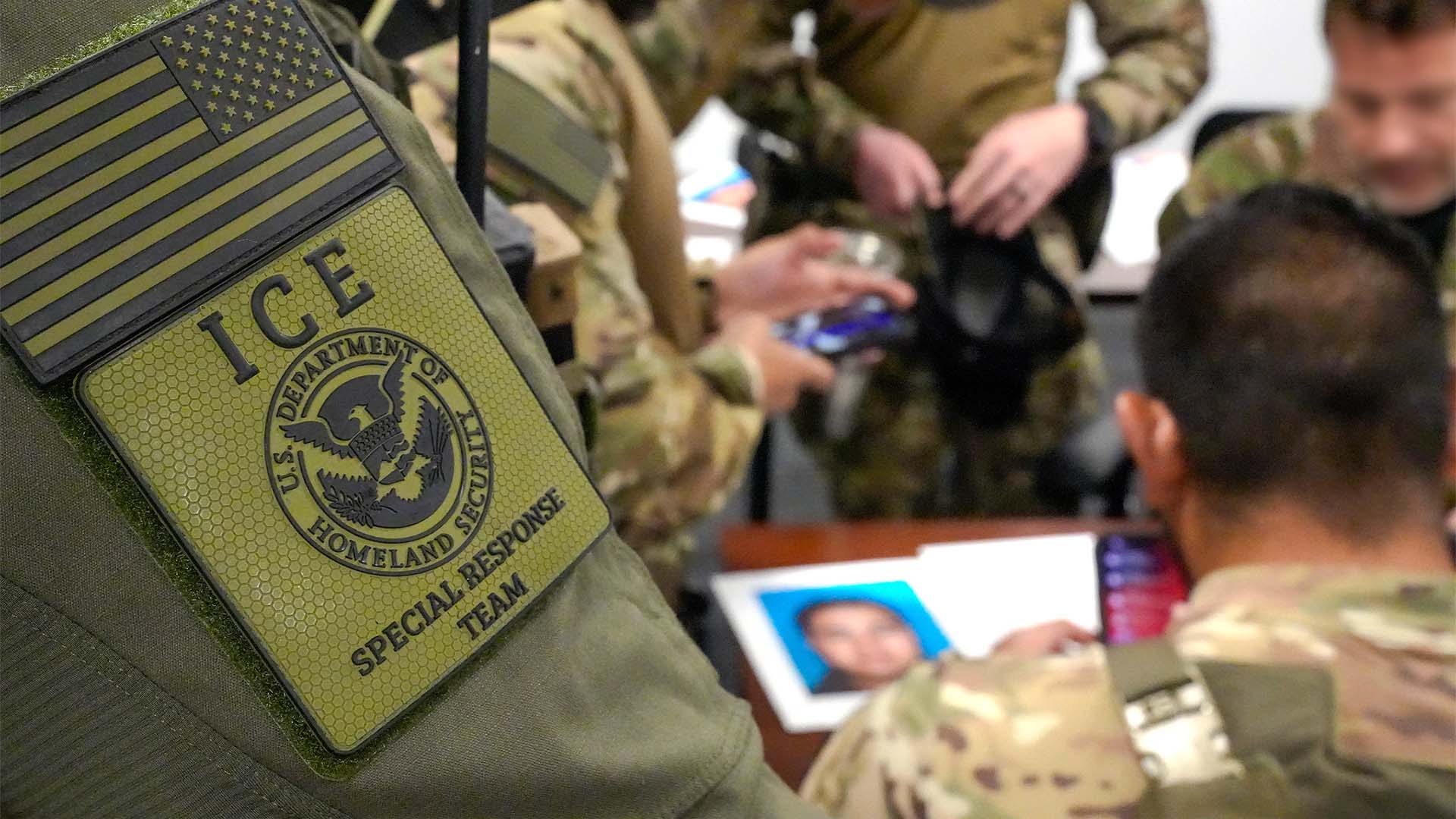

From Minneapolis to Chicago, immigration enforcement has become increasingly visible, violent and overtly political. The shift is reflected not only in the scale and style of recent ICE raids, but also in the public reaction they have provoked. As federal immigration agents have taken to the streets in large numbers, citizens have responded with protests and banners declaring ‘ICE Is Not Welcome’ and ‘ICE Out of Our Cities’. These slogans, now recurrent in urban demonstrations, express a broader rejection of immigration enforcement as a permanent and aggressive presence in everyday civic spaces. They signal that what are being contested are not only specific operations, but the transformation of immigration enforcement into a highly visible, confrontational and politically charged form of policing.
The use of ICE activity to discipline sanctuary jurisdictions is not new, but the explicit linkage between enforcement operations, electoral administration and civil-rights oversight, as seen recently in the Minnesota case, marks a qualitative shift.
Recent ICE raids in Minneapolis (Operation Metro Surge) can be analytically connected to earlier enforcement surges in other major US cities, illustrating a pattern of expanding urban operations rather than isolated incidents. In Chicago, Operation Midway Blitz, launched in September 2025, marked one of the first large-scale interior enforcement campaigns under the current Administration, with hundreds of federal agents deployed across the city and its suburbs and documented use of force during arrests.
Operation Metro Surge, described by the Department of Homeland Security as the largest immigration enforcement operation ever carried out, began in Minnesota in early 2026 with the deployment of around 2,000 agents in the Minneapolis-St Paul area. By mid-January 2026 it had resulted in roughly 3,000 arrests amid daily confrontations, protests and at least two fatal shootings of civilians by federal agents. Alongside citizen mobilisations, state and local authorities have attempted to halt these ICE enforcement campaigns. Notably, the state of Minnesota and the cities of Minneapolis and St Paul filed a federal lawsuit seeking to stop the surge in ICE deployments, arguing that these actions violate constitutional rights and federal law, and describing them as tantamount to a ‘federal invasion’ of local spaces that has disrupted civic life and civil liberties.
Beyond these cases, reports of heightened ICE activity, and parallel protests, have also surfaced in other urban areas such as Los Angeles, New York City, Portland, Memphis and even smaller communities. This reflects that the current enforcement posture is being implemented in multiple geographic contexts and is provoking nationwide resistance. Taken together, these episodes illustrate how US immigration enforcement has evolved along three interrelated dimensions: institutional capacity and agency culture, humanitarian consequences and political instrumentalisation.
From capacity constraints to enforcement surge: what has changed at ICE?
Although initial assessments of Trump’s mass deportation plans emphasised structural constraints on large-scale, rapid deportations, particularly ICE’s chronic staffing shortages and lengthy training requirements that limited the agency’s operational reach and deliberately delayed deployment into the field in order to ensure safe and legally compliant enforcement, this diagnosis no longer fully captures the current enforcement landscape.
At the time, thousands of authorised positions remained unfilled, and new recruits required months of specialised preparation. According to official Department of Homeland Security figures, ICE’s personnel has more than doubled in the past year, growing from around 10,000 officers and agents to over 22,000 as of early 2026. This expansion has been directly enabled by new funding streams approved in 2025, including the provisions in the so-called One Big Beautiful Bill, which prioritised an ambitious recruitment campaign that received over 220,000 applications and accelerated hiring with incentives such as signing bonuses.
This staffing expansion has been accompanied by a sharp rise in enforcement activity. According to official Department of Homeland Security figures, the Administration reports more than 675,000 deportations in its first year, a number that aggregates removals carried out by multiple agencies, including expedited expulsions at the border and other forms of DHS removal. Estimates suggest that deportations carried out by ICE alone may approach or exceed 200,000, reflecting an expanded enforcement footprint and scope of action.
To better understand these figures, disaggregated data focusing specifically on ICE interior enforcement tell a more detailed story. Analyses of enforcement records indicate that ICE agents arrested more than 220,000 individuals in 2025, including over 75,000 people without criminal records in the first nine months of the Administration, underscoring a significant shift in arrest patterns under the intensified enforcement strategy.
Large-scale urban operations reflect this new capacity. The enforcement surge in Minnesota, described by federal authorities as the largest immigration operation ever conducted in the state, involved thousands of federal agents and resulted in around 3,000 arrests in the Minneapolis-St Paul area alone.
What has changed, therefore, is not only rhetoric but operational reach. Yet the speed and political urgency of this expansion raise questions about training standards, oversight mechanisms and institutional culture, concerns that become visible on the streets.
The humanitarian dimension of intensified enforcement
The human consequences of this enforcement surge have been stark. In Minneapolis two fatal shootings involving federal immigration agents have occurred within weeks, during highly visible immigration officers’ operations. The first, on 7 January 2026, saw Renée Nicole Macklin Good, a 37-year-old US citizen and mother of three, shot and killed by an ICE agent during a raid, triggering immediate protest and outrage.
The most recent case, on 24 January 2026, involved the killing of Alex Pretti, a 37-year-old ICU nurse in Minneapolis who was participating in a demonstration against the federal enforcement operation when he was fatally shot ten times by ICE agents. Video footage and eyewitness accounts appear to contradict official statements that the shooting was an act of self-defence, showing Pretti filming officers and attempting to assist others before being pepper-sprayed and fatally shot.
These incidents have triggered protests, civil-rights complaints and widespread calls for independent investigations, with state and local authorities questioning both the necessity and proportionality of federal operations. The humanitarian toll is not limited to fatal shootings: in one widely reported case, federal agents detained a five-year-old boy in Minneapolis after arresting his father, drawing further outrage and concern about the impact of these raids on children and families. In response, officials such as Minnesota’s Governor, Tim Walz, have condemned the shootings and demanded transparent accountability mechanisms.
The pattern echoes earlier enforcement surges in cities such as Chicago, where limited personnel were deployed in highly visible, force-intensive operations that generated political controversy disproportionate to their deportation outcomes. The result is a form of urban enforcement that increases the risk of confrontation and collateral harm, particularly when operations prioritise speed, visibility and force over de-escalation, independent oversight and clear accountability for use of lethal force.
Concerns over accountability have intensified further following reports that an FBI agent who investigated the ICE officer involved in the fatal shooting of Renée Nicole Good resigned after allegedly facing pressure from the FBI leadership in Washington to discontinue a civil rights inquiry into the case. According to reports by The New York Times and Reuters, the episode has raised serious questions about political interference in law-enforcement oversight and the capacity of existing accountability mechanisms to operate independently in the context of intensified immigration enforcement.
Beyond enforcement: the political instrumentalisation of ICE activity
Perhaps most strikingly, recent ICE activity has taken on an overt political dimension that goes well beyond immigration enforcement. Following the fatal shooting in Minneapolis, the US Attorney General, Pam Bondi, formally demanded that Minnesota’s Governor Tim Walz cooperate with the Department of Justice by providing access to state voter registration rolls for review by the Department’s Civil Rights Division. The request was explicitly linked to federal concerns over state cooperation with immigration enforcement and public order in the aftermath of the raids.
The politicisation of immigration enforcement has also spilled over into the federal legislative arena. Following the Minneapolis shooting, Democratic lawmakers publicly warned that they could withhold support for budgetary agreements, raising the prospect of a partial government shutdown unless stronger accountability and oversight mechanisms were put in place for federal immigration operations. As reported, the episode illustrates how immigration enforcement has become entangled with broader partisan and institutional struggles, extending well beyond the domain of migration policy itself.
Pam Bondi’s move has been widely criticised as an attempt to leverage immigration enforcement to exert political pressure over electoral administration and federal-state relations. By tying immigration operations to voting data and civil-rights oversight, the Administration blurred the boundary between law enforcement and political strategy, expanding the reach of immigration enforcement into the domain of domestic politics.
This dynamic of political instrumentalisation is not entirely new. Earlier enforcement surges in cities such as Chicago, particularly during Operation Midway Blitz in September 2025, already used ICE activity to discipline sanctuary jurisdictions and escalate federal-local conflict through highly visible urban raids. In those cases, enforcement served as a form of political signalling aimed at local governments perceived to be uncooperative.
What distinguishes the Minnesota case is the explicit linkage between immigration enforcement, electoral administration and civil-rights oversight, marking a more direct and institutionalised form of political leverage. ICE activity is thus no longer operating solely as a technical instrument of migration control, but increasingly as a tool of political signalling, used to discipline state governments, mobilise electoral narratives and project federal authority into contested policy domains.
Conclusions
Taken together, recent ICE raids in Minneapolis, alongside earlier enforcement surges in cities such as Chicago, reveal a profound transformation in US immigration enforcement. What initially appeared as an expansion of operational capacity has evolved into a broader shift in how immigration control is exercised, experienced and politically mobilised in urban settings.
Expanded staffing and accelerated deployment have enabled large-scale interior interventions far from the border, but at the cost of heightened humanitarian risk, visible breakdowns in accountability, and escalating conflict with local and state authorities. Fatal shootings, the involvement of children in enforcement operations and growing demands for independent investigations illustrate the human consequences of enforcement strategies that prioritise speed, visibility and deterrence over restraint and procedural safeguards.
At the same time, recent developments point to a deeper politicisation of immigration enforcement. The use of ICE activity to discipline sanctuary jurisdictions is not new, but the explicit linkage between enforcement operations, electoral administration and civil-rights oversight, as seen recently in the Minnesota case, marks a qualitative shift. Immigration control is no longer confined to the domain of migration policy or public safety; it has become a vehicle for political signalling, institutional pressure and federal leverage over contested areas of governance.
What emerges, therefore, is not simply tougher enforcement, but a model in which immigration control operates as a tool of visibility, confrontation and political power. What is at stake is not only the effectiveness of immigration enforcement, but the integrity of democratic governance itself. When immigration control becomes a means of political leverage rather than a bounded administrative function, the risks extend beyond migrants and affected communities, touching the foundations of accountability, civil liberties, federalism and the rule of law.